14 incredible places to visit in Virginia right now
-
 Loading...
 - Stevens Harvey
- 27 Apr 2022
- 344 Views
- 0 Like
- 0 Comment
You can slurp fresh oysters, learn about US history’s most famous figures, hike to full-circle views, search for wild horses or simply lie out on a stunning beach. How do you tackle a state like Virginia, with its abundance of remarkable sites? Don’t worry: we’ve done the hard work and whittled down the choices to these 14.

Spend a lazy weekend rambling through the Shenandoah Valley
A Native American legend describes the Shenandoah Valley as a place where “the morning stars placed the brightest jewels from their crowns in the river," and it's truly a sight to behold. The plush, 200-mile-long valley is cradled between the rumpled peaks of the Blue Ridge to one side and the Alleghenies on the other, with the dazzling Shenandoah River meandering its length – a slow-moving ode to a laid-back escape
The best way to experience this mystical realm is simply to roam. I-81 cuts straight through, and it's pretty scenic for an interstate. But take the slower roads – Virginia Rte 11 is a good choice – and poke into little towns along the way: Luray, with its famous caverns; New Market, site of a Civil War battle fought by Virginia Military Institute cadets; and Staunton, full of splendid architecture, are all good choices.
Check out several museums, including the Museum of the Shenandoah Valley in Winchester, the Virginia Quilt Museum in Harrisonburg, showcasing early and contemporary quilt artisans, and the wacky American Celebration on Parade in Shenandoah Caverns, where parade floats go to die. You’ll find ample wines to sip along the Shenandoah Valley Wine Trail, and beers along the Beerwerks Trail.
En route, sample Virginia's abundance of outdoor activities, including hiking, cycling, camping, fishing, horseback riding or simply gliding down the legendary river by kayak or canoe.

Learn about a former president at Monticello
You get a sense of Thomas Jefferson – statesman, architect, scholar, farmer, third US president – at his treasured home Monticello, just outside Charlottesville. Not only did he build the sublime French-Neoclassical residence, finally completing it in 1809, but he also filled it with items that provide modern-day insight into his dagger-sharp mind.
Jefferson's library collection crowds the bookshelves, and the house's staircases are narrow and tucked away because he considered them a waste of space. One of his many inventions, the Great Clock dictated the plantation’s schedule inside and out, and it’s still functioning today.
With its fabulous views, the hilltop house (Monticello means “little mountain”) sits at the heart of a one-time 5000-acre plantation, where Jefferson dabbled in agriculture. Tours don’t ignore his complexity – the man who wrote “all men are created equal” enslaved some 400 individuals at Monticello alone and likely had children with one of them, Sally Hemings.
In nearby Charlottesville awaits the Jefferson-founded University of Virginia, which shaped the ideals of higher education around the world. He designed the Academical Village, with its dorm-edged lawn and a rotunda-domed library devoted to communal living and learning. Charlottesville is a joyous, student-filled city, with bookstores, cultural events and farm-to-table restaurants. Base yourself at the eight-block Pedestrian Mall and wander at your will.

Explore up-and-coming neighborhoods in Richmond
Richmond has been around a long time. Incorporated in 1742, it became Virginia’s capital in 1780 – and the capital of the Confederacy during the Civil War. Thomas Jefferson designed the Capitol building, and Patrick Henry rattled off his “Give me liberty or give me death” speech at St John’s Church. You can’t throw a history book here without hitting a monument or museum (not that that’s a bad thing).
But today this southern city is making waves not for its past but as an up-and-comer hub, with neighborhoods bursting with gastropubs, homegrown breweries and local boutiques, and outdoor adventures on the James River to boot. Henrico has 600 local restaurants and scores of shops, hotels and historic sites, while a plethora of breweries (Veil Brewing Co., Vasen Brewing, Ardent Craft Ales, etc.) await in Scott’s Addition.
The historic African-American neighborhood of Jackson Ward, home to dancing legend Bill “Bojangles” Robinson, has art galleries, the Black History Museum & Cultural Center and tons of local shops and restaurants. And there’s more – put on your walking shoes and wander this awakening city.
Hike to 360-degree views in Shenandoah National Park
Straddling the Blue Ridge between Front Royal at I-66 and Rockfish Gap near I-64, Shenandoah National Park harbors dark forests, fluttery mountain laurel and splashy waterfalls. You can drive its length along the 105-mile Skyline Drive, stopping at breathtaking viewpoints over the river-laced Shenandoah Valley to one side and the rolling green Piedmont hills on the other.
It’s especially gorgeous in autumn – and given the amount of bumper-to-bumper traffic you’ll encounter, you’ll have all the time in the world to study the foliage. Spring is gorgeous too, with budding dogwood and redbud trees, plus white-tailed deer, black bears and bobcats roaming its flanks.
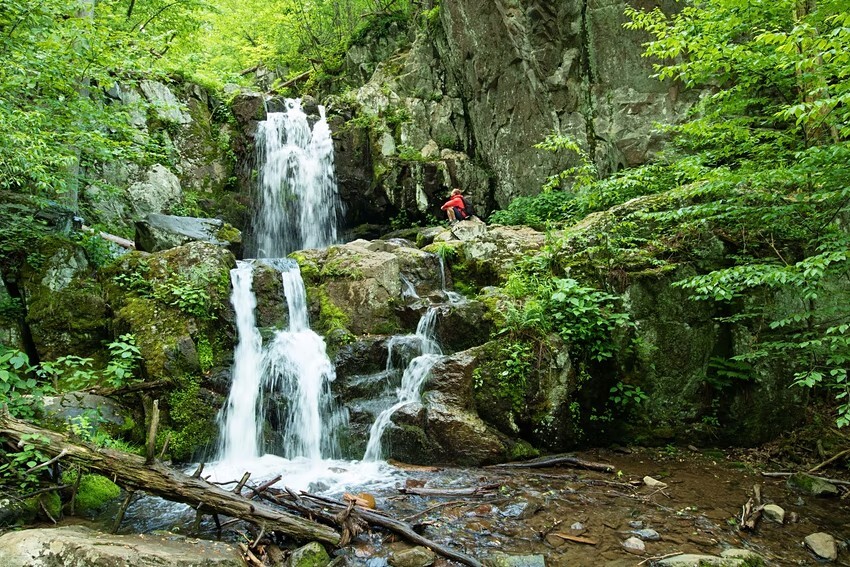
But the best way to experience this national park is on foot. It has 500 miles of hiking trails, including a 104-mile section of the famed Appalachian Trail. Favorites include White Oak Canyon at mile 42.6, a 4.6-mile wander past five waterfalls; Dark Hollow Falls at mile 50.7, a 1.4-mile trek ending at a beautiful waterfall; and the 4-mile hike to Rapidan Camp at mile 52.4, with Hoover’s restored summer White House as the focal point.
The park truly hits its stride with its trails climbing to 360-degree views, and a 2.1-mile round-trip trek up Hawksbill Mountain at mile 46.7 is perhaps the best of the bunch. The 1.5-mile hike up Stony Man from mile 41.7 is another good one. You can camp backcountry or at several campgrounds, or stay overnight at one of the park lodges.
Embrace history in the Colonial Triangle
Few places offer such a wide array of places important to US history as the Colonial Triangle, where three major sites – Jamestown, Colonial Williamsburg and Yorktown – reveal stories of the nation’s earliest days of European settlement. The historic trio are connected by the Colonial Parkway, a tree-shaded roadway ideal for biking and scenic driving.
The desperate English struggled to survive at Jamestown, where they landed in 1607 and eked out a living. Here you can visit Historic Jamestowne, where the ruins of the original site are under archaeological excavation, and the adjacent Jamestown Settlement, a living-history museum with the reconstructed 1607 James Fort, a Native American Village and reproductions of the ships that brought settlers to these shores.
Nearby you’ll find the award-winning, 300-acre Colonial Williamsburg, a living-history museum that takes you back to the days when Williamsburg reigned as the Colonial Virginia’s capital. Historical shops, restaurants, and government buildings line reconstructed streets, where costumed interpreters break into roll-playing—ask a Black soldier how he self-liberated, or the woman with the cream-white silk hat the best recipe for gingerbread.
And if that’s not enough history, nearby you also have Yorktown, where the Revolutionary War ended. The immersive American Revolution Museum at Yorktown has artifact-filled galleries and a recreated Continental Army encampment out back. And, of course, you’ll learn all about October 20, 1781, the day British and German soldiers surrendered. Read More…