5 Tips For Finding An Apartment In Japan That Could Save You 10% To 20% On Rent
-
 Loading...
 - Hisoka Teruya
- 13 Jun 2022
- 253 Views
- 0 Like
- 0 Comment
Apartment rents in Tokyo and other large cities in Japan are relatively inexpensive compared to most other cities in the world. Even so, no one wants to pay more than they have to for housing.
In other articles, we’ve introduced a lot of ways to save money on your monthly rent.
- Stay in a share house
-
Live outside the city center
- Live in Tokyo’s less expensive northern wards – Watch the video
- Why you should consider living in Chiba
- Why you should consider living in Saitama
- Why you should consider living in Kanagawa
- Osaka furnished monthly rentals
- Kyoto furnished apartments
- Stay in a furnished apartment or buy used furniture
- Lower your move-in costs by looking for apartments that don’t charge key money, deposit or agency fee
- What is key money and how to avoid paying it
- How to switch to a less expensive cell phone plan
- How to save money on your electricity bill
- Don’t forget to consider your monthly running costs
In this article, we focus on ways you can save on rent by looking at demand and supply and by shopping for comparable properties. Some of these tips could save you 10% to 20% on rent if you are willing to give up a little convenience.
- Move in the off-season, when there’s lower demand
- Look for older properties
- Look for properties further away from the station
- Look for properties with unit baths
- Be flexible with your desired floor plan
#1 Move in the off-season, when there’s lower demand
In Japan, the annual peak season for both renters and landlords is January to March. This is because the majority of companies and schools start their fiscal or academic year on April 1st. People need to move into their new homes in time to start their jobs or schooling.
For a landlord, all other things being equal, the same property is worth more in the peak season when demand is high. If they can lock in a tenant, they will have secured a stable stream of rental income for the next two years, since the standard apartment lease is for a two-year period.
However, some properties (even good ones!) fall through the cracks during the peak season. June to August is considered the off-season for moving. Most people have already moved. In most of Japan, except perhaps for Hokkaido and the northern prefectures, it’s very hot and humid in the summer months, so fewer people want to move. If a landlord can’t lease out their property during the peak season, they’re faced with trying to find a tenant when there is much lower demand. They are also losing income every month the property is vacant.
Landlords who have vacant properties in the off-season have an incentive to lower the rent slightly, give one month’s free rent, or to waive key money or another fee in order to lease up the property.
This is where you, as a renter, can take advantage of lower demand to get a better deal on an apartment.
How?
The best way is to find an agent that you trust and ask them to negotiate on your behalf. When you meet with your agent, they will ask you a lot of questions to determine your rental needs. At this point, you can ask them if they know of any properties that
- Have been sitting vacant for several months or
- Where the rent is high compared to comparable properties in the neighborhood
These are the types of properties where rent or some initial costs may be negotiable. There is no guarantee that you can get a great deal even during the off-season, but it is much more likely for the reasons discussed above.
#2 Look for older properties
Rent levels are highly dependent on the age of the property. Everything else being equal, such as distance from the station or size of the property, there are many more older apartments available for rent. They are considered less desirable, but you will have more properties to choose from. The difference in supply and demand also means that monthly rent for these types of properties is lower.
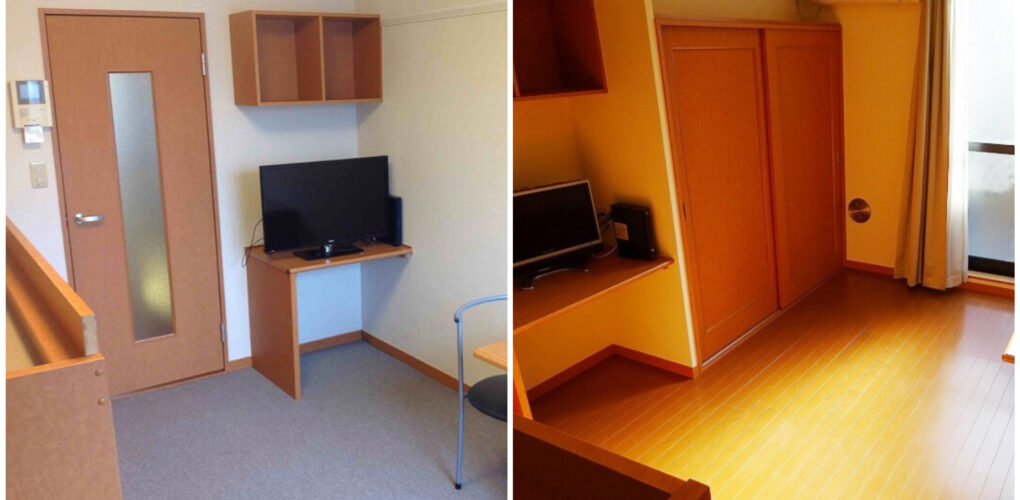
Another thing to keep in mind is that many older properties have been renovated. So the “year built” is not always the best indicator of how the apartment actually looks or the amenities available.
Here’s a good example:

When you are considering older properties, however, it is also important to know about earthquake building codes in Japan. Many older buildings have been earthquake retrofitted, but the important year to keep in mind is 1981, when earthquake codes were significantly revised.
3 Look for properties further away from the station
People generally want as short a commute time as possible, so the closer a property is to the station the higher the rent level, everything else being equal.
This holds true for the reverse as well: the further a property is from the station, the lower the rent tends to be. Depending on the station, you will see average rent levels decreasing for properties that are more than a 15-minute walk from the station.
Here’s an example:

Now let’s take look at a very similar property that is further from the station:

4 Look for properties with unit baths
Apartments where the bathtub/shower, sink, and toilet are pre-fabricated into one unit (called a unit bath) tend to have lower rent than comparable properties. Read More...