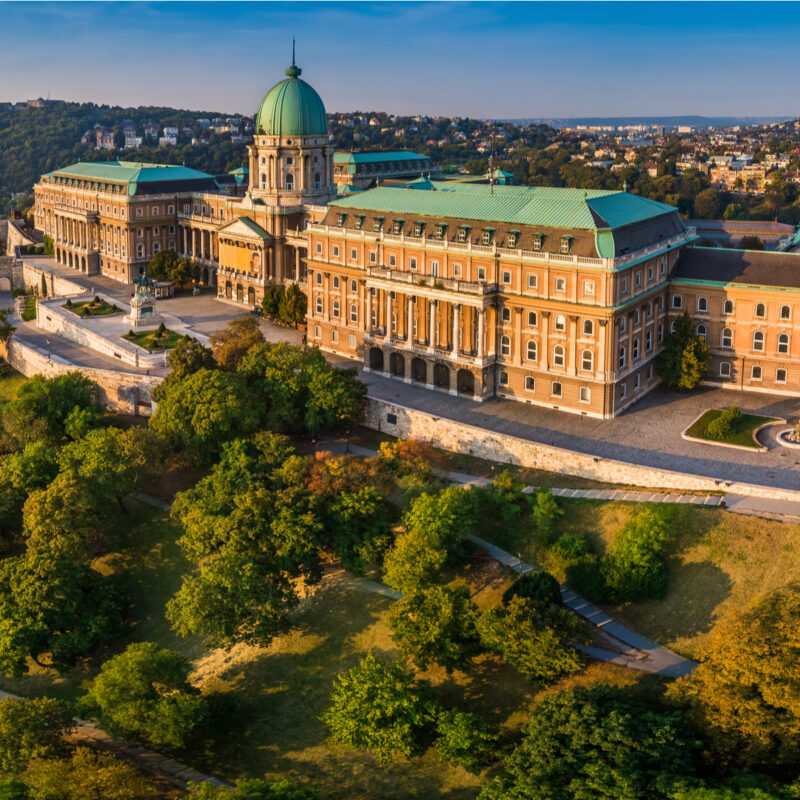
7 Magnificent Castles To Visit In Hungary
-
 Loading...
 - Antar Bennani
- 17 Jun 2022
- 248 Views
- 0 Like
- 0 Comment
Hungary is a country that is graced with no less than 103 castles, most of them open to visitors. This landlocked Central European country has long been the crossroads of many peoples, becoming the Kingdom of Hungary in A.D. 1000 with its cultural and political height in the 15th century. Then, in the 18th century, it came under Habsburg rule and formed part of the Austrian Empire. The influence of so many peoples and the need to defend against invaders like the Turks and Mongols made it necessary for the rulers of the time to build defensive castles in strategic places.
The Danube and Tisza are the main rivers of Hungary, but the landscape is also defined by the Carpathian Basin, the Great Hungarian Plain, and the vast Lake Balaton. The castles I have selected (and the many I have visited) have been chosen by how well they are preserved, their architectural value, and the often breathtaking locations where they stand. Not all of them were means of defense; others were homes to the respective kings and the aristocracy or just places of pleasure and leisure because of the beautiful landscape that surrounded them or the amazing views.
The capital is Budapest, which is actually the united twin cities of Buda and Pest, separated by the river Danube. Castle Hill with Buda Castle and the royal palace stands in Buda, whilst the romantic Vajdahunyad Castle stands in Pest.
There are five international airports in Hungary, the largest and most served being Ferenc Liszt Airport/Budapest. Apart from taxi services, there are Bud shuttle services as well as buses and trains running into Budapest.

1. Vajdahunyad Castle
This castle is one of the most romantic of Hungary and is also a rarity. Standing on an island in Budapest’s beautiful and green city park, it was, despite its appearance, only built in 1896 in honor of the 1,000 years of the existence of Hungary since the conquest of the Carpathian Basin. The entire complex consists of several buildings in styles reaching from the Middle Ages to the 18th century as it reproduces various historic Hungarian buildings, among them the Baroque Palace of Prince Paul Esterhazy I. Originally, the castle complex was built of cardboard and wood but became so popular that it was decided to rebuild it in stone and brick between 1904 and 1908 to make it a permanent structure. It is accessible over one of four bridges.

2. Buda Castle
Located on the southern tip of Castle Hill, Buda Castle, also known as the Royal Palace, was the historical seat of the Hungarian Kings and was completed in 1265. The castle is surrounded by the castle district with its medieval, baroque, and 19th-century houses. Apart from the beauty of the building itself, which is a UNESCO World Heritage Site, it affords wonderful views over the city and the river and is best appreciated by this 2-hour walking tour. Admire the Lion Courtyard, the Matthias Well, and the statue of Tulu Bird, the mythological bird of the Magyars.
Today, the palace is the seat of the Hungarian National Gallery and other museums.
Pro Tip: Access Castle Hill at night to see everything illuminated, it’s even more magical.

3. Eger Castle
Located 68 miles northeast from Budapest stands one of the most fought about castles of Hungary, Eger Castle. After the invasion by the Mongols in the 13th century, Eger Castle was rebuilt for the first time, repairing the cathedral and bishop’s palace on a hill overlooking the river Eger.
Many sieges and battles followed, most prominently the successful resistance to the siege by the army of the Ottoman Empire in 1552. However, the Turks took the castle in 1596 and held it until they were driven out by Christian forces in 1687. The castle suffered severe damage during all the vicious battles, and today only the medieval bishop’s palace stands, though the casemates below the castle can be visited. To understand the entire history of the castle and the importance of the defeat of the Ottoman Empire, take your time to visit the castle’s Istvan Dobo Museum. There are many more exhibitions and even a wax cabinet to learn all about this castle, so significant for the history of Hungary and Europe as a whole. Read More...