
9 Ways to Save Money in 2022.
-
 Loading...
 - Kabir Laghari
- 10 Jun 2022
- 283 Views
- 0 Like
- 0 Comment
Create a Personal Budget
There are plenty of ways to set up your budget, but one approach to consider is the popular 50-30-20 philosophy of personal budgeting.
According to the 50-30-20 philosophy of budgeting, 50% of your budget should go toward essentials – things like your mortgage, cell phone bill, groceries, gas, and other bills.
Next, 30% of your budget should go toward your wants. Wants can include things like clothing, dining out, and entertainment.
The final 20% of your budget should go toward savings.
Here is a tool that will help you set your budget using the 50-30-20 method.
Save Money
Starting an emergency fund is a great resolution to start in the new year. If this is your goal, head to our blog, New Year’s Resolution: Build Your Savings!(Opens in a new Window)
Start Investing
Think of investing as paying your future self. Start by setting a goal to set aside a certain amount of money each month (this can be a part of the 20% of your budget that goes toward savings) to invest.
Consider doing research into a beginner investment portfolio, and looking into working with a professional, accredited financial advisor for assistance.
Make a Will
It might seem morbid, but having a will helps ensure that the assets you have today don’t cause friction for your family should something happen to you.
You can hire an attorney, sure, or you can look into various online resources(Opens in a new Window) for templates and other resources to keep expenses down.
Review Your Current Insurance
Is it possible you’re paying too much for insurance? Is it possible there is coverage your need but don’t currently have? From health insurance to life insurance, homeowners’ insurance to car insurance, there are plenty of options available.
Additionally, be sure to review your beneficiaries to ensure they are all accurate.
Talk with your insurance agent, financial advisor, and of course, your family to make sure you have the coverage that makes the most sense for you and your family.
Pay Down Debt
There are plenty of methods people use to pay down debt. Two of the more well-known methods are the avalanche method and the snowball method.
Debt Avalanche Method
With the debt avalanche method, you make minimum payments on all of your credit obligations and use remaining funds to put more money toward your bills with the highest interest rates.
This method will save you the most money in interest and reduces the amount of time it takes to get out of debt. However, it can be more mentally challenging as it can be harder to see the impact you’re making on your debts and stay motivated.
Debt Snowball Method
With the debt snowball method, you make minimum payments on all of your credit obligations and use the remaining funds to put more money toward your bills with the lowest balance.
This method allows you to feel the satisfaction of paying off the “low hanging fruit” and motivates you to keep working your way through your debts to get them all paid off. Unfortunately, this method involves paying more in interest and can take longer to become debt free.
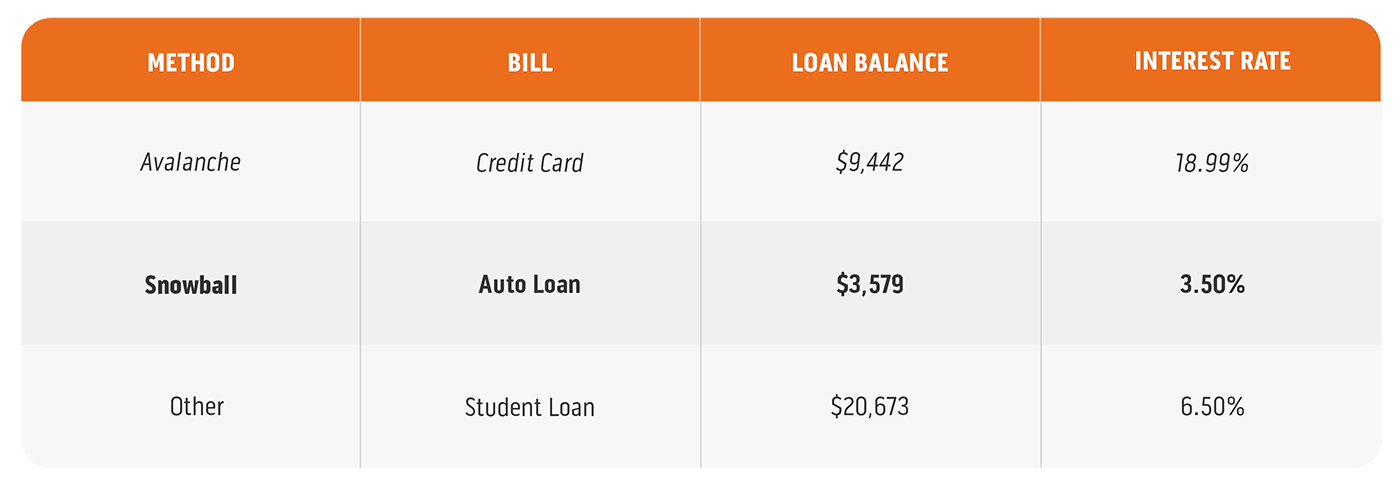
For example, in the chart below, you would focus on paying down the debt that is italicized most aggressively if you were using the avalanche method, and the debt that is in bold if you were using the snowball method.
Maximize Credit Card Rewards
It may seem ironic to talk about using credit cards right after talking about paying off debts – but hear us out.
There is a way to use credit cards wisely – without racking up a bunch of debt in the meantime…if you’re disciplined, that is.
If your credit card has rewards, use that card to pay for as much as you can each month, including your groceries, gas, and even bills.
Then, set up automatic payments to pay off the balance in full each month – if you don’t already carry a balance. Read More...