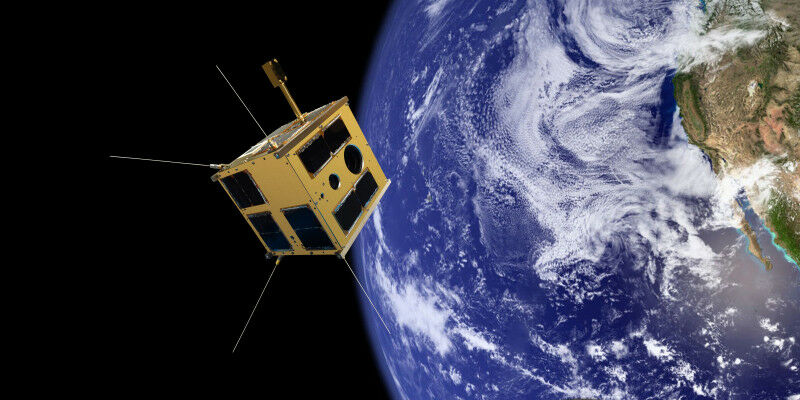
A decade in space: Austria’s first satellite is ten years old
-
 Loading...
 - Raphael Schuster
- 20 Apr 2023
- 58 Views
- 0 Like
- 0 Comment
Developed and built at TU Graz, TUGSAT-1 made Austria into a space nation when it was launched into orbit ten years ago.
The first Austrian satellite has now been in orbit for ten years. On 25 February 2013, TUGSAT-1 made its journey into space aboard a launch vehicle that took off from Satish Dhawan Space Center in India. It travelled alongside its sister satellite UniBRITE from the University of Vienna, which was released a few minutes after TUGSAT-1. Given that its planned mission duration was only two years, TUGSAT-1’s longevity has far exceeded original expectations. The satellite was developed and built at TU Graz by a team led by Otto Koudelka, the now retired head of the university’s Institute of Communication Networks and Satellite Communications. Manuela Wenger (formerly Unterberger), the project’s systems engineer, still keeps a watchful eye on the nanosatellite as a senior scientist at the institute.
TUGSAT-1 was one of five nanosatellites that formed the BRITE Mission, and can be thought of as a counterpart to large space telescopes such as Hubble or James Webb. The large telescopes can see very far into space and record images of extremely faint objects, while TUGSAT-1 with its 17cm telescope is designed to look at nearby stars, which, as they are so bright, would result in overexposed images if captured by Hubble or James Webb. The scientific data from this observation of nearby stars has led to some exciting insights and discoveries. "We didn’t previously know that Orion has some stars that pulsate with a kind of heartbeat. And in 2017, along with the other members of the BRITE network, we observed a nova from build-up right through to the explosion. That was a really breathtaking moment, because the data showed what a nova really looks like," explained Manuela Wenger. Read More..