After climbing Mount Elbrus, roof of Europe: Dr Naji Lamrani Zakaria recounts his climb to the top
-
 Loading...
 - Abigail Ndirangu
- 26 Sep 2022
- 71 Views
- 0 Like
- 0 Comment
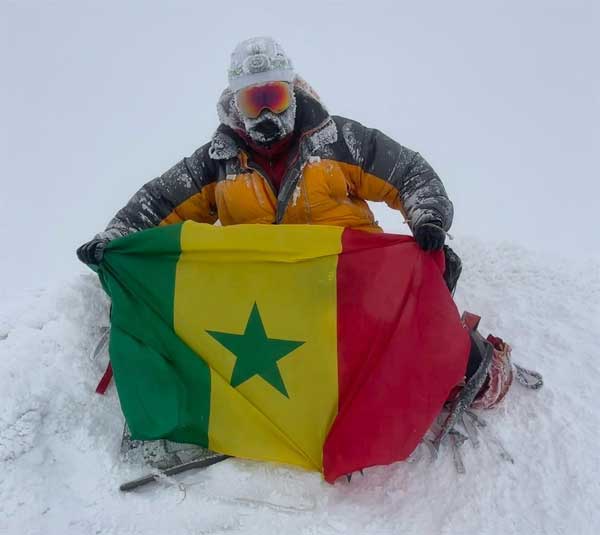
Dr Naji Lamrani Zakaria, who has already conquered Kilimanjaro, the roof of Africa, achieves the feat of placing the flags of Senegal and Morocco on the peak of Mount Elbrouz, located on the border between Georgia and Russia, which culminates at 5642 m. For Le Quotidien, he recounts his climb to the top of Europe, while waiting for the conquest, later, of Everest.
Dr Zakaria, waving the flag of Senegal for the first time in history, at the top of Mount Elbrouz, considered the roof of the European continent, how did you feel?
After hoisting him to the roof of the African continent for the first time, I felt gratitude and a sense of belonging to my second home, my host country, Senegal.
You have probably suffered to achieve this because the risks are enormous?
Suffering ? Who says to suffer says to be in pain. So I would say it's a matter of faith, patience, endurance. You know, the mountain is the best way to get lost, but it's also the best way to find yourself. For me, the mountain is not a source of suffering. It's quite simply a return to basics, a spiritual quest that makes us modest and humble. You know, from the top of each peak, we better perceive the minimal or even derisory place that we occupy in this life. The difficulties lie in the physical and mental preparation. In a nutshell, the secret is mindset.
Are the risks still real?
There are objective dangers of natural origin, over which we have very little control, and subjective dangers of human origin, due to several factors: lack of training, inappropriate equipment used, poor choice of a route , panic, overconfidence, exposure to objective dangers… It should be noted that altitude, cold, wind, sunshine can be pathological risk factors. A drop in atmospheric pressure at altitude can cause hypoxia and the famous Acute Mountain Sickness (AMS), due to lack of acclimatization and a gradual ascent. The cold, in combination with the wind, can cause hypothermia. Solar radiation, increased by altitude and the reflective power of snow, can cause snow blindness. Not to mention the possibility of tendinitis, sprains. Read More…