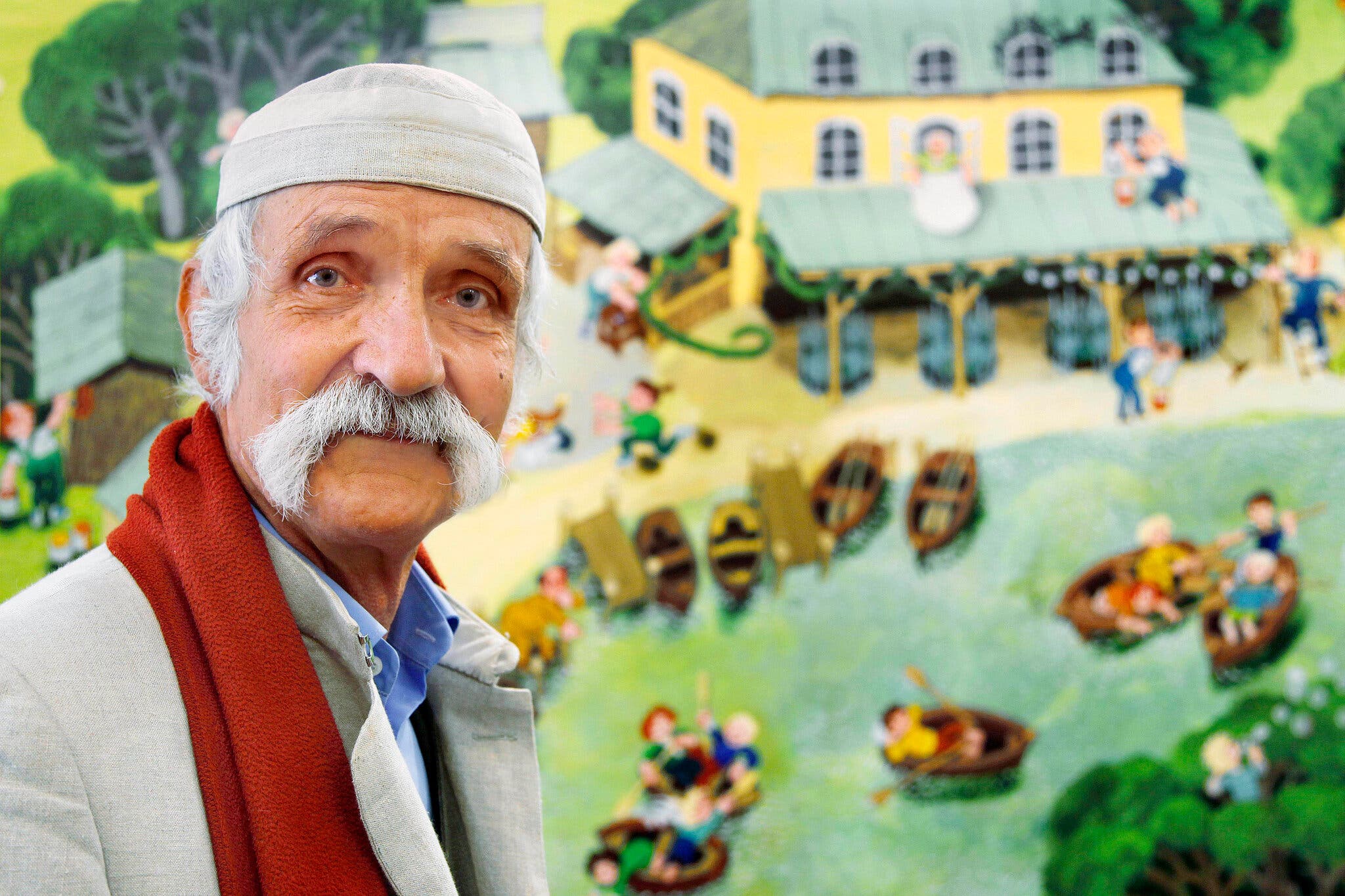
Ali Mitgutsch, Inventive Children's Book Illustrator, Dies at 86
-
 Loading...
 - Eric Robert
- 20 Jan 2022
- 406 Views
- 0 Like
- 0 Comment
Hippies dance to the Beatles while the downstairs neighbor uses her broom trying to get them to turn down the music. Several apartments up, a boy with a bad toothache is waiting for the dentist. The mailman is forced to climb the stairs because the kids have taken over the elevator. In the flat below that of a man with a broken leg, a married couple has just moved in.
For Ali Mitgutsch, who died in Munich on Jan. 10 at 86, all these stories happen on a single teeming page, each of them told not with words but through pictures. And pages like it filled his children’s books.
They have lined the bookshelves of generations of children in Germany, where he became a household name, and where he was celebrated as the father of what Germans call the “Wimmelbuch” (meaning a book that is swarming) — books whose detailed drawings of vast groups of people may include visual jokes and anecdotes.

Over his career he drew more than 70 books, puzzles and posters. His books have sold millions of copies and been translated into 15 languages.
Their success anticipated similar publishing phenomena, most notably the British illustrator Martin Hanford’s “Where’s Wally?” series. (“Where’s Waldo? in the U.S.)
His publisher, Ravensburger, attributed the death to complications of pneumonia.
“We have lost a wonderful person and a great illustrator in Ali Mitgutsch,” President Frank-Walter Steinmeier of Germany said in a statement. “With his drawings, he made us — myself included — laugh, think and dream.”
Mr. Mitgutsch was an unknown illustrator when he hit on his trademark concept in 1968. “Rundherum in Meiner Stadt” (“In the Busy Town”), his first book in what soon became a series, featured large tableaus — of a city park, a construction site, an apartment building — with myriad seemingly unrelated characters going about their daily lives. The book, which is still in print, in 1969 won Germany’s prestigious youth book prize the Deutscher Jugendliteraturpreis.
“Cheeky, funny and affectionate, he looked at the world and at our human weaknesses,” said President Steinmeier, who in 2018 gave Mr. Mitgutsch Germany’s highest civilian honor, the Bundesverdienstkreuz. Read More…