An essential style to the Ranch-style house
-
 Loading...
 - Leo Robert
- 13 Jul 2022
- 113 Views
- 0 Like
- 0 Comment
With its low-slung frame sprawled across the wide open spaces of the developing West, this midcentury relic reflected postwar optimism, the aspiration of suburban family life, and a special way of living—as Sunset Magazine put it in 1946, “informal yet gracious.” Now the classic ranch, once a radical departure from tradition, is being rediscovered by today’s generation as a veneration of relaxed West Coast style. Here’s what you need to know about this enduring architectural style.
SO WHAT’S THE HISTORY OF RANCH-STYLE HOUSES?
At the end of World War II, war veterans who had been offered generous home loans returned home, ready to resume their lives and raise families. However, scarcity during the Great Depression and the war led to few houses being built and pent-up demand. “While architects in the West and the Soviet Union met the need by building high-rise-apartment blocks, created a consumer product that people wanted to buy,” says Alan Hess, architectural historian and author of The Ranch House. “And that was the ranch-style house. It deserves respect because it solved the housing crisis in the midcentury.”
First drafted in the 1930s by architects like Cliff Mae and William Wurster, the ranch-house style lent itself well to mass production: low, one-story, and made of simple and inexpensive materials like shake roofs, board-and-batten walls, and brick foundations. Many scholars argue that survival of the ranch house was also largely dependent on the Hollywood scene at the time. Heroic characters played by John Wayne and Randolph Scott had captured the imagination, and the ranch house—first built in states like encapsulated the mystique of the Old West. “The myth of the cowboy and the heroic Western characters glorified on the big screen—it all blended into the appeal of the ranch house for the average person,” says Hess.

After winning the approval of the Federal Housing Administration, veterans and others could purchase a ranch house with the help of low-cost government loans—a monetary boost that catapulted the ranch house into unprecedented growth. By the 1950s, it was the most ubiquitous residential housing type in the country, with over 1.65 million houses built in 1955, according to Clifford Edward Clark Jr., author of The American Family Home, accounting for nine out of 10 new houses built.
But while the American dream of suburbia was an idyllic pillar of American culture in the ’50s and ’60s, critics denounced the ranch-style house as a conformist suburban artifact, using terms like “ranch burger” and “ticky-tacky.” “There was criticism that suburbia was so low density and that a single family house in the middle of several acres was not efficient,” Hess says. “The price of land was also rising. All of those factors came together to make the ranch house no longer as popular as it had been.” By the early 1970s, buyers and builders were turning to the so-called neo-eclectic homes that were larger, more formal, and more ornate.
WHAT ARE THE FEATURES OF A RANCH HOUSE?
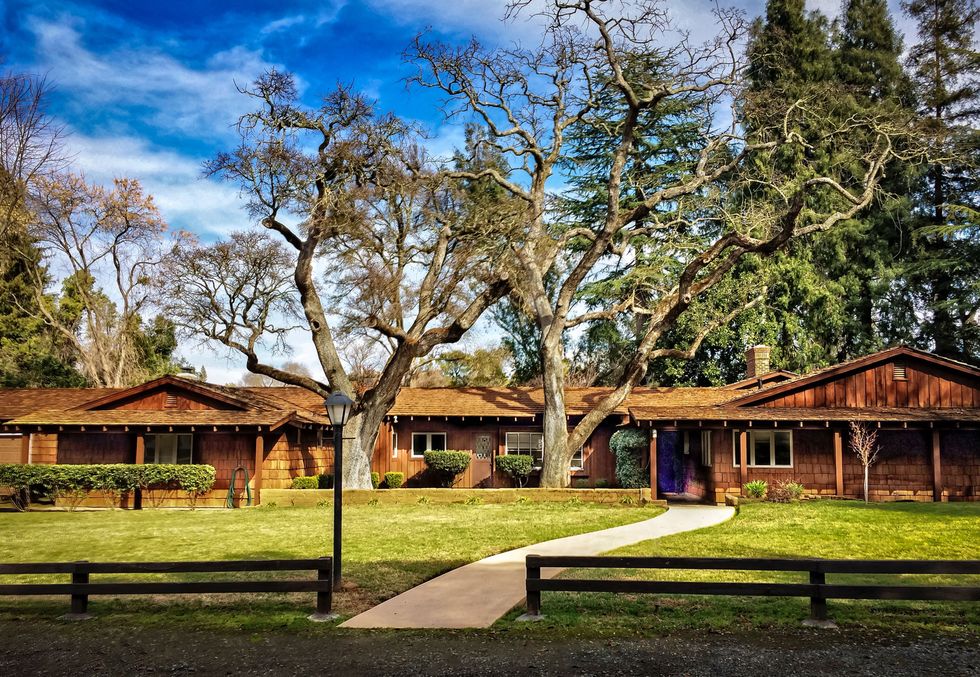
Traditional ranch-style homes—also called ramblers—are known for their simplistic, no-frills design elements. Their signature low-slung frame is formed by a single-story floor plan with long, low-pitched rooflines and deep overhanging eaves that extend past the exterior walls of the house. The shape of the rancher is often rectangular, though many can also be built in a U or L shape. Depending on the price point of the house, they could range from 900 square feet to a more generous 2,500 square feet. Read More...