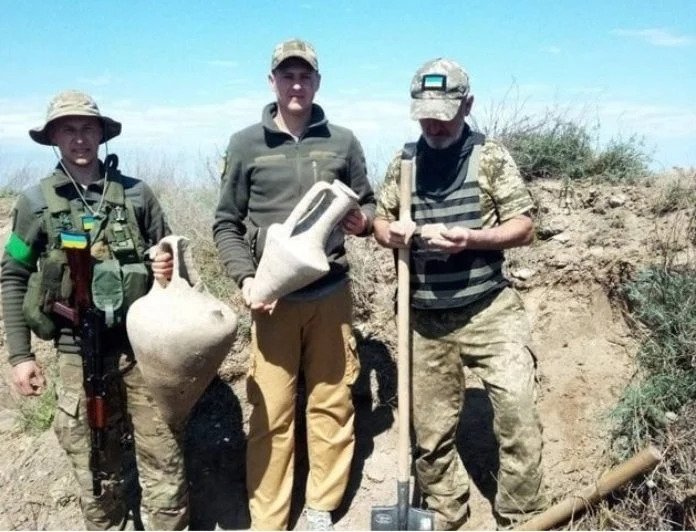
Ancient Greek Amphoras Discovered as Ukraine Soldiers Dig Trenches
-
 Loading...
 - Carissa Andino
- 17 May 2022
- 288 Views
- 0 Like
- 0 Comment
Ancient Greek amphoras were among artifacts discovered last week in Odessa, Ukraine by soldiers while “digging defenses” to protect the city from Russian attacks.
Soldiers from the Ukrainian 126th Territorial Defense brigade who found the artifacts wrote on Facebook that they were “handed over to the staff of the Odessa Archaeological Museum,” who promised to add them to the museum’s collection.
Archaeologists cannot document the site where the troops are based because of the ongoing Russian invasion.
Amphoras in Ukraine date back to the 4th or 5th century BC
The artifacts date back to the 4th or 5th century BC, according to Yana Suporovska, a creator and journalist, while the Heritage Daily reported that they are associated with the Neolithic period as well as the Greek, Roman, and Byzantine Empires.

The Greek presence in today’s Ukraine goes back millennia
The history of the Greeks’ presence on the northern shore of the Black Sea of what are now Ukraine and Russia, goes back millennia, even before the Classical Greek era.
The Myceneans, one of history’s first seafaring cultures, had become quite familiar with the Black Sea littoral through their search for raw materials and, most importantly, for the fish so vital then (and now) to the Greeks’ diet.
In the Classical Greek era, the Ukrainian coast was full of Greek colonies, some of which, such as Olbia, became wealthy centers of culture and trade.
This Hellenic/Hellenistic presence continued through the long Roman era, and as Rome gave way to Christian East Rome (Byzantium), the presence remained and transmitted Greco-Roman culture and Orthodox Christianity into Kievan Rus, the parent culture of both Ukraine and Russia.
The story continues into the modern era. As Byzantium fell to the Turks, so too did Byzantine outposts on the northern Black Sea coast, most notably the Crimean Peninsula, for millennia a center of Greek culture.
Greeks remained in the region even while living amongst a plethora of other nationalities, most notably the Muslim Tatars who ran the place as Turkish vassals. Read More...


