Ancient Korean silk paintings get a mind-bending contemporary spin

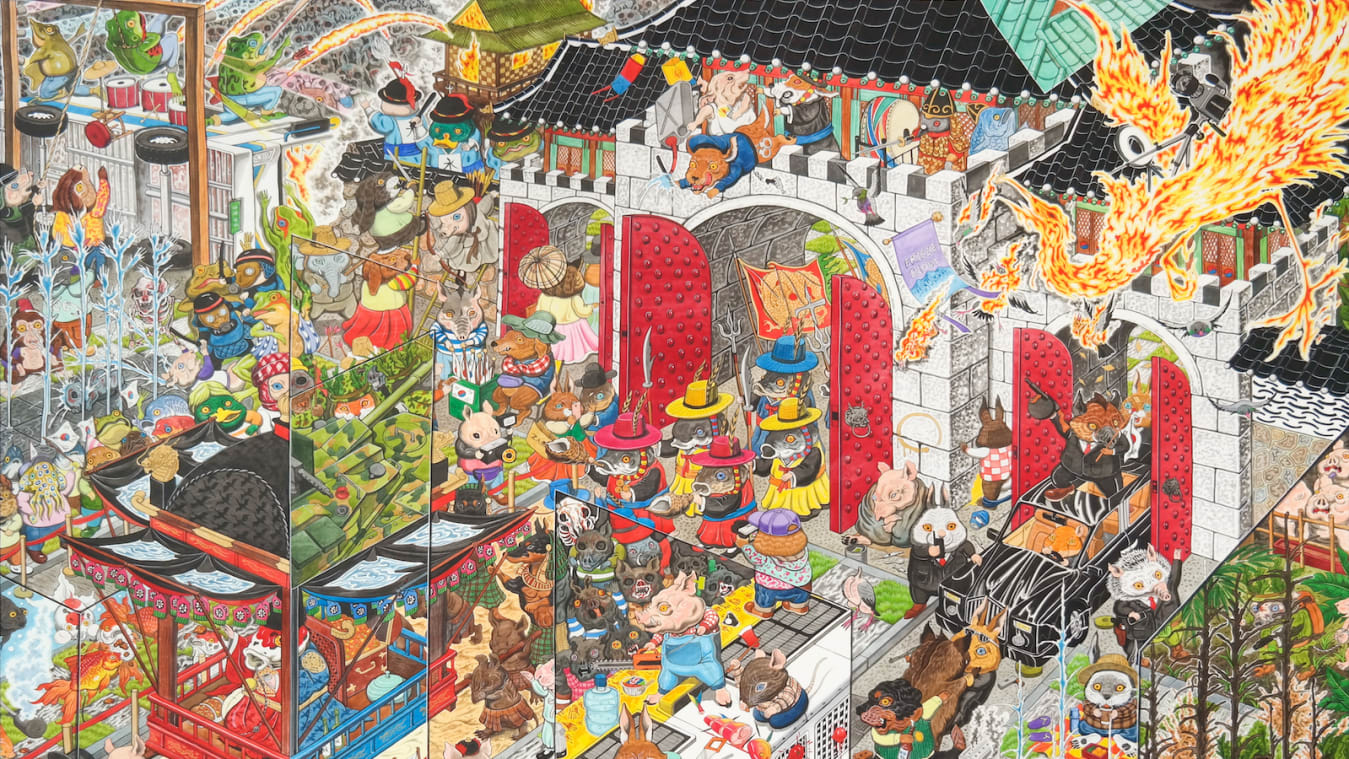
At first glance, the South Korean artist's creations combine the cutesiness of Japanese anime with the allegorical storytelling of centuries-old Buddhist scrolls. Anthropomorphic animals act out endless narratives in colorful, cartoonish worlds.
But the devil is, almost literally, in the details.
Beleaguered catfish, sword-wielding dogs and armored rodents commit acts of violence, malice and mischief, their expressions contorted, their eyes bloodshot and yellow, their faces sometimes partly decomposed. At once amusing and grotesque, the works put a modern spin on the historical painting styles that Kim spent almost a decade mastering.
"I want to be a bridge between the past and the contemporary," he told CNN in Seoul, South Korea, where he recently showed almost a dozen new works at the city's inaugural Frieze art fair.

The 36-year-old is usually based in East London, where he spends up to 10 hours a day, seven days a week, working on his intricate art. But before leaving his home country to study at the UK's Royal College of Art seven years ago, he underwent a traditional and highly technical education in Seoul National University's Oriental Painting program. The course required him to painstakingly reproduce Asian masterpieces and brushwork techniques from centuries past.
"My master was very strict — he didn't want me to experiment," Kim recalled. "They really wanted me to follow their orders, because it's almost a belief (system) or a strict structure that they want the next generation to inherit."
During his studies, Kim found himself particularly drawn to silk paintings from the Goryeo dynasty, a time when Buddhism flourished on the Korean peninsula. Like the Buddhist scrolls he was inspired by, his own detailed works are painted in thin, delicate lines using rich organic pigments. He too uses silk as his canvas, tracing images from paper sketches before bringing them to life with a tiny paintbrush.
In the process, Kim takes the historical art form into present day, naming inspirations that range from Dutch Renaissance painter Hieronymus Bosch to Studio Ghibli co-founder Hayao Miyazaki. ("I was part of the generation that was influenced by anime," Kim said, referring to South Korea's decision to lift a long-standing ban on Japanese animation in the late 1990s.) Read More…