Antikristo: The Cretan Way to Barbeque Meat with Roots in Ancient Greece
-
 Loading...
 - Ambrose Mavros
- 19 May 2022
- 292 Views
- 0 Like
- 0 Comment
Antikristo, from Crete, is no exception to the rule that you will find some of the finest food anywhere in the world in Greece; and as everyone who has ever been to the country knows—and lucky first-time travelers soon find out—grilled meats in Greece are beyond comparison.
From the traditional lamb slowly roasted on a spit at Easter to the delectable goat dishes served up at tavernas in the smallest villages, Greece is a gourmet’s delight. The island of Crete offers yet another delicacy that is rarely sampled—lamb using the antikristo method, which involves roasting the meat over a wire cage suspended over fire.
The word antikristo derives from “opposite,” as in opposite a fire, according to Mariana Kavroulaki, the founder of Greek Culinary History and Cooking Adventures, who is also a food historian.
Seen rarely today on the Greek island of Crete—and actually more often in Athens— antikristo must be sought out by those who wish to sample its delights.
Sheep breeder, antikristo expert has ancient Cretan roots
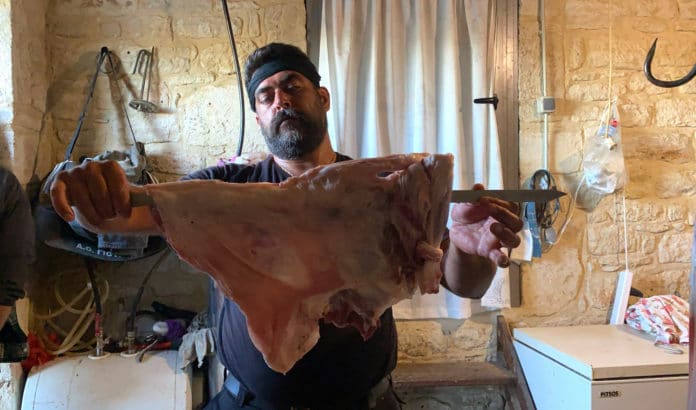
Cheretis Charalambos, whose family roots stretch back to 1,100 into Byzantine times on the island, is a proud Cretan who carries on the tradition of antikristo for fortunate diners. A sheep breeder, he has benefitted from his family’s expertise in that art, which also stretches back into time immemorial.
“I’m very proud of my name,” he tells Greek Reporter in an exclusive interview this week. “We have been here in Crete for almost 1,100 years—we are some of the first Byzantines who came here, and we have kept on with the tradition that was passed down in the family ever since.”
“Working as a breeder is a hard job…our children are keeping up with this,” Charalambos adds, obviously thankful.
When mentioning Crete, observers always note the fighting spirit that is endemic in its people—as seen as recently as 1941, when the idyllic island was invaded by German paratroopers. “This place (Anogia) has taken the lead with battles on Crete,” he explains.
“There have been three holocausts—two by the Ottomans and one by the Germans,” he adds.
“Because of all the revolutions and upheavals,” he explains, his ancient family has now dispersed all over the entire island, which is Greece’s largest.
“My ancestor, Aristides Cheretis, was a leader of the Revolution in 1842, where many fought to their deaths. But we keep on as long as we can—and if it’s ever needed again, we’ll do the same,” Charalambos adds with gusto.
“We keep on strong, in case it is necessary any time (our fighting prowess) is needed—we’ll fight again for our country,” he states defiantly.
As Charalambos prepares the lamb for grilling, it isn’t hard at all to imagine his ancestors fighting valiantly, generation after generation, for their beloved homeland.
The ancient roots of antikristo
The most renowned poet of the ancient world, Homer, even wrote about antikristo in his work The Iliad.
“And after he chopped it, he passed it round (the side) by the skewers; And as soon as the fire was extinguished and its flame faded, he spread the embers and [placed] the skewers on top of it, and while lifting it sprinkled divine salt on the meat,” Homer wrote.
“And as soon as he cooked it and spread it on the board, he took bread and Patroclus distributed it in round baskets,” Homer had written, but “the meat…was distributed by Achilles at their table. Then he sat down opposite Odysseus, on the other side of the wall, and told Patroclus about the gods.”
Antikristo allows for juices to stay in meats while roasting
The lamb grilled by the ancient antikristo method owes its signature taste to the fact that it is roasted while suspended over a wire cage that consists of tiers of circles. Much like the wire hoops in a hoop skirt, this forms the perfect housing for the grilling of the meat.
Cooks often stack the pieces of meat in as many as four or five rows at a time, equivalent to ten lambs cooking at once, making this method perfect for a large feast.
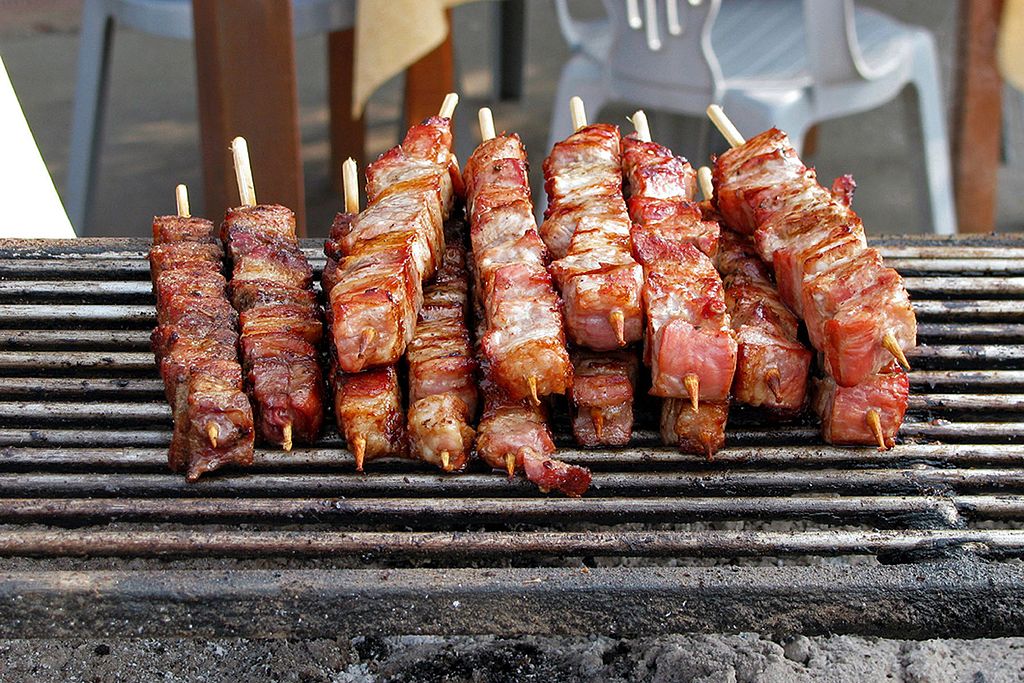
Made from lambs which are between ten and twelve months old, the meat is cut into four pieces and placed on a metal skewer. Seasoned with just a touch of salt and/or pepper, the meat roasts for several hours, locking in juices thanks to the antikristo cages it rests on.
Kavroulaki explains “It is easy to prepare and roast since it doesn’t need much attention,” noting that “the animal is given enough time to secrete its juices and develop many different flavors because the salt dehydrates it and produces a crispy skin.”
The food historian also says that the meat, in traditional Cretan style, is served in a simple manner with only bread and wine and maybe Horta, or wild greens, on the side. For dessert, according to Kavroulaki, a bit of cheese and honey at the end of a meal would be the perfect way to end the meal.
Simplicity—the key to all Greek food
Simplicity is key here, she says—like with all Greek food, as a rule.
As with so many other aspects of Greek life, its roots stretch far back into history. Homer even mentions a similar method in his work the Iliad, in which meat the men prepare is then cut into small pieces, skewered, and roasted over a fire.
However, according to the food historian, on top of the unique flavors imparted by this grilling method, another advantage kept it in use throughout the years. After the Venetians turned over Cretan rule to the Ottoman Empire in 1669, rebels began to organize into camps; the men needed a way to cook meat that would not disclose their location to the hated enemy.
Kavroulaki explains, saying “They used this method because the meat could be cooked in one hour—even if it was almost rare —so the fire wouldn’t reveal their location to enemies.”
In order to cook it so quickly, the rebels would dig a hole in the ground and line it with stones. Atop the fire they made, they would place wooden or metal skewers on larger stones around the fire hole, centering them on a point above the fire.
This way, the meat would cook quickly, there would be minimal smoke produced, and there would be next to nothing to clean up afterward. Read More...