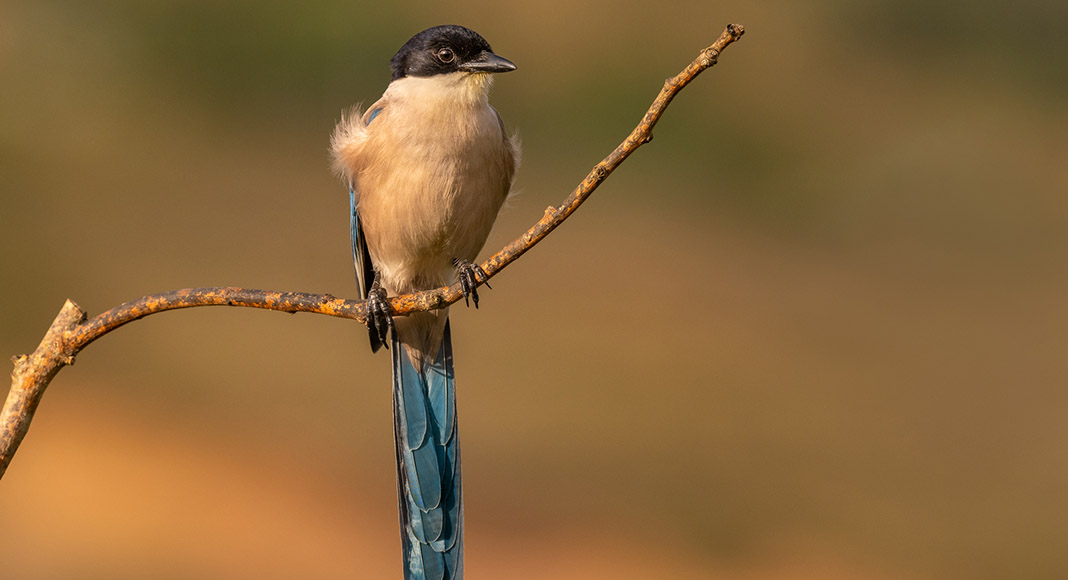
Azure-winged magpie – A touch of blue
-
 Loading...
 - martha luna
- 08 Jul 2022
- 108 Views
- 0 Like
- 0 Comment
I remember the first time I saw these birds many years ago in Alvor, in a large flock near the beach, and was amazed at their contrasting colours.
You’ll notice I haven’t yet mentioned the name of the bird. This is because it always brings up a debate.

The common name for this bird is the azure-winged magpie, which also exists in Eastern Asia. It was often thought these birds were brought on ships in the 17th century to Iberia, however, fossils have been found to pre-date this era.
A genetic study was conducted a few years ago and found that the birds in Iberia and Eastern Asia were a distinct different species and they were, therefore, given a new name of the Iberian magpie.
This, of course, means the Portuguese name of ‘pega-azul’ no longer suited, and so, the new name of ‘charneco’ was introduced. At the scientific level, the Eastern Asian bird is Cyanopica cyanus and the Iberian species is Cyanopica cooki.
Some people merge the names and is often referred to as the Iberian azure-winged magpie. A lot of literature and references still show the Iberian magpie as the azure-winged magpie. So, you can see why there are often debates over them!
A member of the crow family, the Iberian magpie is slightly smaller than the black and white Eurasian magpie, which, once scarce in the Algarve, is rising in numbers.
It measures around 35cm long. Both sexes are visually the same – a black head, brown back, with stunning blue wings and tails.
The flocks can be huge. There is a local flock in my area that seems to be growing every year. I once gave up counting to 70 when they flew over the garden. They seemingly move constantly around their territory foraging and they particularly like stealing fruit from trees to the disgust of many farmers. Often jay birds are mixed in the flocks and sometimes arguments occur when the jay steals food from a magpie. Read More…