Belgian king meets veteran, returns Suku mask to DR Congo
-
 Loading...
 - Senja Hautala
- 08 Jun 2022
- 268 Views
- 0 Like
- 0 Comment
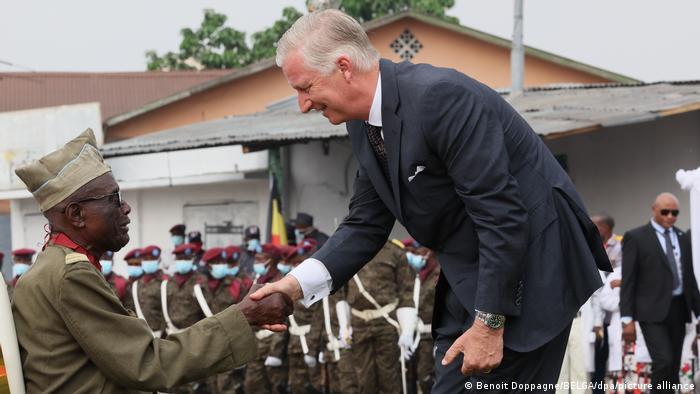
Belgian King Phillippe met the last surviving World War II veteran in the Democratic Republic of Congo and laid a wreath at a memorial site for combat veterans in Kinshasa on Wednesday, the second day of his six-day visit to the African country.
Phillippe shook hands with now 100-year-old Corporal Albert Kunyuku, who joined Belgium's Force Publique in 1940 and was deployed in present-day Myanmar.
The monarch also gave back a traditional initiation mask of the ethnic Suku people to the national museum in Kinshasa, describing the gesture as an "indefinite loan" from Belgium's Royal Museum for Central Africa.
"I am here to return to you this exceptional work in order to allow Congolese to discover and admire it," Philippe said, standing next to Congo President Felix Tshisekedi.
King's 'deepest regrets' not enough for everyone
The six-day visit, which started on Tuesday, is seen as an attempt to move past Belgium's colonial rule in Congo, which cost the African country millions of lives.
But some Congolese have questioned Phillippe's stance and the welcome provided by his government.
"They left us isolated, abandoned. They pillaged all our resources, and today you invite the Belgian king again?" Junior Bombi, a salesman in Kinshasa's central market, told Reuters news agency.
Others, like Professor Antoine Roger Lokongo, said the Belgian king should offer a formal apology beyond the offering his "deepest regrets" in 2020 over violence and humiliation suffered by the Congolese people.
"The simple regret that you have expressed is not sufficient," Lokongo was quoted as saying by Reuters.
History of blood
King Leopold II — the brother of Philippe's great great grandfather — brutally ruled what is now the Democratic Republic of Congo as his personal property between 1885 and 1908. During this time, his colonial military unit forced the local population to collect rubber.
Historians estimate that millions of people were killed, mutilated, or died from disease in Congo during the rule of Belgium's King Leopold II and the subsequent Belgian colonization.
In 1908, his so-called Congo Free State became a colony known as the Belgian Congo. It remained part of the Belgian empire until gaining independence on June 30, 1960. Read More...