Best Disposable Cameras in 2022
-
 Loading...
 - Laura Goma
- 10 Aug 2022
- 76 Views
- 0 Like
- 0 Comment
Once a staple of photography for the general populace, disposable (or “single-use”) cameras have become something of a niche — most people who never stopped shooting film or those younger audiences who are coming to it for the first time choose to use an affordable SLR or point and shoot camera. The image quality is quite superior and a single roll of film is less expensive (though typically not by much) than a disposable camera.
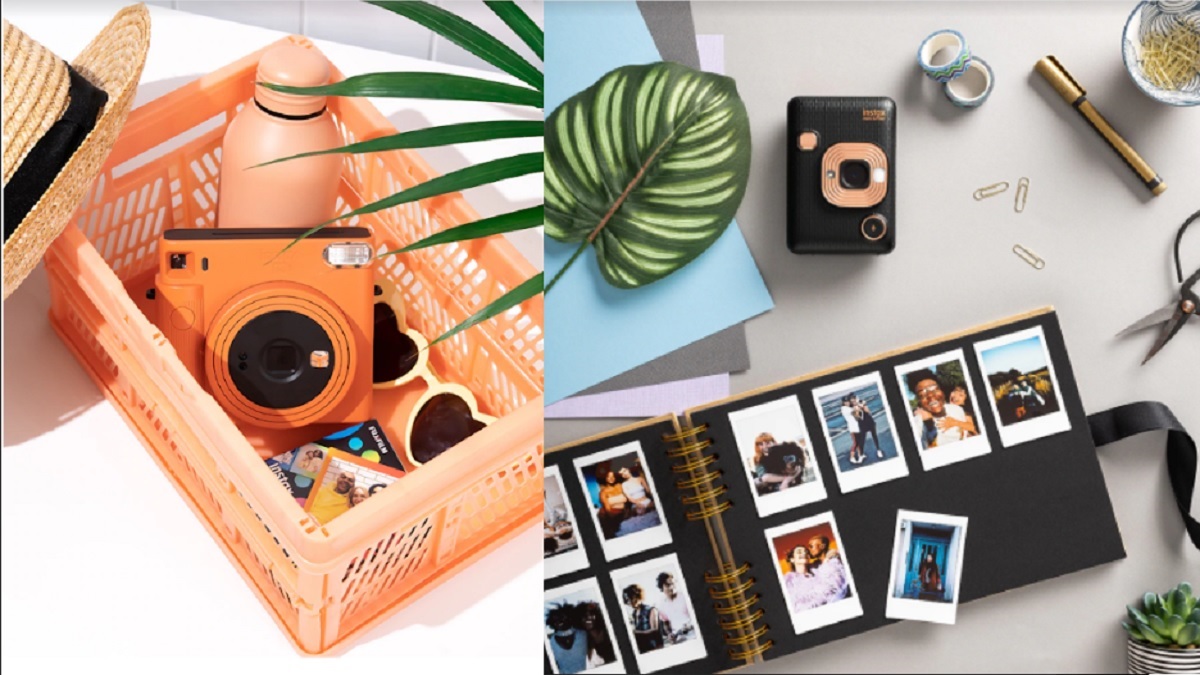
Despite declining sharply since its peak in 2004, the disposable camera market is still here. Why? Perhaps because above all, they embody a strong nostalgia factor — or pseudo-nostalgia for younger folk. The romanticism for a bygone era of less-than-perfect imagery, typically described as “character,” is most immediately obvious when considering the massive popularity of the instant camera market.
Further bolstering the appeal of lo-fi photography is the simplicity epitomized by disposable cameras. Wind film, frame, and push the shutter button. The cameras are fixed focus with a fixed shutter speed, so the only decision that needs to be made is whether to employ the flash.
It’s worth noting, given the current climate emergencies, that while something labeled “disposable” would seem to be very environmentally unfriendly, most places that develop film do recycle these cameras. In fact, the cameras are primarily made from plastic, metal, and batteries — all recyclable — and are designed to be easily disassembled. Additionally, the cameras are often rebuilt and resold — Fujifilm has been doing this since 1990. If in doubt, simply ask your film developing lab what they do with the camera afterward.
What We’re Looking For
Any guide is meant to make it easier to narrow down the plethora of options on the market, so we are looking for the best cameras in several categories to suit a variety of applications and needs. It’s often difficult, if not impossible, to define “best,” especially given the inherent subjectivity in making one single choice.
For our purposes, for this topic, “best” refers to a combination of image quality, price, features, and accordance with the necessary utility.
With that in mind, we have broken this guide down into six categories.
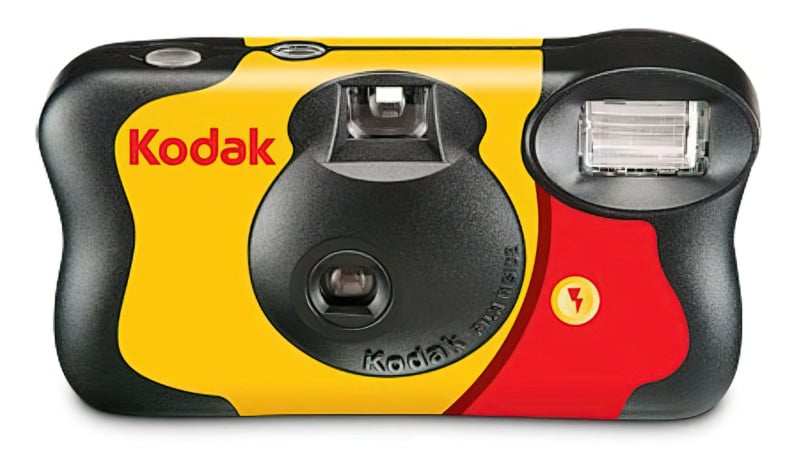
One could say that Kodak kickstarted the concept of a “disposable camera” when it released the first mass-market, affordable camera in 1900 — a simple cardboard snapshot camera with a fixed focus lens and rotary shutter, all for the equivalent of $35 in 2022, known as the Kodak Brownie.
While Fujifilm released the QuickSnap in 1986 — the first 35mm camera marketed as “disposable” — Kodak quickly followed up by launching the Kodak FunSaver in 1989. And since then, it has remained the most popular disposable camera on the market.
There isn’t anything particularly special about the Kodak FunSaver. No fancy features. No amazingly sharp lens. Nothing about it really stands out. And perhaps that’s what makes it an overall choice — it is simply exactly what you expect and works for almost everyone’s needs.
Compared to the Fujifilm QuickSnap, the second most popular disposable on the market, the FunSaver was chosen primarily for one reason: it’s loaded with ISO 800 film, while Fujifilm favored ISO 400 for the QuickSnap. What this means is that the camera is usable in a slightly wider range of conditions — given the small apertures of disposable camera lenses, this is very beneficial.
The flash is also more powerful than the QuickSnap, which extends the camera’s latitude just a little bit more.
Best Black and White Disposable Camera: Kodak Tri-X 400 Single Use Flash
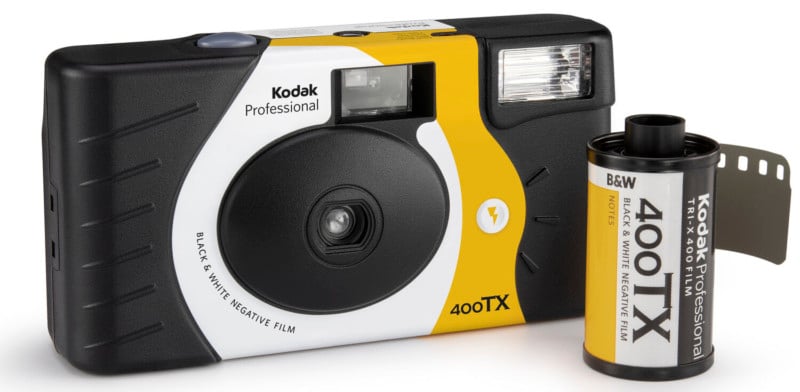
While the disposable camera market is dominated by C-41 color film, there are a few options out there for those who prefer the monochrome aesthetic. One of them stands out above the rest: the Kodak Tri-X 400 Single Use Flash Camera.
Loaded with 27 exposures of Kodak’s oldest film stock — the panchromatic black and white Tri-X — the Tri-X 400 Single Use features more refined ergonomics than some other disposables, like Kodak’s own FunSaver. But it’s really what’s on the inside that makes this one stands out. Unlike the single-element lenses of other disposables, the Tri-X 400 Single Use is fitted with a 30mm f/10 double-element optic, making it perhaps the sharpest lens of any camera on this list. While image fidelity tends to drop off beyond 5 to 6 meters in other single-use cameras, the Tri-X 400’s lens performs quite well even at further distances.
In addition to this higher-quality lens, the camera incorporates a powerful onboard flash with a comparatively quick recharge cycle thanks to the large inner capacitor. A simple press of the recharge button will ready the flash, but should you decide to not use it, it will automatically disable itself after some time.
Lastly, there’s the titular Kodak Tri-X 400 film hidden within the camera’s plastic shell. Holding the title as the most popular black and white film stock ever made, Tri-X 400 is highly revered for its high resolving ability, fine grain character, and very wide exposure latitude. Not only does this bode well for both outdoor daylight and indoor flash subjects, but the film responds extremely well to push-processing.
Considering the Kodak Tri-X 400 Single Use Flash costs just over a dollar more than a roll of the film itself (albeit with 9 fewer exposures), this is absolutely worth giving a shot — its low price also makes it great for bulk party or wedding orders. Read More...