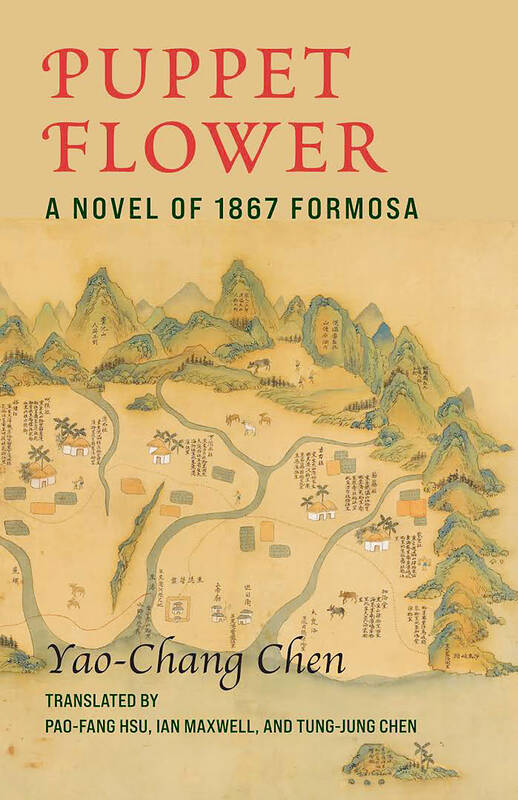
Book review: Nuanced depiction of a formative Formosa

‘Puppet Flower’ is a thoughtful, if seldom riveting depiction of a formative period of Taiwan’s past
Episode two was as far as I got with Seqalu: Formosa 1867. The 12-part historical drama series — which scooped four gongs at last year’s Golden Bell awards — was, from the little I saw, visually appealing and featured decent performances from its Taiwanese leads. The acting from some of the Western cast, on the other hand, was dreadful.
While a stilted script and weak direction doubtless played their part, French-born model Fabio Grangeon’s portrayal of Charles LeGendre, US consul to Amoy (present day Xiamen), was stiffer than a frost-bitten corpse. To compound matters, misplaced syllable stress rendered his dialogue barely comprehensible at times.
Worse still was the treatment of historical figures. An introductory disclaimer at the beginning of each episode explains that these embellishments were intended to “enrich the story with stronger dramatic tension.”
But the depiction of William A. Pickering as a Bohemian wastrel complete with wide-boy banter was bizarre. He first appears reaching from beneath rumpled bedsheets for an empty liquor flask while, in the foreground, the previous night’s conquest — a local apothecary — pretties herself before a mirror. Moments later, he is demanding money from the protagonist Butterfly — his “cut” for securing her a position at an infirmary. “More money for wine!” he bellows.
For anyone familiar with Pickering through historical records, including Pioneering in Formosa, his own splendid account of his years as a customs agent in Taiwan, this is a shameful defamation. Pickering was many things — not least an unabashed imperialist who lobbied the British government to colonize Formosa — but drunken lothario? It is hard to imagine a worse misrepresentation.
TAKING NO LIBERTIES
The novel on which the series is based takes no such liberties. The characters, cultures and competing interests in Puppet Flower: A Story of 1867 Formosa are conveyed with an even hand. The tale is based around the historical Rover Incident which saw tensions arise between indigenous Taiwanese, Qing Dynasty officials and American forces after the killing of the crew of shipwrecked merchant ship.
In telling the tale, author Chen Yao-chang (陳耀昌) rarely lapses into anything approaching moral judgment. His portrait of Pickering reveals a man, by turns, obstinate yet diplomatic, arrogant yet sensitive to the complexities of the local environment and, in particular, the ways of Taiwan’s indigenous peoples. Read More…