Breaking barriers to girls' education
-
 Loading...
 - Amadou Sow
- 05 Apr 2023
- 74 Views
- 0 Like
- 0 Comment
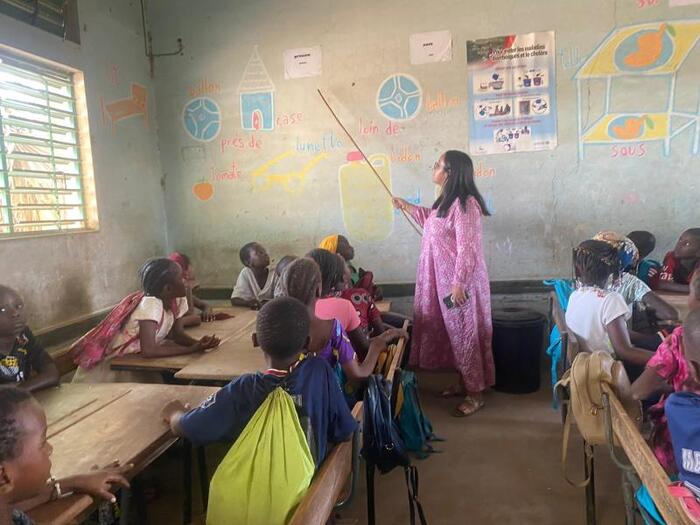
Maissa Abdellaoui, international UN Volunteer with UNICEF Senegal, facilitates a reading corner in an elementary school in the Tambacounda region.
© UNICEF SENEGAL
One of the biggest barriers to girls' education in Senegal is menstrual hygiene management. One in ten girls drops out of school at the onset of menstruation. This happens because many girls do not have information or access to feminine hygiene products.
Maissa Abdellaoui is an international UN Volunteer with a French Algerian background who serves with UNICEF in Senegal. Under the Gender and Exclusion programme, Maissa provides technical support to women teacher networks, menstruation hygiene kits or best referred to as 'dignity kits' for schools and girls, and organization for support groups for girls.
One of the highlights of the programme is the distribution of dignity kits that contain washable sanitary pads – a creative way to stitch locally sourced fabric into reusable cloth pads. Women teacher networks were established to help retain girls in schools in eight regions of Senegal including Matam, Kédougou, Kaffrine, Kolda, Sédhiou, Tambacounda, Ziguinchor and Dakar. A total of 3,648 schools in these regions were provided 263,450 dignity kits.
"Thanks to these dynamic networks, we hold regular activities with girls in schools to address important issues such as menstrual hygiene, violence, early marriage, and pregnancy," says Maissa. Maissa also assists 'reading corners' in schools in several regions of Senegal to improve reading skills at the primary level. Reading corners are a means to ensure that children have basic education on an equal footing. This initiative particularly helps the most vulnerable in the population such as children with disabilities. Read More…


