Calm and Collected: 7 Beginner Breathing Exercises for Anxiety
-
 Loading...
 - Gregory Jones
- 06 Jul 2022
- 115 Views
- 0 Like
- 0 Comment
Did you know anxiety is the body’s normal response to stress? It’s true. It activates the fight or flight response to keep us safe and alert when faced with a threat. But this response can also get overwhelming, leading to severe anxiety that can disrupt your life. When this happens, breathing is one of the best ways to alleviate your symptoms. Breathing exercises for anxiety can reduce your heart rate, keep you calm, and are easy to practice at any point you feel anxious. This article will outline several, how to practice them, and the benefits.
What Are ‘Breathing Exercises’?
While breathing keeps us alive, we often go about our days without recognizing or acknowledging how we feel and where our breath is. Therefore, breathing exercises are mindful and conscious practices that teach you how to connect to yourself, control your breath, and receive all the psychological, physical, and emotional benefits.
What Are The Benefits of Using Breathing Exercises for Anxiety?
When you’re stressed or anxious, your breathing tends to be short, shallow, and irregular. It feels horrible, but your body is trying to send more oxygen to your muscles, preparing you to flee. This activation is your sympathetic nervous system, which controls your fight-or-flight response. Yet, shifting your focus to deep, slow and relaxed breathing will activate your parasympathetic nervous system, leading to benefits like reduced stress, calmed nerves, lower pain levels, and improved concentration.
Ready to practice a breathing exercise and feel calmer?
7 Beginner Breathing Exercises for Anxiety
1. Alternate nostrils
Alternative nostril breathing is an easy stress reliever that calms the nervous system. It’s best to practice it while seated to maintain your posture and receive the added benefit of releasing stress in your upper back.
1. While seated, ensure your spine is long and rest comfortably in a cross-legged position.
2. Position your right hand, and bend your middle and index fingers towards the palm, leaving your thumb, ring finger, and pinky extended.
1. Close your eyes.
2. Place your thumb against your right nostril and inhale through your left nostril.
3. Then, place your ring finger on your left nostril and remove your thumb.
4. Exhale.
5. Continue swapping, closing your right nostril with your thumb, opening and exhaling through your left, and inhaling, and vice versa.
It may feel a little tricky at first. Therefore, go slowly and try to practice at least six rounds to ease your anxiety.
2. Color breathing
Color breathing is a mindful tool that requires your imagination.
1. While lying down or seated, choose a color that represents your stress, for example, red or orange.
2. Then, as you exhale, imagine you are releasing all of your stress and anxiety. Like a dragon, visualize blowing out red from your entire body, starting from your upper and working down towards your feet.
3. Next, choose a color that represents healing and relaxation, like blue or green.
4. As you inhale, imagine you are breathing in this calming color into your entire body, starting from the top and working down.
5. Try to complete three rounds and have fun working through your colors.
3. Belly breathing
Diaphragmatic breathing, aka belly breathing, is one of the most popular breathing exercises for anxiety. It provides a mind-body connection that taps into your nervous system and signals it to calm down.
1. Start by lying on your back or sitting cross-legged, maintaining your posture.
2. Close your eyes.
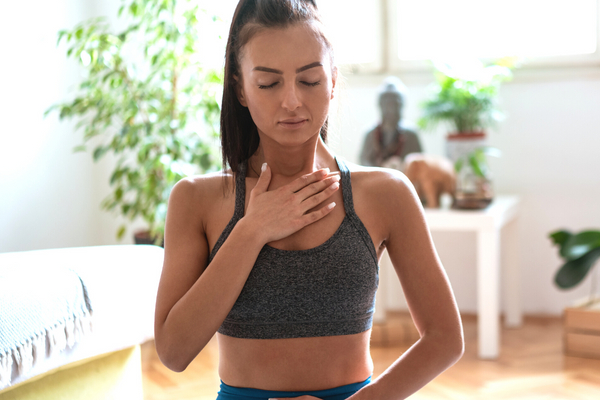
3. Place one hand on your chest and one hand on your belly.
4. Inhale slowly and deeply through your nose.
5. Mindfully focus on your belly rising
6. Then exhale and feel your belly flatten.
7. While inhaling and exhaling, try to keep your hand on your chest still.
8. Repeat for ten breaths, and imagine you are inflating and deflating a balloon as you breathe.
Try practicing this exercise once an hour or a few times a day. When it becomes a habit, you’ll notice you might automatically engage it whenever you feel stressed.