Chemists find a contrary effect: How diluting with water makes a solution firm
-
 Loading...
 - Juan Delgado
- 12 Jul 2022
- 112 Views
- 0 Like
- 0 Comment
In chemistry, everyone learns that you can go from a hydrogel to a liquid by diluting the hydrogel with water. For the reverse transition, you increase the concentration. However, TU/e researchers led by Bert Meijer accidentally discovered that their liquid solution turned into a hydrogel when diluted. This phenomenon hadn’t been researched or described before and will have consequences in many areas in chemistry and biology. The finding, which appears in Science Magazine, was made and researched thanks to exceptional teamwork.
The research focuses on the formation of certain hydrogels. This means that it starts with an aqueous solution of, in this case, two substances (a surfactant and a monomer). The research shows that a gel is formed at a specific ratio of these two substances in water. This gel is formed by long supramolecular networks composed of both substances. The amounts of these substances in water (the concentrations) also determine where the phase transition of the gel formation is located. And when you decrease the concentration without changing the ratio between the two components, the gel dissolves and you have a liquid. So far, this is familiar territory.
What is extraordinary, however, is that if the solution is diluted even further, a gel is formed again. Other supramolecular structures now form and it becomes a hydrogel again. And if it is then diluted even further, it becomes a liquid again. The paper carefully examined what the correct proportions of the active substances should be and at which concentrations the phase transitions take place. These transitions are also fully reversible. If concentrations are increased, the transitions from liquid to gel to liquid to gel occur at the same points. This phenomenon should be present in other fields, such as biology, but has never been researched and documented before. This is why Science Magazine has decided to publish the article.
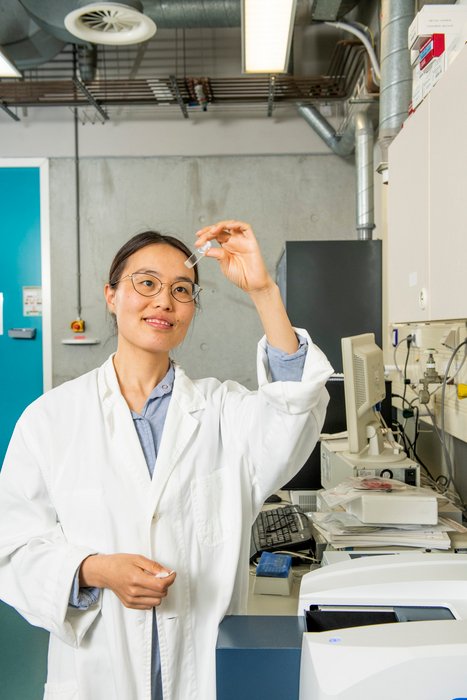
“It's really special how in our group – our 'dream team' – there was always someone who wanted to help out. We were all so fascinated by this research and wanted to know what it was all about. I helped colleagues, they helped me, and that's what made this whole process such a wonderful experience,” Su continues.
The collegiality in the group and the collaboration within the Dutch scientific world often come up when you speak to Meijer and Su, and not just in the workplace. During her maternity leave, her parents were unable to travel to the Netherlands because of all of the corona measures. Su: “Bert was so supportive of me, including during my maternity leave. This meant so much to me, to feel so welcome and supported by my colleagues.” Read More...