Chhattisgarh: the heart of rural India
-
 Loading...
 - Maya Conte
- 20 Nov 2020
- 1491 Views
- 1 Like
- 0 Comment
Three men in huge straw hats covered in peacock feathers and tinsel are playing wooden flutes as they herd cows and water buffalo on the edge of the jungle. Even the animals sport necklaces of bright flowers.
This is Chhattisgarh state, in east-central India: little visited, yet rewarding, it’s a land of elusive leopards, tigers and animist beliefs that gained independence from neighbouring Madhya Pradesh in 2000. This may sound an unusual choice for a family holiday but Chhattisgarh works, because it’s quiet and rural and free of India’s city chaos.
On arrival at Bhoramdeo Jungle Retreat, our guesthouse in the Maikal Hills, we’re greeted with flower garlands and have a red tilaka (a sign of welcome) dotted on our foreheads. A three-hour drive from Raipur airport, the retreat is intimate and simple, with big, overgrown gardens peppered with summerhouses and hammocks, and tribal motifs painted on the walls.
Sunny, the owner, is a born storyteller – his tales tumble out around the fire as we sit outside in the evenings with the other guests: a trio of young British volunteers (working on a local litter project) and a well-travelled Swiss-Indian family. He was nicknamed Sunny for his ready smile and, though a high-caste Hindu Brahmin, he has spent years building up close relationships with the neighbouring tribal people, so as to make tourism as non-intrusive as possible. “There are many villages, so we always take guests to visit different ones, to reduce our impact,” he says.
Chhattisgarh’s tribal people, the Gond and Baiga, live in close harmony with nature, entirely dependent on the forests. “The Baiga dislike ploughing,” Sunny explains. “They see the Earth as their mother, so they don’t want to hurt her.” Instead, while walking in the forest with Sunny, we see people out foraging roots and berries. They also make beautiful, bright, pointillist paintings of plants and animals.
Most days, there’s a haat (market) in one of the villages. It’s a colourful and vibrant affair. The Baiga men sport short lungis (sarongs), long earrings and wild-looking side ponytails, the women have bright pompoms hanging from their hair, chunky silver necklaces and tattoos on their legs. We wander among rainbow rows of bling bangles and exotic vegetables. Deep-fried jalebi and other sweets are sold alongside silkworm cocoons, turmeric roots, pyramids of jaggery and mountain herbs.
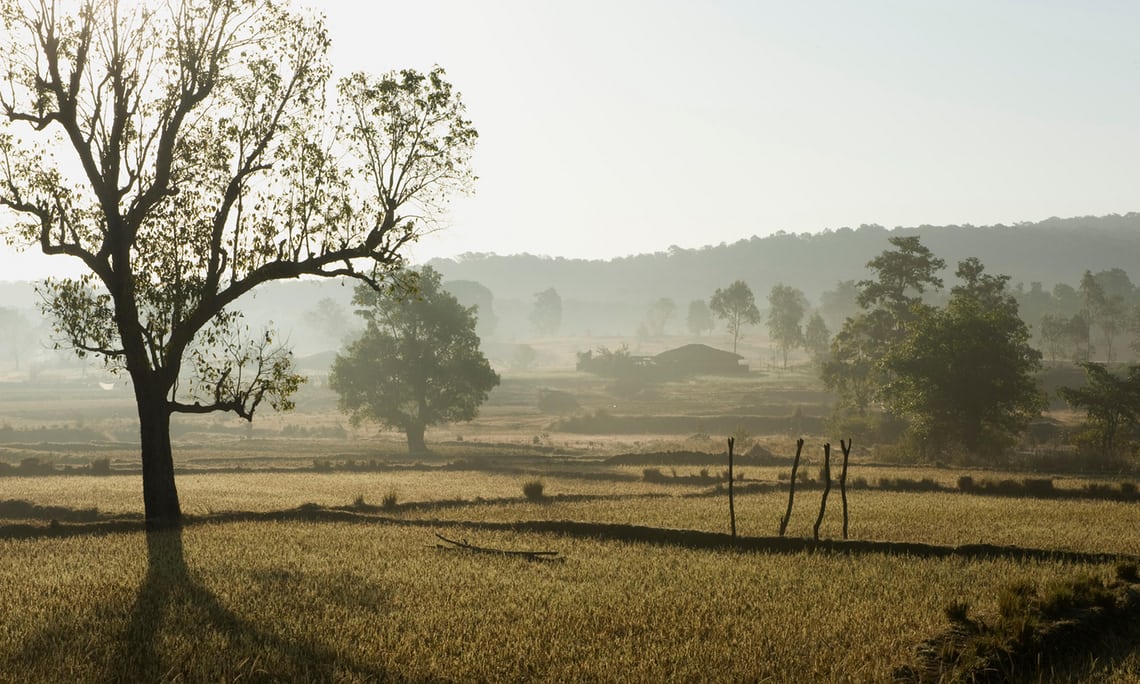
Sunny has bicycles for guest use, so some days we ride off alone through villages of giant banyan trees and blue-washed mud houses. Sunlight slices through open doorways, offering glimpses of courtyards with brightly painted pillars. Women gossip outside on decorated verandas and schoolgirls sail by on bikes, their long plaits tied in big bows. A travelling barber usually sets up on a porch, and Mark joins him one morning for a shave.
We weave through country lanes, past bullock carts and fields of mustard with flags to protect the crops from the evil eye.
One afternoon Sunny drives us to a pottery village – a real one, not a tourist attraction – where artisans spin pots and monkeys do gymnastics in the trees. On the way, we buy delicious, piping hot samosas from a dhaba (roadside restaurant). We return as twilight leaves zips of red in the sky, and temples and little chai stalls are starting to light up. Back at the guesthouse, supper is ready: each evening there’s tasty, home-cooked, mainly vegetarian food.
Opposite the guesthouse is the 11th-century Bhoramdeo temple: with intricate Kama Sutra friezes on its sandstone walls: it resembles Unesco site Khajuraho, without the tourists. We go for puja (worship) here early one evening. In the inner sanctum, devotees offer coconuts and flowers in a frenzy of chanting and bell ringing, while the symbolic Shiva lingam stone is rubbed with milk and sugar. Faces appear bathed in gold as they swing candles and incense and the singing gets louder.
Chhattisgarh means “place of 36 forts” and, heading further south, we stay in one. Kanker palace, a five-hour drive away, is a neo-colonial residence rebuilt in 1937; since prime minister Indira Gandhi stripped India’s royals of their privilegesin 1972, many have turned their palaces into hotels.
Kanker is still a maharajah’s home, but the family has opened a handful of rooms to guests. We arrive to dramatic drumming (welcoming guests is big here) and a high-ceilinged drawing room, with the eyes of a taxidermied tiger staring at us, and gaur (Indian bison) and leopard heads festooning the walls, trophies from the days when hunting was a royal pastime.
In front of the palace is a postwar open-top Ford: Jolly, the middle brother, collects classic cars, and he takes us for a spin in the grounds, much to our sons’ excitement. We pass an old, stonewalled tiger house (no longer used), the palace farm and mango orchards.
The countryside is dotted with villages of the Deer Horn Muria (part of the Gond tribe), where life has changed little for centuries. In one village, we see a traditional dance by boys on stilts: they’re dressed in fuchsia and orange, with hand-painted wooden deer headdresses.
We leave in the golden, early evening light, as returning herds of cows kick up red dust from the roads. “This hour is called godhuli bela – cow-dust time,” says Babbu, our guide. Locals consider this moment to be very auspicious.