Chile communities defy the desert by capturing increasingly scarce water
-
 Loading...
 - Joan Davidson
- 05 Apr 2023
- 70 Views
- 0 Like
- 0 Comment
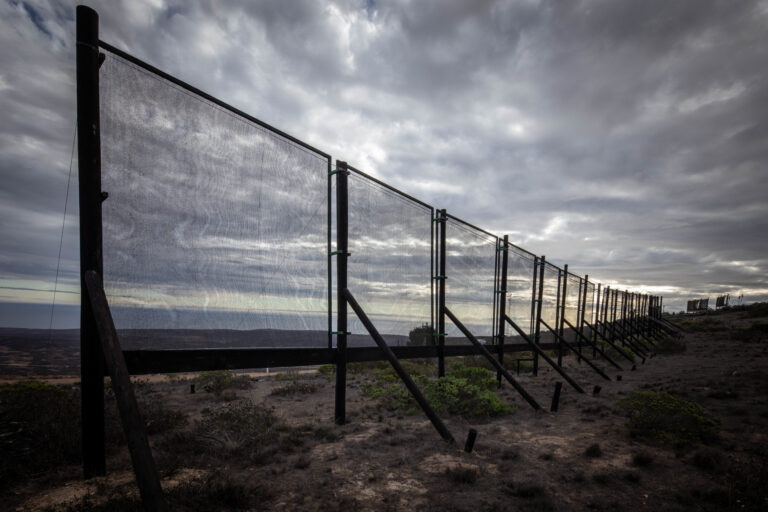
In the middle of an increasingly arid landscape, where Chile’s Atacama Desert, the driest in the world, keeps expanding southward, a small forest less than a third the size of New York’s Central Park is irrigated by water from fog, harvested by the rural community of Peña Blanca.
Each day, they capture more than 1,500 liters (400 gallons) using 252 square meters (2,713 square feet) of fog collectors, installed 17 years ago in cooperation with the Un Alto en el Desierto Foundation, on a hill called Cerro Grande.
Thanks to the water provided by the fog collectors, at least 30 native species of plants grow in the Cerro Grande Ecological Reserve in Chile’s Coquimbo region. Some of these species are threatened, but thrive here despite the expansion of the desert, which is driven by overconsumption of water, land erosion and climate change.
A barrier to desert expansion
According to Chile’s National Forest Corporation (CONAF), approximately 23% of the country’s total area is at risk of desertification. Various studies identify Coquimbo as the most affected region in the country. This is where the southern limit of the Atacama Desert was initially established, along the Copiapó River. However, as the desert expands south, this boundary has become more blurred.
The history of Peña Blanca is one of a thriving rural community of peasants, “with hardworking people and important economic growth,” says Daniel Rojas, a Peña Blanca native and, until last year, president of the community. Today, this prosperity is no more.
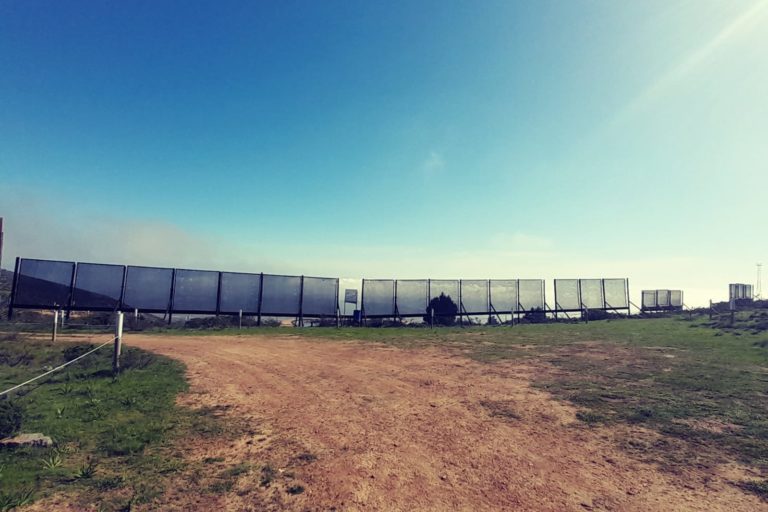
For decades, until the 1980s, the soils of Peña Blanca yielded wheat. “More than 50% of the community, which covers a surface of approximately 3,500 hectares [8,650 acres], was used to farm wheat,” says Rojas, who is also the president of the Un Alto en el Desierto Foundation, which funds structures that act as a barrier to stop the southward expansion of the desert.
“The wheat machines needed to remove vegetation and even stones to be able to use the threshers, the machines that prepare the ground for growing wheat, so the whole area became eroded,” says the geographer Nicolás Schneider, director of the foundation.
At the same time, the rains grew less frequent, Rojas says, and to top it all, free-trade deals meant Chile had begun importing wheat “at prices which were impossible to compete with.” Read More…