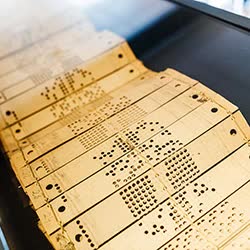
Coding From 1849 to 2022: a Guide to The Timeline of Programming Languages
-
 Loading...
 - Lisa Pereenboom
- 27 Jun 2022
- 157 Views
- 0 Like
- 0 Comment
Coding and programming languages are the building blocks of our modern digital world. But although the most significant developments in this field have happened within living memory, the history of coding and the timeline of programming languages is longer than you might think.
It starts with surprising and remarkable people, long before the birth of other types of commonplace technology like cars and telephones. It even predates modern medical treatments we take for granted, such as insulin and antibiotics. In fact, coding dates back to the 1840s.
Let’s take a closer look at the history of coding and the timeline of programming languages.
Origins
1843 Ada Lovelace
Ada LovelaceAda Lovelace was a British aristocrat; unusually for a woman of her time, she was educated in mathematics and science. However, her contribution to the development of coding and computer languages is not that she invented a device that was the breakthrough of Charles Babbage in the 1820s with his Difference Machine. Instead, Lovelace created the very first machine algorithm in 1843.
She realized that Babbage’s machine could do more than just calculate; it could be used as a general-purpose machine. Lovelace made the leap that numbers could represent other things, and the idea of programming languages was born. Lovelace’s groundbreaking work was the first step in being able to design a language capable of giving computers instructions.
The 20th Century
1936 Alan Turing
Today, Alan Turing is famous for his work on cracking Nazi Germany’s Enigma code machine in 1939. But in 1936, Turing published a paper regarded as the founding piece on computer science. Turing came up with the concept of a universal machine. A machine that could follow instructions. He eventually turned this groundbreaking idea into a plan for a computer powered by electricity that could run programs.
1940s Konrad Zuse
Konrad Zuse created what is considered the first programming language for computers in the early 1940s. It was called Plankalkul, and it could store codes, enabling engineers to carry out routine, repetitive tasks far more efficiently and quickly.
1949 Assembly Language and Shortcode
The next big development was Assembly language, a computer programming language that simplified the instructions to make a computer function. Also, in 1949 came Shortcode, used by
Assembly Language and Shortcode
William Schmitt with the BINAC and UNIVAC computers.
1952 Autocode
In 1952 Autocode was developed for the Mark 1 computer at the University of Manchester. It was the first language that could be translated into machine code.
1957 Fortran
John Backus created FORmula TRANslation or FORTRAN back in 1957. Incredibly, this programming language from the 1950s is still used today in supercomputers and scientific and mathematical computations.
1958 ALGOL and LISP
An algorithmic language created by American and European scientists, ALGOL became the point of origin for world-renowned programming languages such as Pascal, Java, C, and C++.
In the same year, John McCarthy invented the List processor or LISP. Intended for AI, companies like Boeing and Genworks are still using it. Read More...