Coffee table book highlights Czechoslovakia's Communist-era architecture
-
 Loading...
 - Martin Novakova
- 31 Mar 2022
- 349 Views
- 0 Like
- 0 Comment
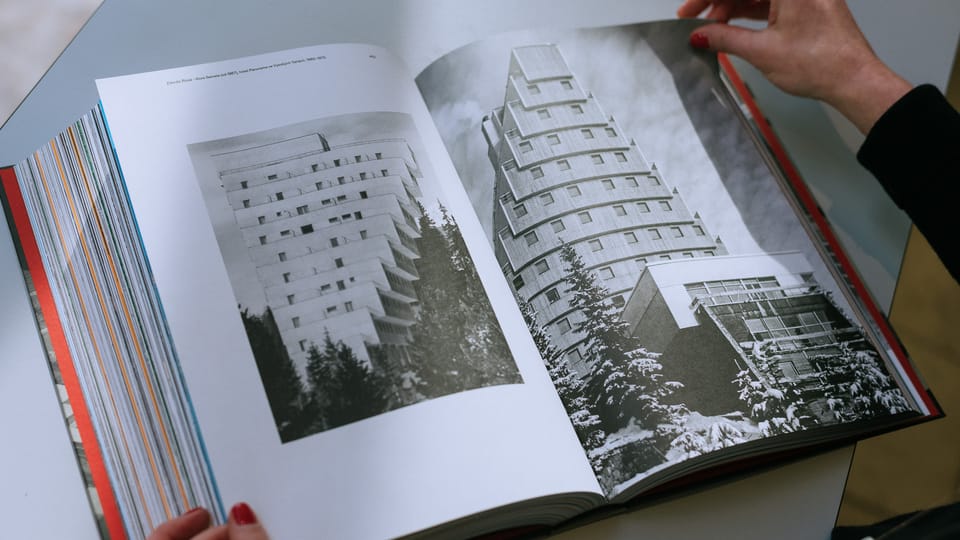
An impressive, two-volume book dedicated to Czechoslovakia’s Communist-era architecture has recently been released by Prague’s Bigg Boss publishing house. The ambitious publication, entitled ‘Architecture 58-89’, was written by 30 experts and took more than 10 years to complete.
The book, which covers nearly 1,400 pages and weighs over 5,5 kilos, was initiated and edited by the artist Vladimir 518, who has long been interested in the stigmatized architecture of pre-1989 Czechoslovakia. With its more than 40 chapters, it is probably the most comprehensive book written on the subject to date.

One of the 30 experts who contributed to the book is architecture historian Jakub PotůÄek. He focused on architects Jaroslav Fragner and Emil PÅ™ikryl, as well as on the creators of Prague’s now demolished Transgas building, Ivo Loos, JindÅ™ich Malátek and Václav Aulický:
“I think the contribution of the book is that it was initiated by a person who is not an art historian and therefore it offers a slightly different point of view than the classical art historical one.
“It’s the point of view of a person who is mainly interested in the culture and visual side of the period, and also in something called activism.
“I think it is evident in some of the chapters, because many of the post-war architects also tried to contribute to some of the key social issues of the time through their work."

The book presents buildings by architects VÄ›ra and Antonín Machonin, Karel Prager and the renowned studio SIAL in Liberec, but also some of the country’s high-rise estates, such as Prague's Invalidovna.
It also focuses on the wider context of the time, from the political system to basic architectural styles, the position of women in architecture and architecture conservation.

A related exhibition is currently on display at the Prague Centre for Architecture and Urban Planning (CAMP), located on the grounds of the Emmaus Monastery, in a building designed by the famous communist-era architect Karel Prager. Read More...