Computer Chips That Imitate the Brain
-
 Loading...
 - Nicolau Araujo
- 19 Jul 2022
- 109 Views
- 0 Like
- 0 Comment
A new microelectronics device can program and reprogram computer hardware on demand by using electrical pulses
What if a computer could learn to rewire its circuits based on the information it receives?
A multi-institutional collaboration, which includes the Department of Energy’s (DOE) Argonne National Laboratory, has created a material that can be used to create computer chips that can do just that. It achieves this by using so-called “neuromorphic” circuitry and computer architecture to replicate brain functions. professor Shriram Ramanathan led the team.
“Human brains can actually change as a result of learning new things,” said Subramanian, a paper co-author with a joint appointment at Argonne. ​“We have now created a device for machines to reconfigure their circuits in a brain-like way.”
With this capability, artificial intelligence-based computers might do difficult jobs more quickly and accurately while using a lot less energy. One example is analyzing complicated medical images. Autonomous cars and robots in space that might rewire their circuits depending on experience are a more futuristic example.
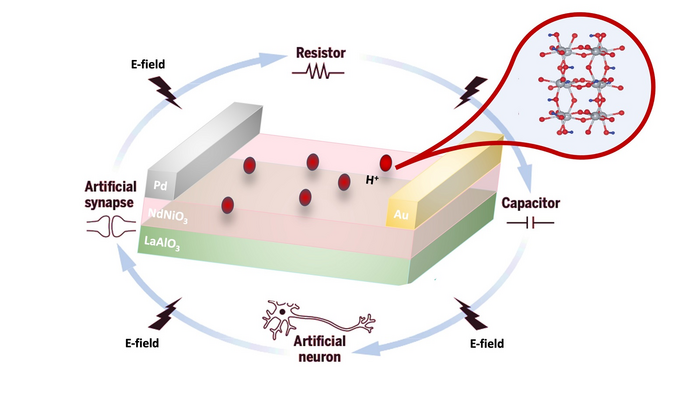
The key material in the new device consists of neodymium, nickel, and oxygen and is referred to as perovskite nickelate (NdNiO3). The team infused this material with hydrogen and attached electrodes to it that allow electrical pulses to be applied at different voltages.
“How much hydrogen is in the nickelate, and where it is, changes the electronic properties,” Sankaranarayanan said. ​“And we can change its location and concentration with different electrical pulses.”
“This material has a many-layered personality,” added Hua Zhou, a paper co-author and Argonne physicist. ​“It has the two usual functions of everyday electronics — the turning on and blocking of electrical current as well as the storing and release of electricity. What’s really new and striking is the addition of two functions similar to the separate behavior of synapses and neurons in the brain.” A neuron is a single nerve cell that connects with other nerve cells via synapses. Neurons initiate sensing of the external world.
For its contribution, the Argonne team carried out the computational and experimental characterization of what happens in the nickelate device under different voltages. To that end, they relied on DOE Office of Science user facilities at Argonne: the Advanced Photon Source, Argonne Leadership Computing Facility, and Center for Nanoscale Materials. Read More...