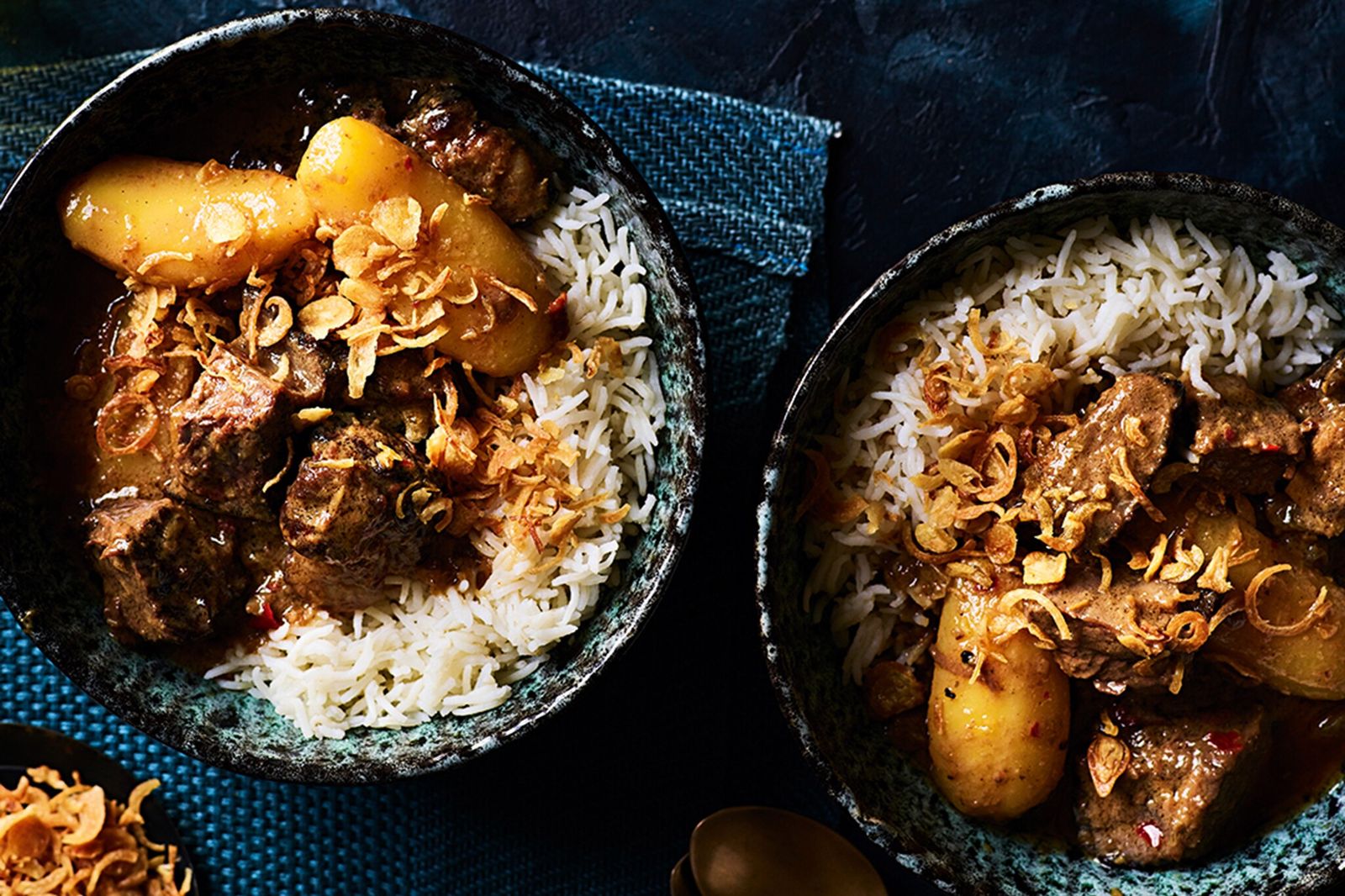
Deconstructing massaman curry, Thailand's mellow classic
-
 Loading...
 - Dandan Huang
- 15 Feb 2023
- 71 Views
- 0 Like
- 0 Comment
Rich and mild, this complex dish contains spices not often seen in Thai cuisine, reflecting culinary influences from across Asia. And the theories about its precise origins are equally diverse.
Massaman isn’t like other Thai curries — at least, not the well-known ones. Rather than being chilli-hot — like a green or red curry — it’s positively mellow, featuring ingredients that might seem more at home in a Middle Eastern spice market or an Indian kitchen than a Thai dish. Mace, nutmeg, cloves, cassia, bay leaves and nuts all play a part in this rich, aromatic, slow-braised dish’s distinctive character.
Massaman curry, as we now know it, probably started life in the 17th century, but its origins stretch much further back. Thailand, which was known as Siam until 1939, was never colonised by Europeans, but has been an important part of trade routes connecting East and West for thousands of years. Recent archaeological finds in Thailand provide evidence of this; they include coins, gems and jewellery that were originally produced in the Mediterranean, modern-day Pakistan and China before finding their way here. But it wasn’t just trinkets that were exchanged — flavours were, too, although exactly when, how and by whom is a matter of debate.
“A version of massaman curry was first introduced to Thailand by the spice traders coming over from India and as far away as Persia,” says Saiphin Moore, chef and co-founder of restaurant chain Rosa’s Thai. “They’d stop over in the ports of southern Thailand on their way to China through the Malacca Straits. Since the curry landed in a region with a large Muslim community, the recipe has always called for beef or chicken. It uses spices you don’t typically see in Thai cuisine, but we make it Thai by mixing them with super-traditional ingredients like lemongrass, galangal and kaffir lime peel. It’s a history of Thai food in one bowl.”
Malaysian cooks may have had a part to play too. As chef Bongkoch ‘Bee’ Satongun, founder of Paste Bangkok, a Michelin-starred restaurant in the Thai capital, points out: “At the time, the relationship between the south of Thailand and northern Malaysia was strong — both Thai and Muslim cultural influences were shared on both sides of the border.”
Still others note that migrants from Persia, modern-day India and Pakistan also settled further north in the plains around what would become Bangkok, including cookbook author Leela Punyaratabandhu’s Hindu Brahmin ancestors. Her version of the recipe cleaves to the idea that massaman is more of a Bangkokian dish than a southern or Muslim creation. The word ‘massaman’ is probably a corruption of ‘Mosulman’, an archaic word meaning Muslim — so whether it was invented within, or brought to, the Muslim communities who grew to love it, it seems likely it was named after them. Read More…