Discussing Laura Anderson Barbata's Costumes & Transdisciplinary Art Practice
-
 Loading...
 - Magda Balsam
- 06 Jul 2022
- 113 Views
- 0 Like
- 0 Comment
Laura Anderson Barbata is a Mexican transdisciplinary artist. As I was researching her work, I wondered about her use of “trans” and how the term differed from an interdisciplinary or multidisciplinary artist. As she explained to me, her work embraces “the concept of transcending borders, not just geographic, but also with her medium and techniques.”
For the past thirty years, she has combined her artistic and social practice to create exchanges with various local and global communities. The projects are about bringing communities together over shared concerns, out of a desire to build long-term meaningful relationships. I had the pleasure of attending a production of Amphibian Stage’s Marie Antoinette in Fort Worth, prior to a conversation with Barbata about her use of symbolism in costume design and her overall creative practice.
Colette Copeland (CC): After reading about your transdisciplinary art practice that addresses themes of social justice and the environment within the context of global collaborations, Marie Antoinette seems a curious choice for subject matter. How did this project come about and what interested you about this story?
Laura Anderson Barbata (LAB): I have worked with Amphibian Stage in the past on numerous projects, including The Quixotic Days and Errant Nights of the Knight Errant Don Quijote; The True History of the Tragic Life and Triumphant Death of Julia Pastrana, the Ugliest Woman in the World; and Leonce and Lena. It is always a great pleasure to work with them. So when I was approached by Director Jay Duffer, I jumped at the opportunity to work with their incredible team. David Adjimi´s script moved me and challenged me to delve into the psychological landscape of the characters, while supporting the narrative through costuming. I am interested in the way clothing and hair can communicate the political, social, emotional, and psychological states of the characters. Plus, I love theater!

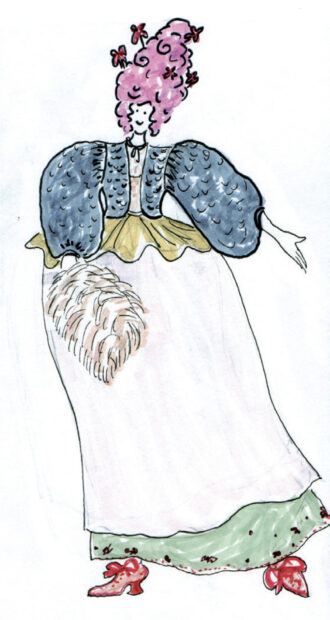
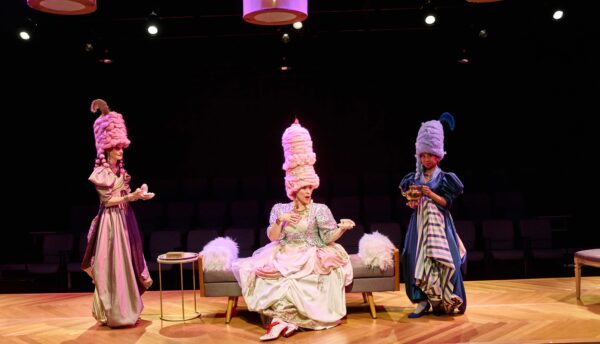
I love what you said about how clothing and hair have the power to communicate on multiple levels. Your innovative, contemporary costume designs added not only to the visual aesthetic of the production, but also to the symbolism of the play. Playwright Adjmi challenges us to think about Marie Antoinette beyond the superficiality of her actions. As Marie struggles in prison, stripped of her royal power, the play examines issues of morality, social class, and accountability for one’s actions. I find it fascinating that you incorporated layering quite literally into the designs. This serves a practical purpose for the actors to avoid time-intensive costume changes, but also functions as a metaphor for the shift in Marie’s character as the play progresses. I am especially enamored with the sheep costume and the brief glimpse of its transformation into the wolf. The cotton candy-colored wigs in the first scene are also fabulous — ridiculous in their height, while also referencing spectacle, the opulent fashion of the time. What concepts inspired you with the costume designs?
LAB: Jay provided the guidance. His vision was for the opening scene to be opulent, to show excess and over-the-top wigs, all of which would be transformed as the play unfolded. He wanted us to be able to witness Marie Antoinette´s unraveling. The costume layering is a very important aspect of the narrative, especially as it is utilized in reverse. We see Marie Antoinette slowly being stripped away from everything as the play evolves–from her three-tiered cotton candy wig to all the layers that compose her outfits. For the opening scene, I was inspired by the excessive sweetness — airy textures and pastel colors of cotton candy — to create Marie´s and her friends’ super tall wigs.
The use of color throughout also has an important role. As the play unfolds, the color palette evolves, slowly darkening, and the color red begins to appear and grow with intensity as Marie´s layers are shed. The Sheep is a fascinating character filled with symbolism. I love the way the playwright transforms the Sheep into a Wolf; and the way Jay directed this scene turns it into a moment of profound psychological and emotional tension from which Marie Antoinette cannot escape. This project began in 2019 and was put on hold because of COVID when all theaters were shuttered. During lockdown, I continued working and developing the designs for this project with the assistance of the fashion designer Matthieu M.
It was interesting how you used the color red to add to the emotional intensity as the play progressed. At first, red is only visible through the layers of Marie’s costume, but at the climatic moment of her psychological crisis, her gown is covered with embroidered red flowers. Read More...