Ecuador expands protections around Galà¡pagos, creating ‘a new highway' for sea life

The Galápagos, Charles Darwin once said, are “a little world within itself.” Many of the finches, tortoises and other animals that he saw there in 1835 — and that inspired his ideas on evolution — know no other home on Earth.
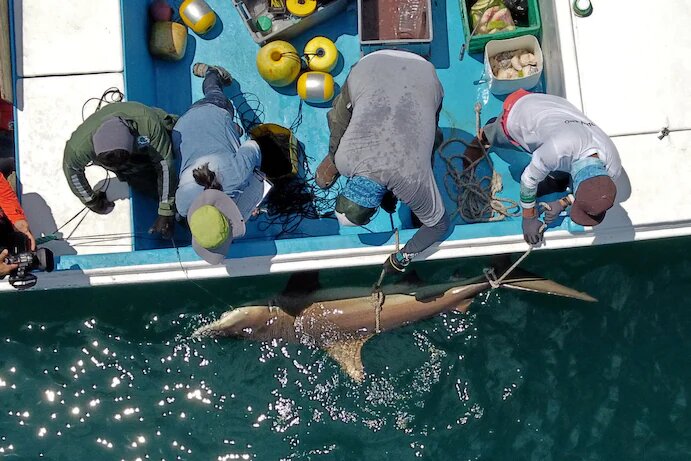
But the sharks, whales, sea turtles and manta rays that teem in the waters around the wildlife-rich islands are on the move. Like Darwin, who spent only five weeks in the Galápagos, many sea species there are transient, regularly migrating outside that little world and to neighboring island chains.
On Friday, the government of Ecuador announced it will curb fishing in more than 20,000 square miles of ocean to the northeast of the archipelago, in essence erecting guardrails around an underwater animal freeway between the Ecuador’s Galápagos Islands and Costa Rica’s Cocos Island.
“It’s like creating a new highway for them to travel,” said Gustavo Manrique, Ecuador’s minister of environment, water and ecological transition.
No fishing will be allowed in half of the newly protected area, while longline fishing will be banned in the other half.
Since 1998, more than 50,000 square miles surrounding the Galápagos has been set aside as a marine reserve, protected from industrial fishing. But schools of bulbous whale sharks and trim scalloped hammerheads zip between archipelagoes in search of food or mates, putting themselves at risk of being hauled up by fishers eager to sell their fins in Asia, where many regard shark fin soup as a delicacy.
“The boundaries are created by humans,” Manrique said in an interview Friday. “But the species, they don’t know about boundaries.”

The decree Friday from Ecuadoran President Guillermo Lasso comes as calls to safeguard more of the world’s oceans grow louder. The burdens on ocean life — from littered plastic, increased temperatures and more-acidic waters in addition to overfishing — are conspiring to make the oceans inhospitable for many forms of marine life upon which millions of people depend. Read More…