EJOLT: The ‘Environmental Justice' NGO Doing Separatism's Bidding in Western Sahara
-
 Loading...
 - Naunet Abdo
- 22 Apr 2022
- 317 Views
- 0 Like
- 0 Comment
In April this year, a new study titled “Reporting International Conflicts through the Environmental Discourse: The Moroccan Sahara Conflict as a Case Study” was published by Dr. Mohamed Mliless, an independent researcher in Ecolinguistics, and Dr. Mohammed Larouz, Dean of the Faculty of Arts and Humanities in Meknes. The study has since been published in a recently issued collective book under the title “The Climate-Conflict- Displacement Nexus from a Human Security Perspective.”
The promotion of environmental justice (EJ) has been a central concern of international NGOs to reinforce environmental equity worldwide. But this does not seem to be the case with the Environmental Justice Organizations Liabilities and Trade (EJOLT), whose approach distorts the real picture in the Moroccan Sahara.
Being an EJ impact assessment tool, EJOLT is one of the most prominent mapping Atlas which identifies. Typically, Its work entails describing and assessing thousands of hazardous sites in the world, among which 18 are located in Morocco.
Disinvestment campaign masquerading as climate justice
In the Western Sahara region, however, EJOLT’s work goes beyond its self-description as an environmental justice crusader to actively embrace the Polisario Front’s Algeria-backed separatist discourse. As such, Mliless and Larouz’s study has shown, the NGO’s separatism-leaning political orientation in the region is the main reason why it has consistently been opposing industrial and energy projects in Morocco’s southern provinces.
The discourse used by EJOLT to describe EJ issues in the provinces is a pure harassment and an explicit disinvestment plan it pursues to implement a separatist and anarchist agenda in this particular region.
To argue for this position, the EJOLT prefers taking a pro-Polisario disinvestment stand in the region, which includes conflating environmental justice with the separatist Polisario Front’s quest to benefit from the southern provinces’ “disputed resources.” To demystify such a discourse, Mliless and Larouz’s study examines the EJOLT’s homepage and extracts its narratives.
The investigation revealed that there are six infrastructures targeted by the EJOLT. The analysis also revealed that the EJOLT uses a biased discourse – mostly distorted and defamatory – that failed to provide the real picture of the population in the region. Moreover, the EJOLT argues that the Polisario militia which lives on Algerian territory, NOT the Moroccan population living in the Moroccan Sahara provinces, must benefit from the existing resources.
Similarly, the rhetoric used in EJOLT’s campaigning has long failed to recognize that one million inhabitants inside the Moroccan Sahara have been directly benefiting from the many projects developed in the region. Equally important, the results of Mliless and Larouz’s study show that EJOLT’s discourse aims at triggering violence, insecurity, and instability in the region, thus serving potential interested agendas.
Furthermore, the research explains how EJOLT’s narratives promote insecurity and nourish violence given the fact that the forms of mobilization prescribed by the EJOLT to call for EJ activism are fueled
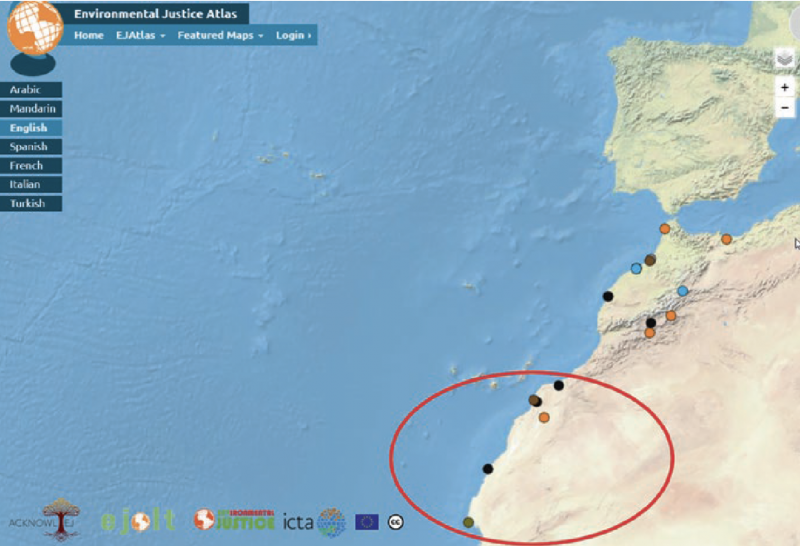
with hatred, defamation, and violence. Analyzing EJOLT’s online platform, the research located 18 mining, fishing, and energy locations in Moroccan among which six have been mapped in the Moroccan Sahara provinces.
Through its platform, EJOLT seems to provide an invaluable service to Algeria and the Polisario by launching a viral battle to reinforce boycotts of phosphate, fishery, and renewable energy products from being extracted and exported to foreign markets. Is this about environmental justice or disinvestment?

In Morocco, EJOLT has identified 18 environmental conflicts and EJ projects, among which six infrastructures (mineral, energy, and fishery) are located in the Moroccan Sahara. To describe these plants, Mliless and Larouz argue that EJOLT relied on biased documents that were furnished by Algeria and international NGOs which support the separatist ideology in the region. Read More...