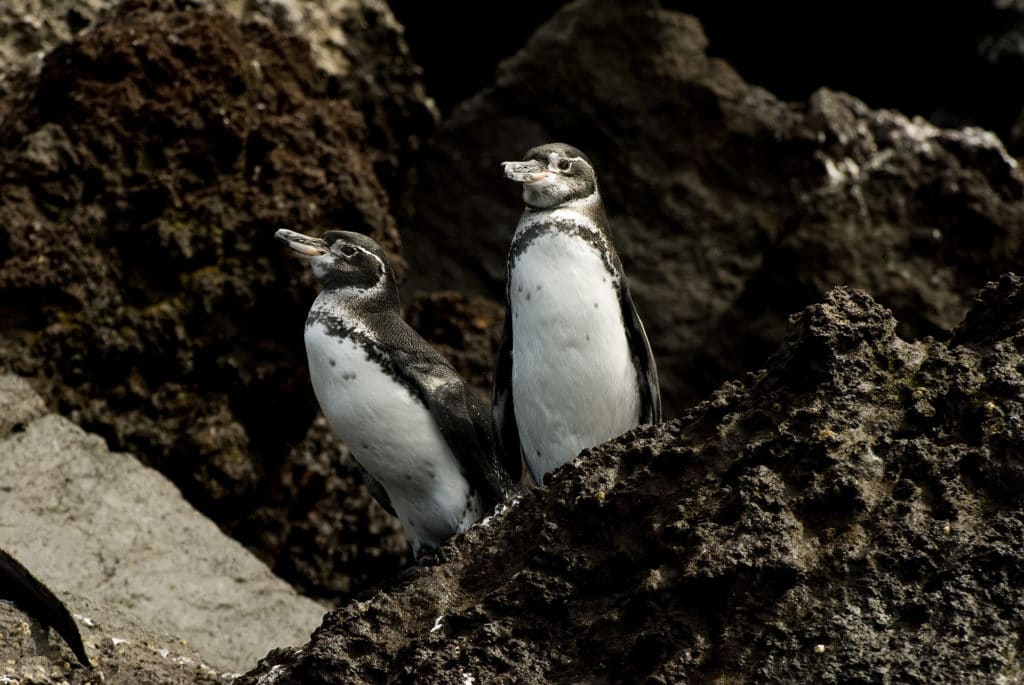
Endangered Animals Spotlight: Galapagos Penguin
-
 Loading...
 - Josef Horacek
- 02 Aug 2022
- 96 Views
- 0 Like
- 0 Comment
Family: Spheniscidae
Genus: Spheniscus
Species: Spheniscus mendiculus
IUCN Status: Endangered
Population: Approximately 1,200
The Galapagos penguin is the most northerly occurring species of penguin in the world, endemic to the Galapagos Islands of Ecuador. They are believed to have travelled to the islands from Antarctica on the Humboldt Current, an ocean current of cold, nutrient-rich water that travels up along the west coast of South America.
Despite the drastic change in habitat, these penguins developed several morphological adaptations to survive within the Galapagos’ unique climate and ecosystem. Although once an isolated sanctuary for the incredibly rich and unique biodiversity found on the islands, the introduction of invasive species, unsustainable fishing practices, and increasingly unstable climate conditions have led to the demise of numerous species, including the Galapagos penguin.
Appearance
The Galapagos penguin is one of the smallest species of penguin in the world, with an average height of 49 centimetres and an average weight of 2.5 kilograms. Their slight stature is believed to be an evolutionary adaptation to the rugged, volcanic Galapagos landscape, as it allows for easy access to small caves and crevasses in which they nest, breed, and seek shelter from the intense equatorial sun.
They are characterised by thin, C-shaped strips of white feathers from the corner of each eye to the chin, and a single strip of black feathers cutting across the white breast feathers. Baby Galapagos penguins initially have brown, downy feathers which gradually moult as they grow up. Like fellow temperate penguin species, the Magellanic and Humboldt penguins of South America, the Galapagos penguin has patches of bare skin around its eyes, at the base of its bill, and on its legs, from which the animal release heat.

Diet
As with numerous equatorial seabirds and inhabitants of the Galapagos Islands, the Galapagos penguin relies heavily upon two cold-water, nutrient-rich oceanic currents – the Humboldt and Cromwell currents – to supply a rich array of prey throughout the year. When upwelling occurs on the equator, trade winds displace warm, nutrient-poor surface water and allow for cold, productive Antarctic waters to rise. This abundance of nutrients acts as sustenance for phytoplankton, which in turn sustain an infinite number of small fish and crustacean species. As these primary producers and consumers form the basis of the ocean food chain, the Humboldt and Cromwell currents support one of the largest ecosystems in the world with incredibly high concentrations of distinctive fish and marine mammal species. Since upwelling occurs most frequently around islands and archipelagos due to shallow sea floors, the Galapagos penguin is able to hunt close to the comparatively safe shoreline.
Nevertheless, the process of upwelling is by no means a regular or frequent occurrence: trade winds are weakest during the hot, rainy season (December to May) and strongest during the cool, dry season (June to November). Upwelling thus occurs at varying strengths throughout the year, resulting in periods of unstable and unpredictable availability of prey for the Galapagos penguin.

The diet of the Galapagos penguin consists mainly of cold-water schooling fish, such as sardines, anchovies, and mullet. As visual predators, they typically hunt during the day, with a clear protective membrane covering the penguin’s eyes to avoid irritation from the salt water. Despite their notoriously clumsy manner on land, Galapagos penguins are incredibly agile when underwater, swimming at speeds of 35 kilometres per hour and diving up to 27 metres deep; however, most diving trips tend to take place within five meters of the shoreline, at a modest depth of six meters and for a duration of less than one minute. Like many other pelagic-hunting penguin species, the Galapagos penguin practices group foraging, diving beneath schools of fish, herding them towards the surface, and picking them off from below. This provides fellow seabirds an opportunity to feed on the surface with relative ease.
Adult and juvenile Galapagos penguins are prey for sharks, sea lions, and Galapagos fur seals when hunting underwater. Eggs and chicks are vulnerable to the Galapagos hawk, as well as introduced predators such as rats, dogs, cats and other birds of prey.
Habitat and Behaviour
The Galapagos Islands are a volcanic archipelago in the Pacific Ocean, made up of 13 major islands and an undetermined number of smaller ones. Straddling the equator, a handful of islands sit in the Northern Hemisphere, whilst the majority fall in the Southern Hemisphere. Here, temperatures range from 19C to 32C. When combined with the intense equatorial sun, these temperatures make for a sweltering climate for the Galapagos penguin.
In order to survive in the unique Galapagos ecosystem, these remarkable creatures have thus developed a number of morphological and behavioural adaptations. Read More...