Facebook Ads are Changing the Way Universities Market Themselves to Prospective Students
-
 Loading...
 - WildJupiter Rave
- 02 Jul 2021
- 1140 Views
- 0 Like
- 0 Comment
In the modern, connected age, advertisers have more audience targeting capabilities than ever before.
The capacity to personalize your brand messaging based on interests, demographics and location, among other factors, has become more accessible than ever, and at the forefront of this hyper-personalized approach is Facebook, whose ad platform provides more targeting optionsthan we've ever had access to, with consistently expanding options and updates.
Many industries are reaping the benefits of such tools, including higher education providers, which are finding new ways to reach more students and generate interest in their schools.
Universities, whose tactics used to rely heavily on direct mail campaigns and college aggregators that helped students identify top schools, are now putting more emphasis on digital marketing, and reaping the benefits of Facebook’s massive reach and favorable metrics.
To find out exactly how schools are capitalizing on this wealth of information, we spoke to marketers at four universities about how paid marketing and advertising campaigns are shaping their outreach strategies, and the ways in which they’ve found success using Facebook and other paid advertising campaigns, in order to attract new students.
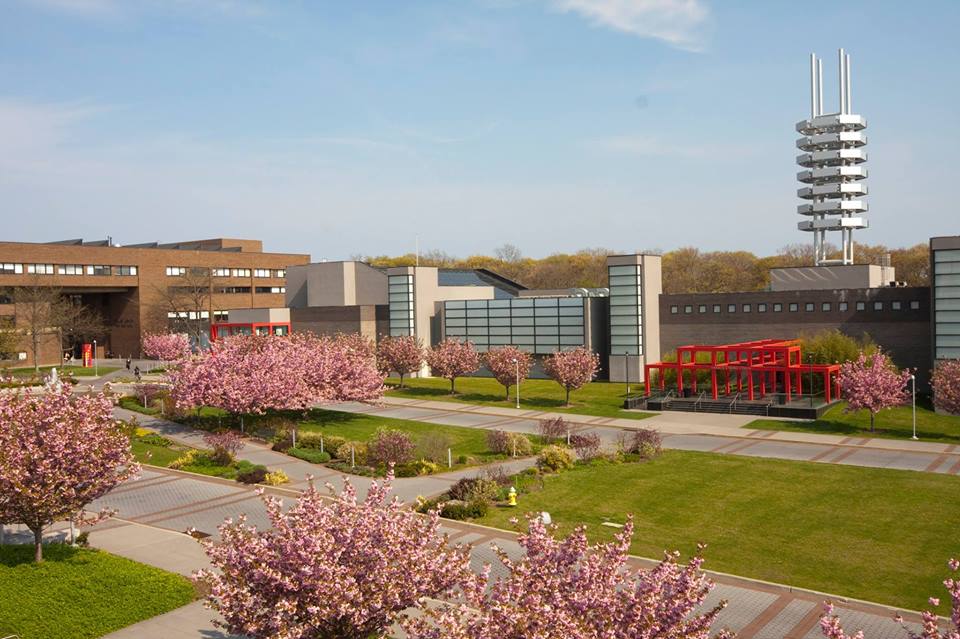
Stony Brook University
Facebook gives universities access to a range of demographic insights about the people interacting with their Pages - marketers can then use this information to target specific audience segments, and localities of prospective students interested in their school.
At Stony Brook University, nearly all of their digital marketing efforts are via paid messaging to prospective students through their social channels. Whether it’s using the platforms to build awareness, or to generate leads, the university has found it critical to be where the students are spending their time, and serving appropriate content through those mediums.
According to Nicholas Scibetta, Vice President for Communications and Marketing at Stony Brook University, Stony Brook’s preferred channels include a variety of media, including Pandora where the message is audio, Facebook where they often use video, and Instagram which relies on imagery.
“Once a student is in our CRM, we then use emails to provide additional information and move them through the enrollment funnel. The admissions team targets audiences by identifying other colleges those students are interested in, that we deem a competitor, or if they’ve shown a direct interest in Stony Brook. With this strategy, we still use a combination of digital and direct mail.”
The university then measures prospective student campaigns by analyzing those that come through the top of enrollment funnel, provide an email, and proceed all the way to putting a deposit and showing up on campus in the fall.
“We use different tools at different parts of the funnel. We know students who come visit campus are more likely to attend, so we make that a focus of our campaigns as well.”
Winona State University
Targeting specific audiences on Facebook is a no-brainer. With Facebook’s robust backend tools, universities can create hyper-targeted audience segments in order to maximize their reach, and create specific messaging for prospective students in different geographic areas and of different backgrounds.
As explained by Samuel Beyers, Recruitment & Marketing Coordinator at Winona State, the school has made Facebook its main paid traffic tactic, with a focus on geo-targeting the partners in their community.
“We put a lot of focus into marketing our psychology and mental health nurse certification programs to nurse practitioners across Wisconsin. We’re able to use Facebook to target nurses in the area and gauge their interest in the program.”
Having the right objective for your Facebook advertising strategy, and focusing on very specific subsets within your audience, will produce the most qualified leads and deliver more successful campaigns. This strategy has also made it possible for WSU to get their message in front of people who are not only the most qualified, but are also the most likely to take action and convert.
“We target working professionals, so our students are on average 33 years old. They come from a background of having some higher education and usually have an associates degree which lets us know to do more marketing for our continuing education and doctoral programs.”
Indiana University
With the wealth of data available on Facebook - both generally on the platform itself and through the platform's ad tools - there are many ways to measure the success of your Facebook ad campaigns.
Indiana University has developed a robust strategy to monitor which of its messages perform best, in order to maximize campaign delivery - the university recognized early on the importance of carefully tracking the results of their paid traffic campaigns, and have been able to streamline their Facebook ad strategy based on in-depth analysis of the ads they run.
As explained by Kristofer Karol, Director of Social Media Strategy at Indiana University.
“We measure the success of our campaigns based on conversions and the cost per conversion. It’s nice to be able to measure analytics immediately between campaigns to target demographics of people who were shown to go to the website and enter an email and generate a lead.”
Karol also notes that they have a defined approach the specific types of Facebook ads the university runs.
“On Facebook, we found the most success in running three different types of ads from July to November and use a combination of carousel ads, video ads, and graphics. From measuring campaigns on Facebook, Instagram, and Twitter, our Facebook campaign - the carousel ad specifically - far outperformed the other channels. Additionally, running multiple types of ads on Facebook let us know that images of the pretty spots on campus generate the highest conversions.”
The university was able to come up with specific messaging for each of their campaigns after analyzing data from previous attempts and determining which resonated most with prospective students.
Missouri State University
Missouri State’s marketing and communications department has also recognized the importance of measuring campaign analytics - and learned how to take these numbers with a grain of salt.
According to Suzanne Shaw, Missouri State University’s Vice President of Marketing and Communications:
“When measuring the results of our campaigns, we’ve come to recognize that click-through doesn’t mean they apply, so we try not to focus heavily on those specific numbers and to look closer at exact conversions. We still do track the analytics to get a better understanding of brand awareness and to understand our audience better, but try not to make big decisions for our campaigns based on this information.”
Furthermore, each department at Missouri State has its own strategies for targeting audiences specific to their programs, but the university also has a broader social media strategy that it follows.
“Since Facebook changed their algorithm to favor ads, we’re doing a trial run of the ads to raise awareness on articles and posts that we received a good response to on our Facebook Page to further promote them to new audiences on the platform.”
With over 2 billion active monthly users on Facebook, it’s become one of the top-performing social platforms for audience segmentation, and gathering demographic information, based on what each user is most interested in. Businesses, including universities, now have more tools than ever at their disposal in this regard, making targeting the right audience for their schools, programs, and campuses easier and more effective.
As digital marketing trends continue to evolve, we’ll undoubtedly see universities implementing their own unique strategies and building communities that match their core values.