Facebook's Adding New Face Recognition Tools, Advancing its Image Identification Efforts
-
 Loading...
 - Nicky Jerry
- 20 Dec 2020
- 1616 Views
- 0 Like
- 0 Comment
Over the past few years, Facebook’s been developing and enhancing its image recognition technology, with a view to utilizing it to add more context and relevance to their data banks. This week, Facebook has announced the next step in advancing their image-recognition tools, with the addition of new alerts for photos taken of you – whether you’re tagged in them or not – and enhanced identifiers for vision-impaired users.
Here’s how they work.
Identifying You
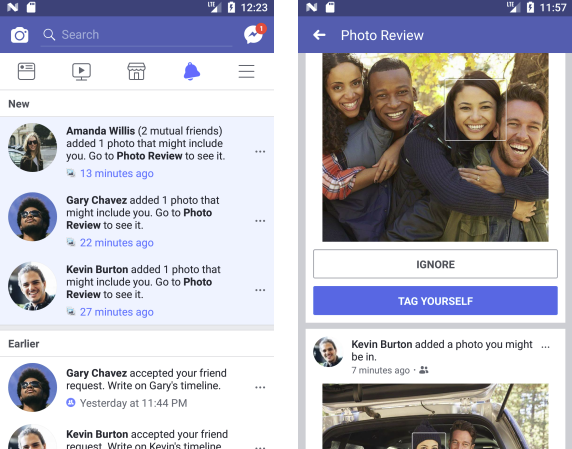
Facebook’s main announcement relates to the expansion of their photo identification system which will now alert you whenever a photo in which you’re included is uploaded to the platform.
As you can see from the above example, now, when someone posts an image in which Facebook recognizes your face, you’ll get an alert, and an option to tag yourself in it, if you wish. If it’s not you, you can let Facebook know, while you also have options to report the image if you object to the content.
As noted, this is really just an extension of Facebook’s existing systemwhich identifies users in photos – and worth noting, you won’t get alerts for absolutely any uploaded photo in which your face is recognized.
As explained by Facebook:
“...if you’re in a photo and are part of the audience for that post, we’ll notify you, even if you haven’t been tagged.
This means if someone who you’re not connected to posts an image of a crowd, and your face is recognized, you won’t be notified, as you’re not connected to that person. That makes sense, as it could get a little creepy if random people were tagging others.
The exception to this is if someone uses your image for their profile photo – Facebook’s also using this expansion to alert users to potential identity theft. So if someone tries to use your image as their profile, Facebook will let you know, enabling you to take further action.
Given Facebook has had similar capacity for years, the addition is not a huge leap, technologically speaking. But it is an advancement in acceptability - face identification tools rightfully tend to freak people out, and Facebook’s the clear leader in tracking where you are, who you talk to and what you do, based on images alone. But there’s huge value in that data - there are many ways Facebook could use such capacity for advanced ad targeting, News Feed refinement, improved personalization, etc.
But Facebook also knows that they need to tread carefully with such technology to avoid backlash, which is why they’ve also released a new ‘Hard Questions’ post on how face identification works to assure users of the process, and their options.
Facebook also says that they have no plans to use such data to ‘enhance ad targeting or content relevancy sorting’, at least not at this stage.
But again, Facebook’s had the capacity to do this, to track users through images in this way, for years – they’re already using that data, in some capacity, to enhance their image identification system. You’d have to assume that they’ll look to use this for improved data tracking in future. And the potential on that front is significant.
This also comes on the back of Facebook’s recent efforts to combat revenge porn by asking users to upload naked images of themselves in order for Facebook to alert them to potential matches, and the announcement of a new option to unlock your Facebook account by using Face ID.
All of these are smaller advances, little updates and tweaks in the way Facebook can use, and is using, facial recognition. But each one is also another shift towards the normalization of image recognition technology, acclimatizing users to this new process. The end goal of that could be the reduction of the fear factor around image recognition, which would then open the gates for Facebook to make more use of such tools. And again, Facebook is already doing this, they can already identify a wide range of objects and people in every photo uploaded to the platform, whether you realize it or not.
In order to fully capitalize on such advances, Facebook needs users to accept them. These new options align with the wider introduction of image recognition and identification tools.
Improved Accessibility
The second part of Facebook’s latest announcement relates to improving accessibility for visually impaired users.
As explained by Facebook:
“We’re always working to make it easier for all people, regardless of ability, to access Facebook, make connections and have more opportunities. Two years ago, we launched an automatic alt-text tool, which describes photos to people with vision loss. Now, with face recognition, people who use screen readers will know who appears in photos in their News Feed even if people aren’t tagged.”
The tool adds more functionality for those that need visual assistance – while again, it also highlights just how good Facebook’s automated image identification systems already are (if you’re interested in getting an understanding of exactly what Facebook’s systems can identify in each photo, this Google Chrome extension will provide a listing of identified objects in every image you see on The Social Network).
Definitely, that provides more benefit, it’s a logical addition for Facebook. But it also hints at the future to come, at the expanded data potential for image identification.
The Next Level?
As noted, the development of image recognition technology could facilitate a new wave of ad targeting and data options, which could provide significant benefit to both Facebook and marketers who are looking to reach more specific audiences.
Imagine being able to identify potential advocates based on what they regularly take photos of (a cafe offering a discount to people who regularly share images of coffee, for example), or targeting users based on the products featured within their photos. There’s also location ID – which has already been flagged by Snapchat as a potential new ad option, with the capacity to offer ad viewers discounts based on where they are and what they’re looking at, all determined by image identification alone.
Twitter's also developing image recognition-triggered ads, while Google’s working on similar AR enhancement tools based on image identification.
There’s a wide range of uses for such tools - but as noted, normalizing them is the first step, reducing the fear that people’s actions are being tracked through their photos.
That’s why Facebook's so keen to highlight each users’ options, underlining the capacity to opt out of such tools if they wish.
Security concerns will remain – and there have already been various cases which have highlighted the potential risks in using Face ID, that it’s not necessarily a foolproof option. But as with many such advances, most users won’t check – most users won’t change their settings, and the default will see them get the new alerts, thus, normalizing the process.
These are the small, but required, steps Facebook needs to take in order to advance their visual recognition offerings, and enhance their data systems. That’s not to say there’s any evil intent, but we’re barely scratching the surface of what expanded visual identification will eventually be able to offer.
Facebook says they’re introducing their updated image recognition features in most regions except Canada and the EU, where The Social Network is restricted from providing face recognition technology due to legal limitations.