Feisty, Fragile, Fascinating: An Interview With Chitra Divakaruni
-
 Loading...
 - Divija Shah
- 07 Jun 2022
- 273 Views
- 0 Like
- 0 Comment
As a child, Dr. Chitra Banerjee Divakaruni spent her summer holidays with her maternal grandfather in Bengal, where he regaled her with stories from the epics, the Mahabharata and the Ramayana, along with tales from Bengal.
“My grandfather had a huge influence on my writing,” she says. “The land, the customs, the folktales and fairytales, many of which make their way into my writing, all came from him.”
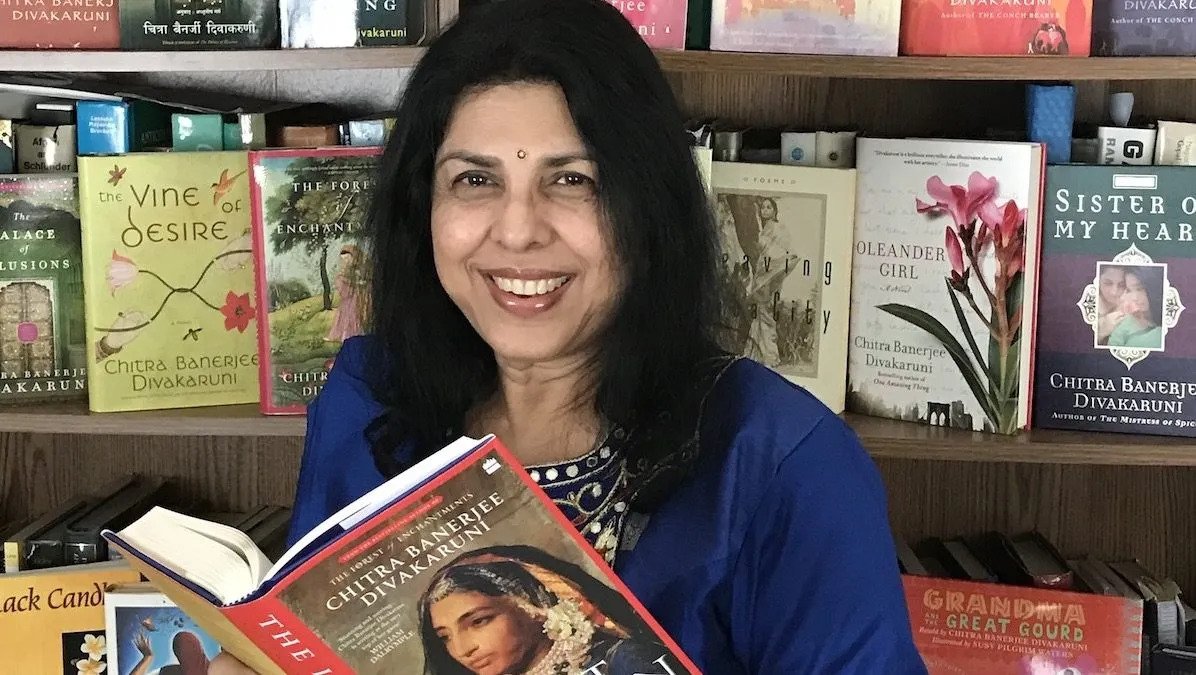
As did the epics. Though in the narratives of Divakaruni, they came with a twist. The Palace of Illusions (2008) and The Forest of Enchantments (2019), two of the most ambitious novels she embarked on, were retellings of the epics where Divakaruni gave voice to the innermost thoughts of Draupadi and Sita.
Growing up in Kolkata, the sense of Sita she got was of a “very meek and mild, obedient wife and daughter-in-law, who did not create any trouble. Elders would bless me and say, may you be like Sita, the epitome of all those qualities. That used to really annoy me! I thought there has to be more to Sita than that.”
That’s the kind of fallacious thinking that Divakaruni hopes to address through her portrayals of strong heroines. In her books, she paints them not as the meek and mild queens of traditional mythology, but intelligent, firebrand women, who protested the wrongs heaped upon them, and took up cudgels on behalf of women around them.

In her latest book, The Last Queen, which was just released in the United States, Divakaruni continues to delve into the minds of powerful queens, this time with the story of Maharani Jind Kaur, the youngest and most beloved wife of the Lion of Punjab, Ranjit Singh, Maharaja of the Sikh empire.
Why Rani Jindan?
“She is an amazingly strong woman who was just pushed aside in the annals of our history,” says Divakaruni.
History books teach about the Sher-e-Punjab, and his son, Dalip Singh, who was deposed by the British, exiled to England in his childhood, and ultimately made a puppet of the British crown. But in between the father and son ruled Maharani Jind Kaur, as the Queen Regent, an astute young widow fighting to protect Punjab, the legacy of her beloved husband, and the birthright of her son Dalip, from mercenary courtiers and the avaricious British.
“I thought Rani Jindan had a fascinating life and deserved to be in the limelight. She was very inspiring to me because of the difficulties she went through in a world that was pretty hostile to women who stepped out of their roles; I really wanted to tell her story,” says Divakaruni.
Readers and critics have called her books, especially the epic retellings, “unputdownable.”
“I love that word!” Divakaruni exclaims in delight. “I want it to be unputdownable.”
In this regard, The Last Queen doesn’t disappoint. The story has everything a fast-paced novel can be expected to have: royalty, romance, conspiracy, murder and mayhem. Divakaruni’s narrative style is fluid and accessible, with a sprinkling of wit and humor.
Divakaruni herself is a disarmingly charming conversationalist; her humor belies her towering persona as a multiple award-winning author. Her work has been included in the Best American Short Stories, The O’Henry Prize Stories, and two Pushcart Prize Anthologies, among others. She is also Professor of Creative Writing at the University of Houston, a program that is rated among the top creative writing programs in the US.
A strong advocate for women’s rights, she co-founded the San Francisco Bay Area-based Maitri, a nonprofit that provides support services to South Asian survivors of domestic violence. She is also an Emeritus board member of Pratham, a nonprofit dedicated to eradicating illiteracy in India. Read More...