Five good-news environmental stories from 2021

From record heatwaves causing devastating wildfires in Russia’s Siberia, to a prolonged drought hitting South America and the worst floods to hit South Sudan in 60 years, there has been plenty of bad news when it comes to the state of the global environment in 2021.
But amid a year of worsening environmental stress – including mostly ineffective international climate negotiations in Glasgow, locust plagues ravaging crops in East Africa, and an entire town being destroyed by fire in western Canada – some small shoots of hope have emerged.
When it comes to the state of planet Earth, scientists and conservationists have highlighted five of the most important good-news stories from 2021:
1) The ozone layer is healing
It was one of the key environmental causes of the 1980s: trying to prevent the hole in the ozone layer, which protects the planet from harmful UV rays, from getting any larger. Activists mobilised street protests and politicians held summits.
And change is happening, according to a recent study by the US National Center for Atmospheric Research (NCAR): Because of the 1987 Montreal Protocol, a global deal to regulate nearly 100 man-made chemicals that deplete the ozone layer, 443 million Americans will likely be spared from skin cancer through the end of this century.
The hole in the ozone layer remains enormous – about the size of North America – but it is recovering at a rate of one to three percent every 10 years, according to the UN. The hole over parts of the northern hemisphere is expected to heal completely by the 2030s, with full repair over the southern hemisphere and polar regions expected by the 2060s, according to UN data.
Global action on the problem via the Montreal Protocol has prevented more than 99 percent of potential health effects that would have otherwise occurred from ozone destruction, NCAR reported.
Environmentalists hope the relative success in the movement to protect the ozone layer can be replicated in the fight against climate change; so far, that has not happened.
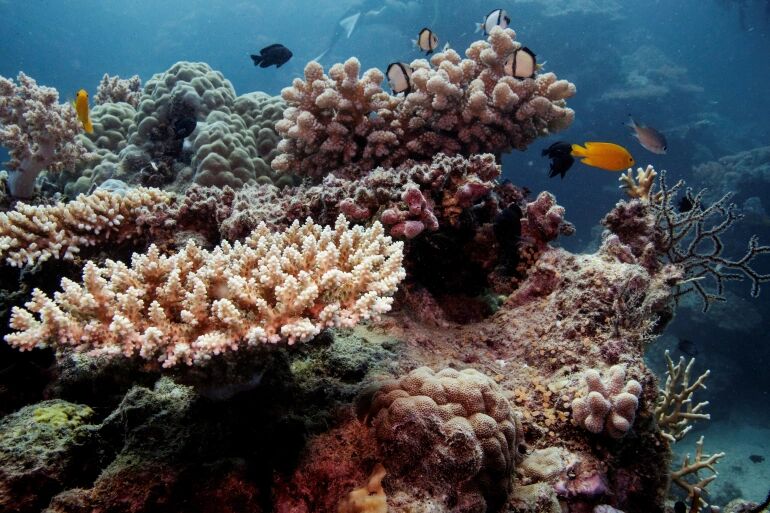
2) ‘Coral IVF’ aids Australia’s Great Barrier Reef
The world’s largest living structure is under threat from rising ocean temperatures linked to climate change, which have caused coral bleaching.
This year, however, has seen some recovery on the Great Barrier Reef. Scientists have been using man-made pools in a process comparable to in vitro fertilisation (IVF), moving eggs from areas of the reef where coral has been growing. These are then transferred in an effort to regenerate areas hit by bleaching or destruction from storms.
The process of assisted spawning, dubbed “coral IVF”, aided the birth of billions of new coral babies this year, in an explosion of colour. The reef is still facing substantial dangers, but scientists and conservationists hope these types of technologies can spur broader recovery in the world’s reefs, home to roughly a quarter of marine life.
3) China’s giant pandas no longer ‘endangered’
Home to more than 1,800 giant pandas living in the wilderness, China reported in July that the iconic bears are no longer officially “endangered”. Thanks to conservation efforts, they are now classified as just “vulnerable”.
The International Union for Conservation of Nature, an independent tracking group, made a similar assessment several years earlier.
Partial credit for the improvement in the giant panda population can be traced to an expanded network of protected areas in the world’s most populous country, covering about 18 percent of China’s landmass, according to Chinese authorities. Read More…