Gargantuan 'superflare' from distant star may have launched one of the strongest solar storms ever seen
-
 Loading...
 - Berta Celko
- 03 May 2023
- 59 Views
- 0 Like
- 0 Comment
Scientists studying a star system in Orion witnessed one of the most powerful stellar eruptions ever seen — and it could be devastating to nearby planets.
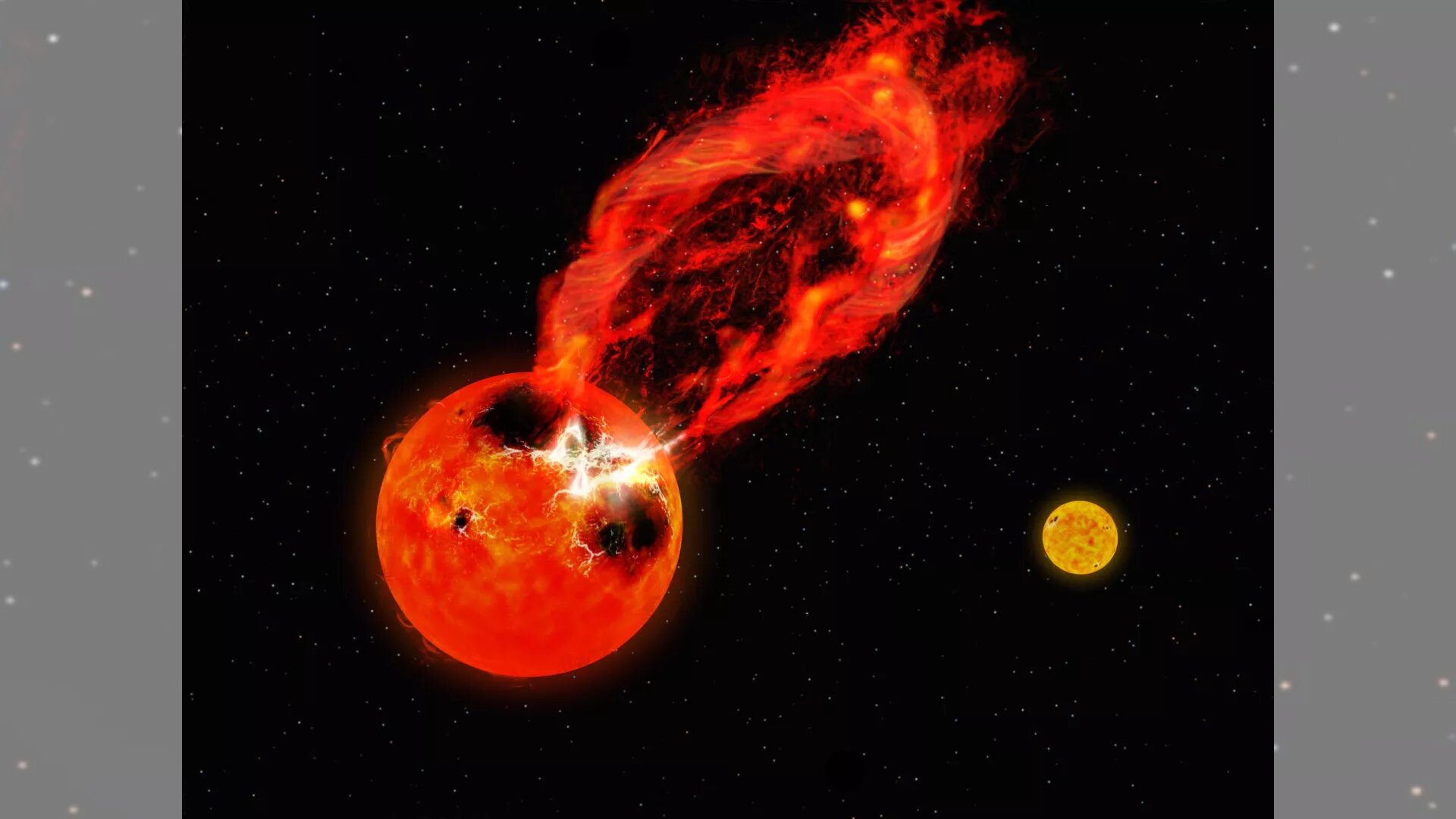
Scientists scoping out a star system in the constellation Orion have witnessed one of the most gargantuan and powerful stellar flares ever seen. Dubbed a "superflare," the enormous blast of stellar radiation is 10 times more massive than anything ever witnessed erupting from the sun, according to new research published in The Astrophysical Journal(opens in new tab).
While the mechanism behind these monster flares still isn't well understood, the new research suggests that superflares originate from stars that are highly magnetically active. These superflares may be accompanied by enormous eruptions of charged particles that could devastate life on any planets in their firing line, the study authors wrote. (Fortunately for us, Earth is not one of those planets.)
In their new research, the astronomers targeted a star system called V1355 Orionis, which is about 400 light-years from Earth and features two stars orbiting each other. These stars belong to a class of stars known to harbor many sunspots — dark, planet-size regions that form as the result of intense electromagnetic activity — and that have been tied to other observed superflares.
In general, stellar flares occur when magnetic-field lines in a star's atmosphere tangle, snap and reconnect, releasing a powerful gout of radiation that's visible across the entire electromagnetic spectrum. On the sun, flares may be accompanied by towering loops of plasma, known as prominences, that can rise tens of thousands of miles above the sun's surface. If this solar plasma launches quickly enough, it can break free of the sun and become a coronal mass ejection (CME) — an enormous blob of high-energy particles that can knock satellites out of orbit and short-circuit power grids on Earth, if our planet happens to be in the blob's path. Read More…