Google Plus isn't a dead horse - it's doing exactly what it was meant to
-
 Loading...
 - Ken Ma
- 20 Nov 2020
- 1119 Views
- 0 Like
- 0 Comment
The purpose of Google Plus is not to be a social network but to package up all your data in one place.
Although I’ve never once logged into my Google Plus account, it has been quietly drawing a picture of me since 2011.
Google says I’m a 25-32 year old female with 34,052 email conversations, 92 Google documents, more than 2000 contacts, interested in mobile phones, haircare, books and literature, food and shooter games (not all these are accurate.)
Within that single account which I’ve never used, Google has built up a detailed packet of what sort of consumer I am – a gold mine for advertising companies who have relied on vagaries and guesswork, until companies like Google and Facebook came along.
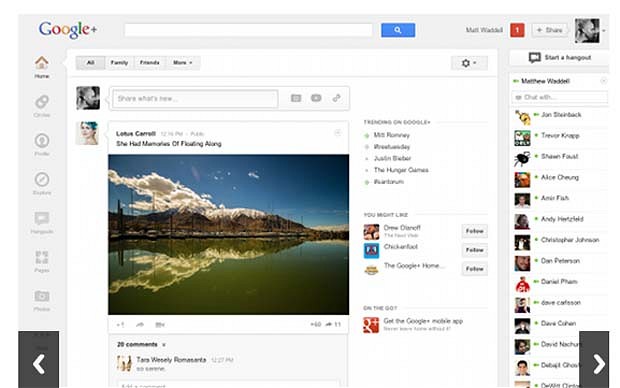
This week, the search engine giant announced with fanfare its redesign of Google Plus yet again. If you don’t know what Google Plus is, you’ll be easily forgiven: it’s Google’s attempt at a social network that brought together all its disparate services, from photos to Hangouts, into one central dashboard. Its aim: to neatly combine all your data.
The redesign this time includes two features front and centre – Communities, where people can discuss shared interests, and Collections, a Pinterest-like feature where hobbyists can collate things they love.

Hangouts is, according to Google, a sort of online pub: a place for chance meetings and shared experiences, in which users will be able to do things like watch a YouTube video together despite being on opposite sides of the world. Photo: REUTERS
When Google Plus launched in 2011, it was the looming threat of being beaten by an upstart newcomer that propelled Google into the social networking space. Everyone agreed this was the technology giant’s gauntlet to Facebook, which at the time was valued at $14bn and had 500m engaged, active users who used the site constantly. Suddenly, Facebook was competing for the very same eyeballs, and by extension advertisers, as Google.
In its launch interview with Wired magazine, the reception was lukewarm. “Observers might wonder whether it’s simply one more social effort by a company that’s had a lousy track record in that field to date,” it read.
Google is no stranger to failure. It has spun out a number of services that it has since buried quietly – ranging from the early Google Answers, which shut down in 2010 to the much-mourned Google Reader, the company’s RSS feed, and finally Google Glass which – like Google+ launched to big hype, only to be withdrawn and redesigned. But Google Plus was supposed to be different: it was the company’s stab at becoming your primary communication channel on the internet.
Although Google was able to get billions of sign-ups by virtue of its huge user network – with a little help from some coercive tactics that forced people to create a Google Plus account in order to access certain Google features like YouTube comments – its active usage has been dismal.
While Google won’t disclose numbers publicly, analysts have estimated that that less than 1pc of its 2.2 billion users actually use it.
A study earlier this year found that only 3.5 million account holders had more than 50 posts in the previous 30 days. Businesses signed up so their posts would show up high in Google’s search results.
he fact that Google Plus is dead is not news to anyone – it is so absent from the zeitgeist, that we all knew it was never a real competitor to Facebook or Twitter, and now to fast-growing specialist communities like Snapchat and Instagram. So why is Google flogging a dead horse? If users are truly as uninspired as research shows, surely it’s time to carve out all the healthy parts and discard the carcass?
The answer is that we’ve all been thinking about Google Plus wrong. We assumed it was a social network for sharing viral content and growing communities, but it’s not. Its primary purpose is to consolidate identities.
Google’s new chief executive, Indian-born Sundar Pichai has admitted this. Google Plus ensures “a common identity across our products,” he has said. Similarly Bradley Horowitz, vice president of product management for Google Plus has said "Google Plus gives you the opportunity to be yourself, and gives Google that common understanding of who you are.”
It is about connecting the dots of who you are across all its platforms as varied as YouTube, Google Maps and Chrome to package you up as a product for advertisers.
The fact that social networks exist by virtue of auctioning off your data may not be surprising, but in the case of Facebook, for instance, the data is a by-product of our willingness to share with it. Facebook is first and foremost a social tool, which ultimately carved a business out of leveraging its users’ conversations, memories and activities.
In Google's case, evidence seems to show that it already knows it can't compete on the same footing as its competitors. Every time one of Google Plus’ features worked, it just spun it out so it could flourish. The extremely successful Google Photos was spun off last March and went on sign up 100 million monthly active users within five months of its emancipation.
For a few years now, it has not even been trying to get you to share via Google Plus more widely. Users noted that Google quietly removed the Google+ Share button that used to appear in the top-right corner of Chrome and search.
Yet, Google is able to mine even more about your social habits than Facebook can, because it has a much broader range of data.
Google knows what over 1 billion YouTube users like to watch, it can track your location on a minute-by-minute basis over time through Maps, your email exchanges with friends, family and businesses, and every search term, or review you post through its search engine.
So ultimately it doesn't matter what businesses and consumers think about Google Plus, or even whether they use it. Google is having the last laugh.