Growing Up Queer and Evangelical in Victoria, BC

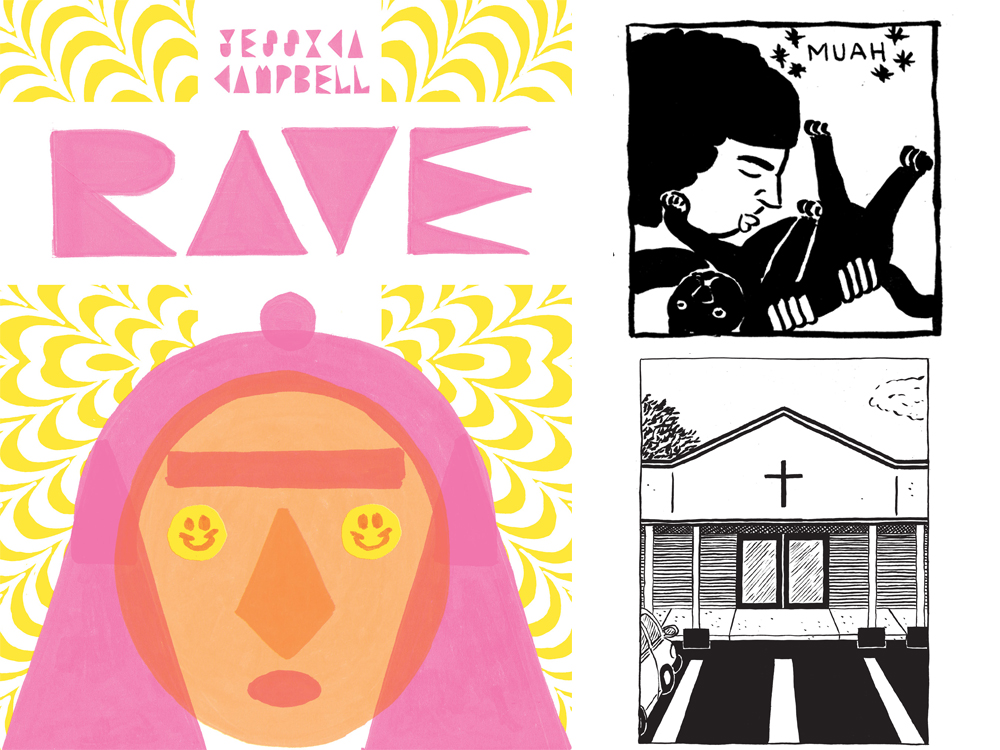
Being a teenager is hard. Being a closeted teenager raised in an evangelical household in the early 2000s is quantumly hard. But such is the premise of Jessica Campbell’s new graphic novel Rave.
The experience of 15-year-old Lauren — frumpy, confused, forced to wear awful long skirts and attend Christian raves — forms the meat of the story. When Lauren’s high school science teacher pairs her with a classmate named Mariah, the teenagers soon discover there are far more interesting things to do than a school project on evolution. Makeovers, movies, snacks and sexual exploration explode Lauren’s sense of self. Soon enough, the emotional complexities of balancing church, school, friends and wild new desire prove overwhelming.
First love is never easy and when a tragic event occurs, Lauren is forced to confront her deep-seated ambivalence about her faith and her sexuality and finally choose a path for herself.
Campbell’s alternately hilarious and bittersweet drawings funnel all the universal agony, ecstasy and uncertainty of coming of age into a story that clangs a psychic gong of recognition and empathy. In addition to her work as a graphic novelist, Campbell’s visual art practice is equally extraordinary.
The Tyee connected with Campbell to discuss her work, the weirdness of her hometown of Victoria, B.C., and the Christian right’s escalating war on women. This interview has been lightly edited for clarity and length.
The Tyee: Victoria has this very strange reputation of being a quaint Anglophile city with a dark side (Satanism, cupcakes on gravestones, murderous teenagers, etc.). Was this mixture partly what drew you to setting the story here?
Jessica Campbell: Yes, exactly! Victoria is really weird, a fake British tourist town with a thriving underbelly of meth labs and a history of all kinds of alternate religions/spiritual practices, including Paganism, Wicca or even Satanism. I grew up there, and I think setting the book there was just obvious to me because it’s what I know.
When I was growing up in the evangelical church, we would often be told that we were living in the Satanist capital of North America, which was meant to induce fear and drive us deeper into the church. I don’t really know if that’s true (or even what that means, exactly), but I grew up during the “Satanic panic” era and the fear of anything approaching Satanism was ever-present.
Growing up, it felt like the ground beneath my feet kept shifting. Like, for the first few years of my life, I was allowed to celebrate Halloween, but then at around six, it was deemed too Satanic, and my dad burned all of the Halloween decorations we’d made in school in the fireplace.
I was likewise forbidden from playing Dungeons and Dragons as a (nerdy) teenager because of its proximity to Satanism. Meanwhile, The Lord of the Rings was fine to read, likely because my dad had enjoyed it in his own nerdy youth. I think the fear of Satanism and the occult was amplified by living in Victoria, where we would encounter people with names like Blood Root in the course of our daily lives.
In the book, however, I don’t really feel like I made the location super overt. I live in the United States now and have met many more people who were raised Evangelical/Pentecostal than I ever knew in Canada, and the particularities of Victoria felt too complicated or specific to cover in the book. Mostly the setting is conveyed through drawings of really specific convenience stores (like the old Mac’s in Cook Street Village), street names, early ’00s Island-specific slang, etc.
Like Lauren, you grew up in a deeply religious household. How did this early experience shape you as an artist?
Well, in the case of this book, I think there is a very obvious relationship between my upbringing and the story. But, more broadly, I’m not sure if I fully have a grasp on this. It is true that I was raised in a deeply religious household, but it’s equally true that neither of my parents were, and that none of my extended family was religious, and that I attended public school. My grandmother (and my grandfather who died before I was born) loved art and [my grandmother] always had a lot of art in her household in addition to many more art books, so I was exposed to it.
I also had a bit of a talent for drawing as a child, so I was encouraged to draw, which I think is what often happens. Like, someone sees you drawing and says “Hey, you’re kind of good at this!” So, you continue to do it for the praise. I remember winning a drawing competition in 1994 that allowed me to make a card for an athlete competing in the Commonwealth Games in Victoria.
I do remember making some drawings of Jesus as a child, and there was a moment as a teenager when I was also somewhat devout, but I also went through a lull in my interest in art. I think this was in part due to the anxiety of adolescence and an uncertainty about what I wanted to do? Then I came back to artmaking in high school around the same time that I got a job at Munro’s Books [in Victoria] that precluded me from attending church on Sundays (since I was at the bookstore).
One thing to note is that the Pentecostal/Evangelical church is relatively art-free. Like, there are sometimes fabric banners, but most of the churches I attended were in high school (or former high school) gymnasiums and were fully unadorned, so there wasn’t really a visual vocabulary to inform my aesthetic.
In addition to your work as a graphic novelist, you have another art practice. Do the two influence or inform one another or are they deeply different manifestations of your creative work? (I have to say, your artwork is simply stunning, I really love it.)
Thank you so much for your kind words! I think of the two practices as functioning in a different way. The comics are narrative and direct, often really overtly humorous, and the studio/textile work is more associative, visceral, experiential.
I think both disciplines have great strengths and do certain things well. A friend (the cartoonist Laura Park) recently pointed out to me that both have a really strong sense of pattern and design, which may be a more overt visual relationship between them? Also, I’m constantly dealing with the same themes, as these are the ideas that bounce around in my head: sexism, daddy issues, the evangelical church, humour, etc. Read More...