History and Culture of Ecuador

Ecuadorian Culture
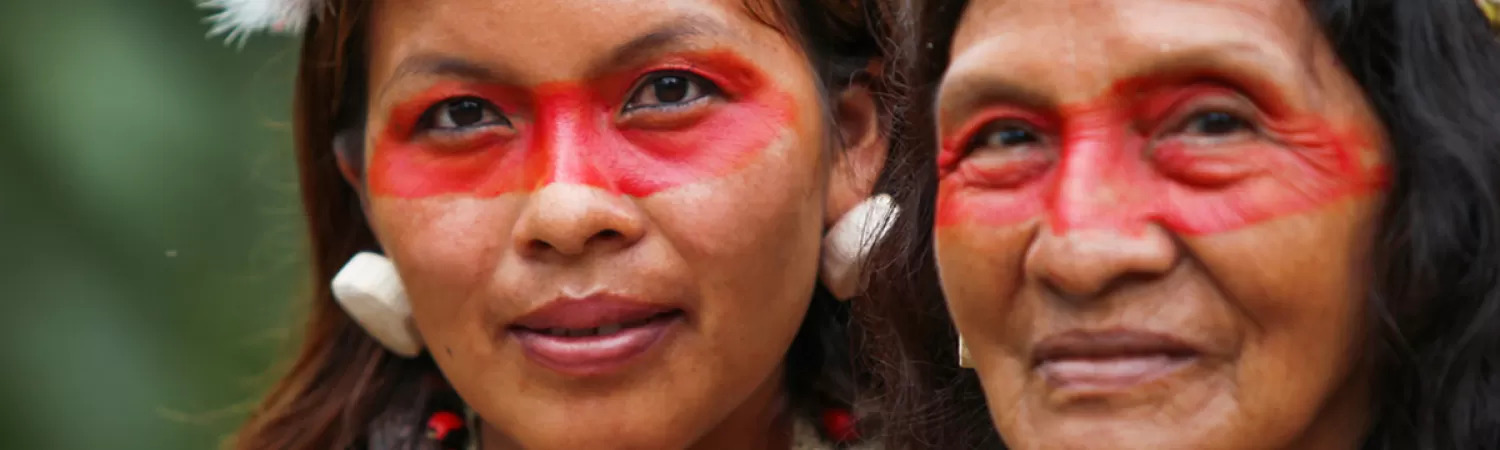
Ecuador’s distinct culture is as vibrant and beautiful as the hand woven tapestries of its local artisans. Stemming from its long and rich history, Ecuadorian culture includes a fair mix of indigenous practices along with European colonial influence. Almost everyone in Ecuador has a mixed-race background, which has resulted in tremendous cultural diversity as well as unique customs and traditions across the whole country.
Generally speaking, the overwhelming majority of Ecuadorians are Spanish-speaking Catholics, but as it becomes a more integrated and globalized nation each year, this is changing.
Culture Shaped by Geography
Straddling the equator, the Ecuadorian coast rushes up to snow-capped volcanoes then falls away to hot Amazon jungle--all in a country the size of the State of Colorado! It shares a long-contested border with Peru to the south and east, and is bounded by Colombia to the north and the Pacific Ocean to the west. The country can be divided into four regions: the western coastal lowlands, the central Andean highlands, the eastern jungles of the Amazon basin and - some 1000 KM (620 miles) west of the mainland - the Galapagos Islands. Thanks to its agreeable climate and patchwork of habitats (alpine grasslands, coastal swamps, tropical rainforest), Ecuador is one of the most species-rich nations on earth, and ecologists have dubbed Ecuador a megadiversity hotspot.
The Amazon basin, east of the Andes, is an almost impenetrable tangle of rainforest known to Ecuadorians as the Oriente (the East). Although the Amazon itself does not flow through Ecuador, all rivers east of the Andes eventually empty into the mighty river. The Cuyabeno Wildlife Refuge, which we will visit, has been declared one of Earth's ten biological hotspots of biodiversity. Hotspots are the world's richest and most threatened ecosystems and Ecuador claims two!
The Andean highlands - the country's backbone - are composed of two volcanic ranges separated by a central valley. The capital city of Quito is nestled in the Northern end of this valley at 2850 meters above sea level, just 22 km (14 miles) south of the equator. Inhabited for centuries by Andean Indians, roughly half of Ecuador's population lives amidst these rugged mountains.
In all of Ecuador’s major cities, Spanish is the official language. Especially in cities where tourism is not a booming business, like Guayaquil and other smaller towns, it can actually be hard to find people who do speak English. Interestingly, in the rural highlands, it is not uncommon to find someone who speaks both Spanish and Quichua (an indigenous variation of the ancient Inca Quechua tongue).
In recent years, the burgeoning tourism industry has introduced English as a second language in many destination cities, like Quito, the Galapagos Islands, and Baños. In fact, the Sierra highland city of Cuenca has become the home of one of the foremost American expat communities, and English is widely spoken there. Since English is used internationally as a language of business, all schools in Ecuador have it as a language requirement, and the number of bilingual primary and secondary schools and language institutes is on the rise as well.
Religion in Ecuador
The predominant religion is Roman Catholic, but there is a scattering of other Christian faiths. Indigenous Ecuadorians, however, have blended Catholicism and their traditional beliefs. An example is the near synonymous association of Pacha Mama (Mother Earth) and the Virgin Mary.
Holiday seasons like Christmas and Easter are particularly fascinating times to visit Ecuador. However, since Ecuador has freedom of religion, there are small populations of other Christian groups like Adventists, Mormons, and Evangelicals, and also an extremely small, but present Jewish population, along with a scattering of other religions.
Customs often include musical celebrations, long processions and walks, and many other engaging displays. Novenas are a common tradition in the Latin Catholic church, in which the community will host walks or services for the nine days before a holy day in pious preparation and prayer.
Christmas: During the Advent season, in preparation for Christmas, live nativities, and Christmas pageants are a common sight. On Christmas Eve, communities will often perform the Posadas, a reenactment of Mary and Joseph’s search for an inn in Bethlehem. Another tradition is toasting with the eggnog liquor rompope and enjoying a ham or turkey dinner with family.
Language
Spanish is the main language throughout Ecuador, although most highland Indians are bilingual, with Quechua being their preferred language, while Spanish is only learned in school. When bargaining in rural markets, a Quechua word or two will not only endear you to the vendors, but usually get you an extra orange or more juice! Several small lowland groups speak their own languages. English is understood in the best hotels and in airline offices and travel agencies, but it's of little use elsewhere.
Art, Architecture, and Music
Despite its small size, Ecuador is a major cultural center for arts in South America. Most consider Quito to be the cultural capital as well as the political capital, and a visit to the well-appointed art museum shows why. Ecuador is the birthplace of famous painters like Oswaldo Guayasamin, Camilo Egas, and Manuel Rendon, as well as great writers like Juan Montalvo, Juan Leon Mera, and Juan Benigno Vela (all three from the highland city of Ambato).
Ecuador is also famous for its talented artisans. The city of Otavalo, north of Quito, has one of the largest indigenous markets in South America, where travelers can find beautifully woven clothes, tapestries, leatherwork, intricately carved wood, and gorgeous jewelry.
When traveling through Ecuador, especially in Quito and Cuenca, the architecture alone is enough to make you marvel. The most prominent style is the well-preserved colonial architecture. In fact, Quito’s historic center was named as UNESCO’s first World Heritage Site. Quito is also home to the impressive Gothic masterpiece La Basilica del Voto Nacional and the Baroque emblem La Compania de Jesus Jesuit cathedral.
Common instruments in Ecuador include the drums, guitars, bamboo and pan flutes, and other small string instruments, like the charango, and it is always fun when you hear some of your favorite contemporary tunes, like the Sound of Silence, being played by an indigenous band.
Leisure
Two of the most popular activities in Ecuador are soccer and dancing. The whole country rallies behind the “Tricolor” or “La Seleccion” (Ecuador’s national team), and there is a fierce rivalry between the major soccer clubs of Emelec, Barcelona, and La Liga de Quito. When people aren’t watching soccer, many enjoy playing soccer wherever they are able, whether on a grass field, a concrete court, or even just in the street with friends. Volleyball and tennis are other popular sports in Ecuador.
To relax, there’s a buzzing weekend culture of discotecas, or nightclubs, that pump up the music for a night full of salsa, bachata, merengue, and other styles of dance.
Machismo & Racism
For all of the wonderful parts of Ecuador’s culture, there is pervasive misogyny that affects much of the country. In Spanish, this is known as Machismo, and is responsible for conservative beliefs that it is the woman’s responsibility to tend to domestic responsibilities like raising the children, cleaning the house, and preparing the food. It also lends itself to an exaggerated idea of what masculinity means. Progressive ideas have started to erode this centuries-old sexism, but it will be a difficult battle against these strongly ingrained values.
Likewise, racism is prevalent among many Ecuadorians with the African and indigenous populations feeling the brunt of centuries of rule by the descendants of Europeans. Read More...