How Filipinos Celebrate Christmas

The Christmas spirit is well-known in the Philippines. They take part in one of the world’s longest Christmas seasons. On the islands, Filipino Christmas begins early—in September, to be precise. When the “Ber” months approach, the party begins! Dawn masses, also known as Simbang Gabi, are popular in the Philippines, as are Christmas songs produced by Jose Mari Chan are usually performed in public areas everywhere.
Filipinos can enjoy the festive season and have a happy Christmas within these four months. If you’re a foreigner spending Christmas in the Philippines with your Filipino partner and want to know more about how Filipinos celebrate Christmas, read on, and let’s walk you through!
8 Unique Christmas Traditions In the Philippines
1. Christmas starts in September
The Philippines has the world’s longest and most joyous Christmas season. Visualize Filipinos enjoying the Epiphany, or perhaps the Feast of the Three Kings, for four months, beginning in September and ending in early January.
Unlike those in the United States, Filipino households do not decorate for Halloween and Thanksgiving in October and November. That doesn’t rule out the possibility that they’ve already started decorating. When the first “-ber” month (September) begins, you can expect to see some plastic poinsettias here and there, as well as Santa Claus figures.
It’s not uncommon to see a series of massive Christmas decorations pop up in parks, shopping centers, and open places around the country as early as September. The parol, a Christmas lantern hung on houses or street lights, is a distinctive and popular Christmas ornament. The lantern is shaped like a five-pointed star, which symbolizes the star of Bethlehem that guided the wise men to the manger where Jesus was.
Even though Christmas is still four months away, you can already witness Christmas music being played everywhere, youngsters singing Christmas carols outside of every house, and people exclaiming, “Christmas na!” Even Christmas sales and gift shops try to attract people’s attention, not to forget the rush hours and traffic jams that occur throughout these periods.
2. Christmas songs and carols
Filipinos are well-known for their musical inclination. Famous songs and carols are a Christmas tradition because it’s the season. What better way to get into the Christmas mood than to listen to Christmas music? Make a playlist of your favorite holiday music, including some that are upbeat and vibrant for festive events and some that are nice and slow for nights spent with a hot cup of hot chocolate.
Jose Mari Chan’s “Christmas In Our Hearts” is one of the most well-known melodies you’ll hear. You will know that the holidays are approaching when you hear this tune everywhere, such as in the malls, restaurants, as well as parks. This song perfectly highlighted the Filipino Christmas spirit and tradition.
Filipinos love songs that truly encapsulate the essence of Christmas in the Philippines. Among these songs is Kumukutikutitap, a song penned by Ryan Cayabyab, a well-known composer, musician, and conductor. Filipinos especially enjoy hearing APO Hiking Society’s song “Malamig ang simoy ng hangin” which also suits the mood well. The final song that Pinoys are looking forward to listening to is Aegis’ Christmas Bonus. The popular line “Kaya’t ibigay mo na ang aming Christmas bonus” is sung by Filipinos throughout the Christmas season.
Caroling is a well-known Christmas custom. Carolers are typically groups of children or adults that go door to door at night. They sing Christmas carols and play musical instruments made from tins or soft drink tops, like tambourines and maracas. The children and adults will thank the house owner with a song after receiving money as a reward for singing.
3. Simbang gabi
Simbang Gabi is a Christmas tradition in which Filipinos perform a nine-day series of going to church. It begins on the 16th of December and continues until Christmas Eve. Simbang Gabi’s last day falls on Christmas Eve. Misa de Gallo is another name for it.
According to folklore, if you complete the Simbang Gabi, you can have your prayers answered. The dishes sold from kiosks near the chapel are very popular among Filipinos. After mass, they enjoy eating bibingka (rice cake served in clay pots) and puto bumbong (purple rice cake cooked within a bamboo tube).
4. Noche Buena
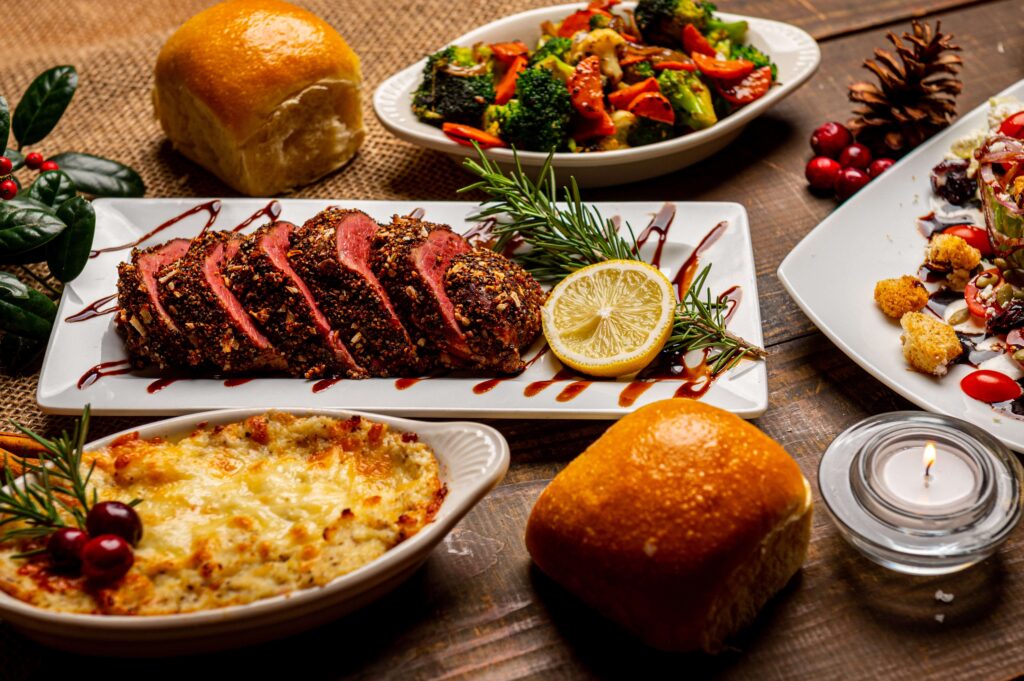
Most families in other countries, such as Spain, Sweden, Ireland, and others, celebrate Christmas on the morning of the 25th. In the Philippines, they celebrate straight after the Christmas Midnight Mass, which is another tradition of how Filipinos celebrate Christmas.
Filipino families celebrate a feast on Christmas Eve called Noche Buena. It’s the time of year when families cook their favorite dishes such as Lechon, Queso De Bola, spaghetti, Morcon, bacon, and fruit salad. You get to spend a lot of time and bond with your family and loved ones over a meal, in addition to filling your belly with delicious food. Read More…


