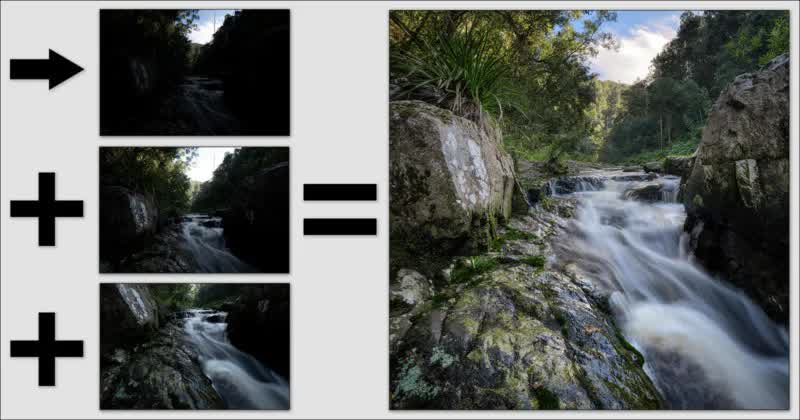
How to Deal with Extreme Dynamic Range in Landscape Photography
-
 Loading...
 - Stjepan Jankovic
- 14 Feb 2023
- 58 Views
- 0 Like
- 0 Comment
No doubt most of us have found ourselves in the following situation… You’ve discovered a beautiful landscape scene that you’ve carefully composed in your camera’s viewfinder. Your camera is on a tripod and there’s no wind, so you’re feeling confident that you’ll be able to capture everything in one shot with both a small aperture and a slow shutter speed. Things are looking great!
But when you check your photos afterward, you realize that they look nothing like what you remember seeing at the time. Either all the bright parts (the sky and clouds) are now completely white, or else the dark bits (all the shadows) are rendered solid black. It’s so infuriating! It doesn’t matter how much we fiddle with our shutter speed, aperture, and/or ISO, our cameras never seem to be able to capture what our eyes can see.
Could any camera ever accurately capture what our eyes and brains are experiencing? We are able to discern details in all the brightest areas of any scene, as well as notice details in all the darkest shadow areas (under most lighting conditions). Our eyes and brains are truly amazing!
Perhaps we’re all experiencing an incorrect perception of reality? Maybe our cameras are all telling the truth and it’s our brains that are deceiving us with an altered sense of what’s real? When we notice the details in a bright sky and then immediately afterwards notice some details in the dark rocks in the foreground – are our brains somehow compensating for the difference in dynamic range, or are we seeing things exactly as they are in reality? Read More…