How virtual reality is taking dementia patients back to the future
-
 Loading...
 - Havel Romero
- 20 Nov 2020
- 1083 Views
- 0 Like
- 0 Comment
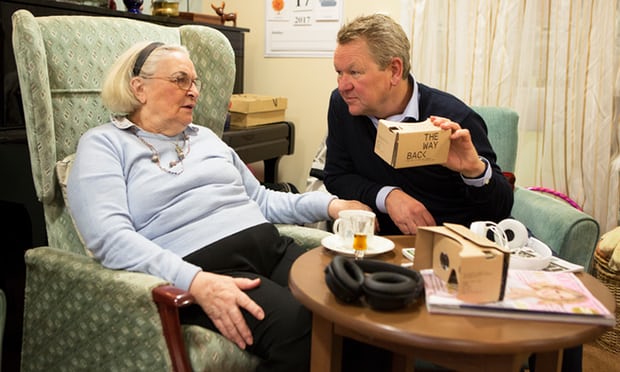
In a comfortable armchair, glass of sherry at her side, Elspeth Ford is getting to grips with her 3D goggles. “Maybe I’ll go another other way now,” she says, looking left, right, up, down. She breaks into a cheery rendition of the Lambeth Walk.
Elspeth, 79, is a resident at Langham Court, a dementia care home in Surrey, and today she is trialling a virtual reality project, Wayback, that has been designed especially for those living with dementia. Peering into her headset, Elspeth is temporarily transported to 2 June 1953, and a street party for the Queen’s coronation. She is enjoying a children’s fancy-dress competition. “I love that boy dressed as an Oxo cube,” she laughs.
This is the first in what will become a series of virtual reality films set at historic moments, and available free for those with dementia, their families and carers to enjoy together through a mobile phone and a pair of inexpensive 3D goggles. The idea was developed by three advertising creatives with family experience of dementia. For Camilla Ford, Elspeth’s daughter, it is an exciting concept. “It gave Mum a huge amount of pleasure and really engaged her,” she says. Anxiety – “about what she is meant to be doing” – often stops Elspeth getting involved in activities. “Dementia is debilitating in so many ways; you always need creative ways to give positive experiences. She was immersed in this and it took her back to a time of happy memories, when she was productive and emotionally fulfilled.”
Elspeth has had vascular dementia for seven years, and finding a point of contact increasingly involves moving to where she is, rather than trying to bring her into the present, says Camilla. “If she is in a place she can identify with, and we can see it too, we are somehow equalised. We are at a stage where we aren’t trying to create memories but to relish positive emotions, dropping the expectation of who Mum was and just being with the person in front of us.”
Elspeth sets off for lunch with her son Dominic, still smiling. It is unlikely, says Camilla, that her mother will remember what has made her feel happy. “The point is that she feels uplifted, not necessarily that she knows why.”
Dan Cole, one of Wayback’s creators, agrees. “If the film can open some memories, start a conversation or bring a smile, that’s a success,” he says. The idea began to form after a drive around Camden, north London, with his father, then in the early stages of Alzheimer’s. “It was his old stomping ground and he kept recognising places and telling me little tales; the pub his dad drank in, where he hung about with his mates, even an alley where he once got into a scrap,” says Dan. “In that fleeting moment it was so clear in his mind. I could ask questions. He could tell me things.”
The effects on his father’s mood, and on Dan’s sense of connection with him, lasted longer. “It was the idea you could move forward by going back, maybe use those memories as a starting point for a shared experience.” The resulting film was made over two days in a north-London street (satellite dishes and other modern trappings digitally removed) with a volunteer cast and crew of 187 and painstakingly sourced period props, costumes and menu (fish-paste sandwiches, notes one Langham Court resident approvingly). Dan’s father, who died three years ago, is among the dedications at the end. The music – beyond the Lambeth Walk – is by Frankie Laine and Guy Mitchell. “My dad’s favourites,” says Dan.
Married couple Ronald and Anne Graham-Clarke are watching the film together. “Oh, this is fun. I feel as if I’m at the party,” says Ronald, 89. Both he and Anne, 84, are chuckling. She taps her foot to the music. Afterwards, Anne tells Sarah Hoare, one of Langham Court’s directors, about watching the coronation at home in Scotland with her parents and sister. “My family bought a TV for the first time to watch it. It was my parents’ wedding anniversary too. It was a great party.”
Anne’s response, says Hoare, is a wonderful example of virtual reality’s potential. “She completely came out of herself because she was relaxed and enjoying herself. I have never actually seen her laugh before.”
Langham Court’s philosophy is based on the Butterfly Household model, devised by Dr David Sheard, a dementia specialist and CEO of Dementia Care Matters, who is supporting Wayback. “People living with dementia become more feeling beings than thinking beings,” he says. “Feelings endure and are more to be trusted when facts diminish.” Facilitating a trip back in time – “to their undamaged longer-term memories” –can, he says, unlock the happy emotions that accompany them. “Wayback offers the opportunity to live in the moment, to go back in time and to just ‘be’ again and to feel validated.”
Reminiscence, using music, photographs, props and role play for instance, is a well-established model of dementia care. Virtual reality, Sheard believes, could provide a useful tool alongside this.
“The biggest risk to someone living with dementia is to lose self-esteem, to feel not connected. Years ago, it was thought to be ethical to remind people of the facts, but how do you put back what is gone from a person’s brain? Eventually activities that tax the brain and short-term memory create stress and ill being.”
The best measure of dementia care, Sheard believes, is wellbeing. “Dementia takes people back to the past as a way to make sense of the now. The feelings generated by an experience can stay for a very long time afterwards.”
Daphne Padfield, 93, is taking her turn with the goggles. “I felt I was really there,” she exclaims, when the film finishes. Did she attend a street party for the coronation, asks Hoare. Daphne’s detailed response is a surprise. “I was actually there,” she says. “My mother, sisters and I had seats on a very good stand. We all had new dresses. They were all dying to tell her about it when we got back to school.” Daphne happily recounts her experiences of the day for some time. “It was such a thrill. I shall never forget,” she says, rather poignantly. “It is forever imprinted in my memory.”


