I met 60 suspects of war crimes committed in Rwanda and Yugoslavia: what they had to say reveal cracks in our international justice system
-
 Loading...
 - Elvin Tuyisenge
- 06 Apr 2023
- 59 Views
- 0 Like
- 0 Comment
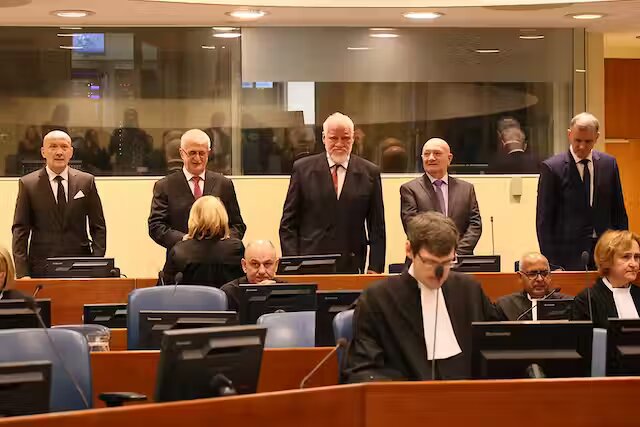
Croat leaders Jadranko Prlic, Bruno Stojic, Slobodan Praljak, Milivoj Petkovic, Valentin Coric and Berislav Pusic stand trial at the Hague in 2013. Creative Commons, CC BY
Since the Nuremberg trials (1945-1946), criminal jurisdictions such as those for the former Yugoslavia and Rwanda have aimed to judge the world’s most serious offenses: war crimes, crimes against humanity, and genocides.
These jurisdictions have inspired substantial legal, anthropological, and sociological analyses. Most of the research carried out has been either through field observations or interviews with victims and professionals. Our research, however, looks at another angle: that of the criminal experience of the accused (whether they have been acquitted or convicted). The aim here is not to understand the criminal act, but the institutional processes that were set up to respond to it.
Epistemology of a singular research
We have therefore conducted interviews with sixty people tried by the International Criminal Tribunal for the former Yugoslavia (ICTY) or the International Criminal Tribunal for Rwanda (ICTR) – a number no other journalist or researcher had until now been able to access – to learn about their justice experience. All interviews were conducted under conditions of anonymity, and most took place in the prisons where the convicted persons were held.
The idea of meeting people commonly referred to as genocidaires or war criminals is based on the teaching of the French philosopher Paul Ricœur. In a 1992 article published in the magazine Esprit, he explains:
“The act of judging has reached its goal when the person who has, so to speak, won their case still feels able to say: my opponent, the one who lost, remains like me a subject of law: their cause deserved to be heard; their arguments were plausible, and they were heard. But recognition would only be complete if [the same] could be said by the condemned person; they should be able to declare that the sentence against them was not an act of violence but of recognition.”
The study of international criminal justice is also guided by such questions. Indeed, it has a range of objectives: retribution, deterrence, and reintegration, but also the writing of history or memory, the satisfaction of victims, or cathartic release.
Such aims require that the suspects can be reached or, at the very least, approached. As we shall see, international criminal jurisdictions have not managed to enrol the perpetrators of crime into their view of justice like they have done with other war protagonists. Read More…