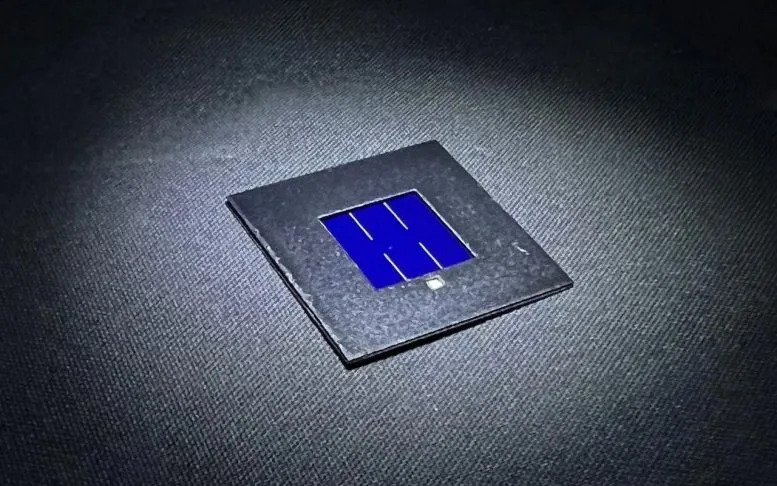
Innovative Technology Offers Big Performance Boost to Perovskite–Silicon Tandem Solar Cells
-
 Loading...
 - Nikhil Jha
- 08 Aug 2022
- 81 Views
- 0 Like
- 0 Comment
An extra metal fluoride layer enables charge separation and boosts performance in perovskite–silicon tandem solar cells.
Inserting a metal fluoride layer in multilayered perovskite–silicon tandem solar cells can stall charge recombination and enhance performance, King Abdullah University of Science & Technology (KAUST) researchers have found.
Tandem solar cells that combine perovskite and silicon-based subcells in one device are expected to better capture and convert sunlight into electricity than their conventional single-junction silicon competitors. And they are anticipated to do so at a lower cost. However, when sunlight strikes the perovskite subcell, the resulting pairs of electrons and positively charged holes tend to recombine at the interface between perovskite and the electron-transport layer. Additionally, a mismatch between energy levels at this interface hinders electron separation within the cell. These issues together reduce the tandem cells’ open-circuit voltage, or maximum operating voltage, which restricts device performance.
By adding a layer of lithium fluoride between the perovskite and the electron-transport layer, which typically comprises the electron-acceptor fullerene (C60), these performance concerns may be partly resolved. However, the devices become unstable because lithium salts easily liquefy and diffuse through surfaces. Lead author Jiang Liu, a postdoc in Stefaan De Wolf’s group, states, “None of the devices have passed the standard test protocols of the International Electrotechnical Commission, prompting us to create an alternative.”
Liu, De Wolf, and colleagues systematically investigated the potential of other metal fluorides, such as magnesium fluoride, as interlayer materials at the perovskite/C60 interface of tandem cells. They thermally evaporated the metal fluorides on the perovskite layer to form an ultrathin uniform film with controlled thickness before adding C60 and top contact components. The interlayers are also highly transparent and stable, in line with the inverted p-i-n solar cell requirements. Read More...