Is It an Artificial Paradise or an Artificial Hell or Both?
-
 Loading...
 - Antar Bennani
- 14 Apr 2022
- 313 Views
- 0 Like
- 0 Comment
Over the past 30-plus years, Elliott Green has defined a path in painting and drawing that is unlike any other. For that alone you might think that he would be better known, but this would mean the art world has turned its back on branding, signature styles, and dependability — capitalist mainstays — in favor of change, the unexpected, and the uncanny. Between 1989 and 2009, he depicted human and animal figures with rubbery, infinitely stretchable limbs engaged in unnamable interactions, at once sexual, scatological, inexplicable, and sinister. The fantasies were unsettling because they required viewers to complete them, thus partially exposing their own awareness of the links between insecurity and aggression. In these years, Green evoked an alternative world populated by humans and animals that possessed amazing contortionist powers. In retrospect, what is striking about this body of work is that he never developed a signature motif, alter ego, or caricature. He did not brand himself.
Whatever trajectory Green seemed to be defining changed when he stopped exhibiting for nearly a decade (2009-17). Among the events that precipitated this change were moving out of Manhattan and receiving the 2011 Jules Guerin Rome Prize at the American Academy (strongly supported by Thomas Nozkowski, an independent artist who remains under-recognized). During this period of reevaluation, he changed both the methods he used to apply paint and his subject matter. He went from cartoonish imagery to landscape paintings, as well as made a series of tools that enabled him to apply moire patterns and other repetitive markings to his compositions. And yet, despite this radical shift, one constant connecting these two disparate bodies of work is that Green remains preoccupied with evoking an alternate world.

I became aware of Green’s new direction when I saw his works in the 2015 Invitational Exhibition of Visual Arts hosted by the American Academy of Arts and Letters (March 12–April 12, 2015), and in Objecty, a group show at Tibor de Nagy (June 22–July 29, 2016), in which I believe Green was included because of Trevor Winkfield, also an independent under-recognized artist. This is how I described the work in the Academy exhibition:
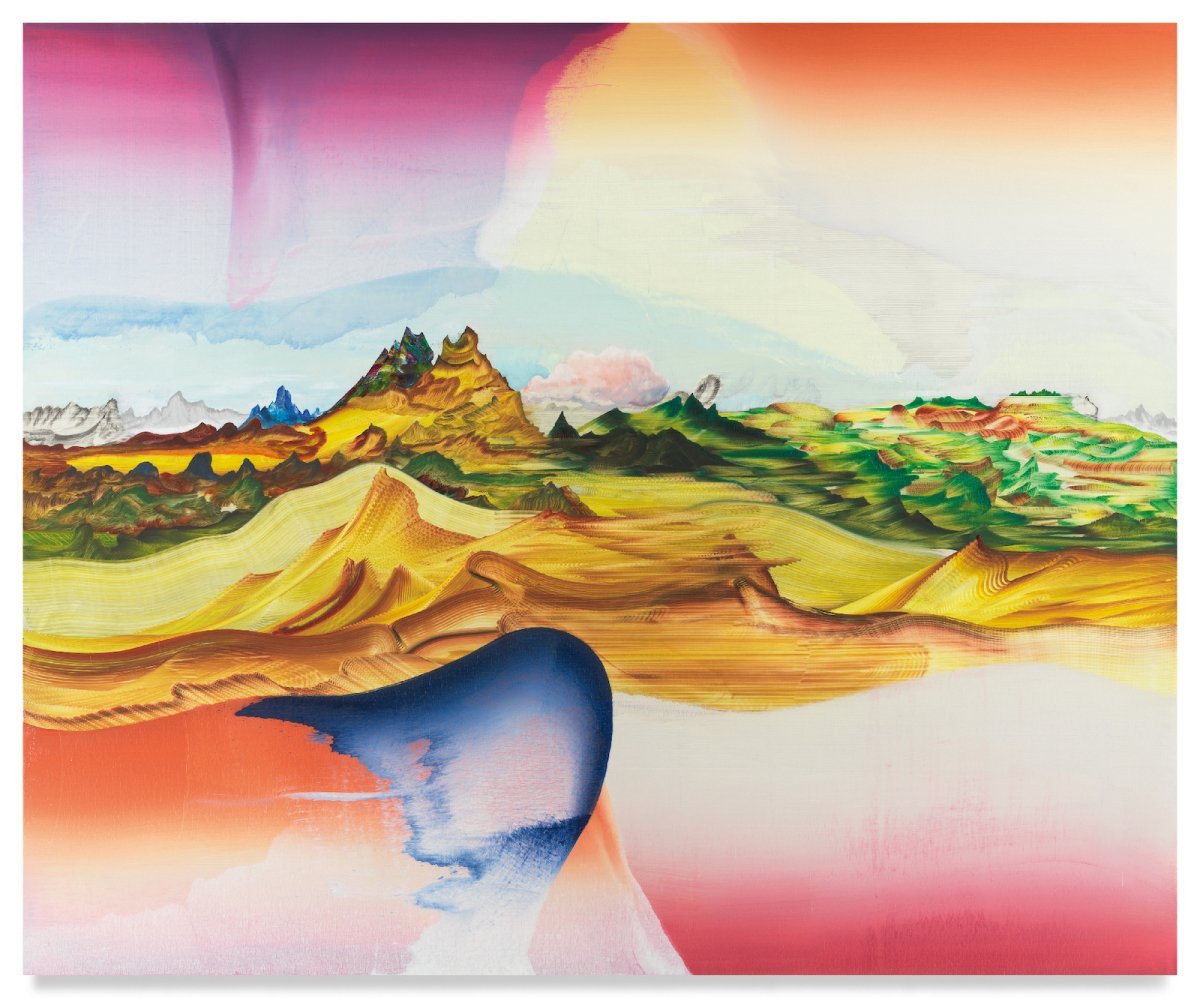
He combined ravishing brushwork with mysterious, Xanadu-like landscapes that emerged, radiant, out of the undulating applications of paint. Rainbows, clouds, jagged mountains, verdant hills, pastoral lakes, and, most importantly, changing light in a panoramic view — it was all there and it was just paint.
This is why I saw Elliott Green, his debut exhibition at Miles McEnery Gallery (March 17-April 23), on its first day and then returned after two trips took me out town; for many reasons I wanted to look again and more slowly. Green’s paintings are not fast. You don’t get the gist of them in one take, which is interesting because he adheres to the classical landscape format of dividing a horizontal picture plane into three stacked areas; this is how landscapes were transposed to two-dimensional surfaces starting early in oil painting’s history.

In the recent work, Green has upped the stakes for himself in his color choices, incorporating pinks and violets, and his willingness to combine the decipherable and indecipherable, all while hewing to the classic tripartite division of a rectangle into foreground, middle ground, and background, a combination routinely given a stable framework — the earth we stand upon, the landscape in front of us, the sky above. As Green employs the three-part compositions, he subverts different aspects of them and their interrelationships. His trust in the viewer is implicit in this, which runs counter to many artists. Where are we when we look at “Shout” or “Friends of Friends” (both 2021)? Are we standing on a cloud or floating in the air or on water? And yet, even as that sense of instability comes into our experience, the large paintings pull us into a radiant world in which not everything can be named or understood. There is a fundamental difference between landscape artists who believe that seeing is ownership and those who recognize that they will always be strangers in this or any world they visit. Read More...