Is the EU deal with Israel and Egypt a way out from Russian gas?
-
 Loading...
 - Lara Vossen
- 21 Jun 2022
- 237 Views
- 0 Like
- 0 Comment
When the European Commission chief Ursula von der Leyen signed an agreement to ship gas from Israel through Egypt to the European Union, she clearly wanted it to be seen as a big achievement.
At the ceremony, held at a five-star hotel in Cairo on Wednesday, von der Leyen hailed the deal as a “historic step” away from Russian energy and towards a “green transition”.
“We reaffirm our joint commitment and determination to accelerate the just energy transition and develop a resource-efficient, socially just and low emissions and climate neutral economy,” she said at a joint news conference with Egyptian President Abdel Fattah el-Sisi.
The memorandum of understanding concerning the delivery of natural gas through Egypt, where the gas will be liquefied before being shipped to Europe, would put “an end to [the bloc’s] dependence on Russian fossil fuels” as it seeks to distance itself following the invasion of Ukraine, according to von der Leyen.
However, her words have been met with scepticism by organisations monitoring the EU’s energy policy and transition towards green energy. They claim the agreement will do little to grant independence from problematic governments or promote an environmentally and socially sound energy transition.
Breaking away from Russian dependency
Brussels has been seeking to diversify its energy supplies after importing roughly 40 percent of its gas from Moscow last year. Russian companies have turned off supplies to several “unfriendly” countries that refused to accept Moscow’s roubles-for-gas payment scheme, sending EU states scrambling for alternatives.
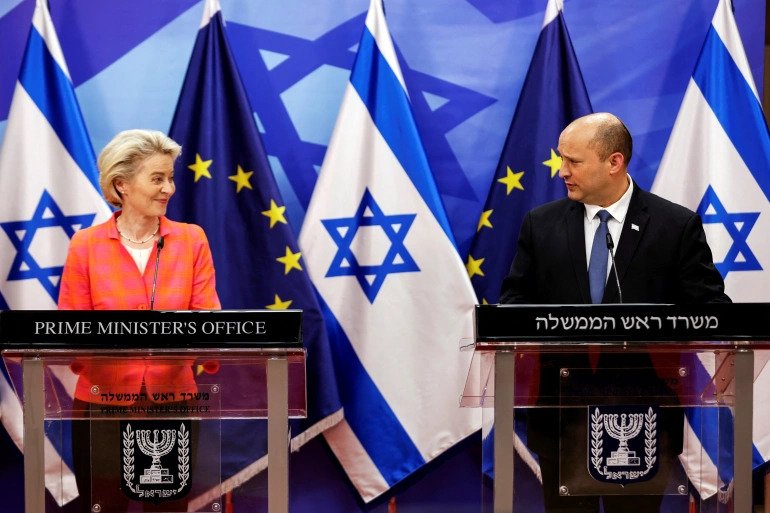
On a visit to Israel on Tuesday, von der Leyen said Russia’s “attempt to blackmail us through energy” had led the EU to turn to “trustworthy suppliers”.
“I am very grateful … that you are willing to increase the deliveries of gas to the European Union via Egypt,” she said, addressing Prime Minister Naftali Bennett.
Not everyone agrees with the EU’s thought process on the deal, however.
“The European Union is shifting from one repressive regime to two more,” Pascoe Sabido, researcher and campaigner at the Corporate Europe Observatory, told Al Jazeera. “It is putting the priority of getting gas over human rights.”
Cairo and Tel Aviv are accused of grave human rights violations and war crimes.
Egyptian President el-Sisi has drawn criticism from Western countries for the prosecution of activists, journalists and perceived political opponents under “counterterrorism” laws. The Israeli military has been accused of human rights violations for decades, including military assaults on the blockaded Gaza Strip, the continued illegal occupation of East Jerusalem and the West Bank, and the recent killing of Al Jazeera journalist Shireen Abu Akleh.
According to Sabido, gas exports will grant both governments greater political leverage and room for the “whitewashing of human rights abuses”.
“The money [from gas] is going to be spent on increasing militarisation, increasing settlements … Whilst the EU might be claiming to move away from Russia, it is doing so at the expense of Palestinians,” Sabido said.
An increase in gas exports from Israel to Europe will also require Tel Aviv to explore its natural gas fields to find commercially viable quantities of gas. On May 30, Karine Elharrar, the Israeli energy minister, tweeted that Israel was engaging “in efforts to assist Europe” by “embarking on the fourth Israeli natural gas exploration”.
The push for gas could further heat up the dispute between Israel and Lebanon over a disputed maritime area of about 850 square kilometres (328 square miles).
Israel has set up a gas rig at the Karish field, which Tel Aviv says is part of its United Nations-recognised exclusive economic zone, while Beirut says it is in a disputed area.
Green transition
In Cairo, von der Leyen said the memorandum of understanding tapped “into the full potential of EU-Egypt relations, by putting the clean energy transition and the fight against climate change at the heart of our partnership”.
“The cooperation will have a particular focus on renewable energy sources, hydrogen, and energy efficiency,” she told reporters.
The agreement recognises that natural gas will have a central role in the EU’s energy market until 2030. Following that, the use of natural gas is expected to decline in line with its commitment to becoming a zero-emission economy by 2050.
Organisations including Friends of the Earth and Food & Water Action Europe have cautioned against letting short-term energy supply concerns lock Europe into longer-term, costly deals that take years to become operational.
“We are highly concerned with any gas plans that are locking the EU on fossil fuel dependency for the years to come, and this is what this deal is actually doing,” Frida Kieninger, director of EU affairs at Food & Water Action Europe, told Al Jazeera.
The memorandum mentioned the EastMed pipeline – a complex project costing an estimated 5.2 billion euros ($5.4bn) along with annual maintenance costs – as one of the options to bring gas to Europe. But the United States earlier this year pulled its support for the planned 1,900km (1,181-mile) pipeline after saying the project would take too long to build and be too costly to be viable.
Von der Leyen’s claim that the pipeline will “hopefully one day [be a] hydrogen-ready pipeline” runs counter to the expert opinion that sees turning an LNG import terminal into a hydrogen-receiving terminal as a near-impossible task, according to reports by Food & Water Action Europe. Read More...