Keeping Food on the Table in a Warming World: Bolstering Plant Immunity Against the Heat

Climate change is making plants more susceptible to disease. New research could help them fight back.
When heat waves strike, they don’t just take a toll on people — plants that we depend on for food suffer too. This is because when temperatures get too high, certain plant defenses don’t work very well, leaving them more vulnerable to attacks from pathogens and insect pests.
Now, researchers say they have identified a specific protein in plant cells that explains why immunity falters as temperatures rise. They’ve also discovered a way to reverse the loss and strengthen plant defenses against the heat.
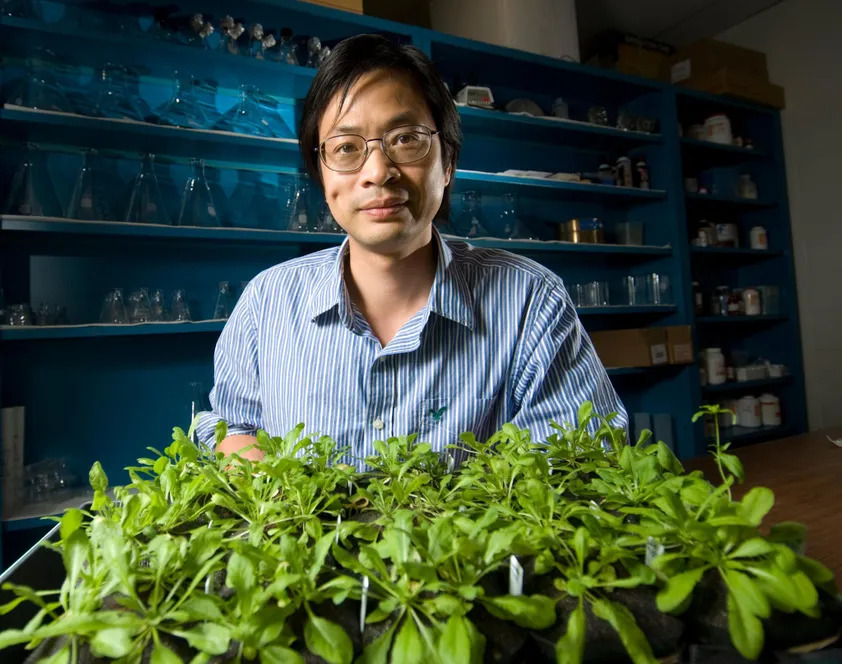
The findings, which will be published today in the journal Nature, were discovered in a spindly plant with white flowers called Arabidopsis thaliana, which is the “lab rat” of plant research. If the same results hold up in crops, it would be welcome news for food security in a warming world, said biologist and corresponding author Sheng-Yang.
Scientists have known for decades that above-normal temperatures suppress a plant’s ability to make salicylic acid, a defense hormone that fires up the plant’s immune system and stops invaders before they cause too much damage. However, the molecular basis of this immunity meltdown wasn’t well understood.
In the mid 2010s, He and his then-graduate student Bethany Huot found that even brief heat waves can have a dramatic effect on hormone defenses in Arabidopsis plants, leaving them more prone to infection by a bacterium called Pseudomonas syringae.
Normally when this pathogen attacks, the levels of salicylic acid in a plant’s leaves go up 7-fold to keep bacteria from spreading. But when temperatures rise above 86 degrees for just two days — not even triple digits — plants can no longer make enough defense hormone to keep infection from taking hold.
“Plants get a lot more infections at warm temperatures because their level of basal immunity is down,” He said. “So we wanted to know, how do plants feel the heat? And can we actually fix it to make plants heat-resilient?”
Around the same time, a different team had found that molecules in plant cells called phytochromes function as internal thermometers, helping plants sense warmer temperatures in the spring and activate growth and flowering.
So He and his colleagues wondered: could these same heat-sensing molecules be what’s knocking down the immune system when things warm up, and be the key to bringing it back?
To find out, the researchers took normal plants and mutant plants whose phytochromes were always active regardless of temperature, infected them with P. syringae bacteria, and grew them at 73 and 82 degrees to see how they did. But the phytochrome mutants fared exactly like normal plants: they still couldn’t make enough salicylic acid when temperatures rose to fend off infections.
Co-first authors Danve Castroverde and Jonghum Kim spent several years doing similar experiments with other gene suspects, and those mutant plants got sick during warm spells too. So they tried a different strategy. Using next-generation sequencing, they compared gene readouts in infected Arabidopsis plants at normal and elevated temperatures. It turned out that many of the genes that were suppressed at elevated temperatures were regulated by the same molecule, a gene called CBP60g.
The CBP60g gene acts like a master switch that controls other genes, so anything that downregulates or “turns off” CBP60g means lots of other genes are turned off, too — they don’t make the proteins that enable a plant cell to build up salicylic acid. Read More...