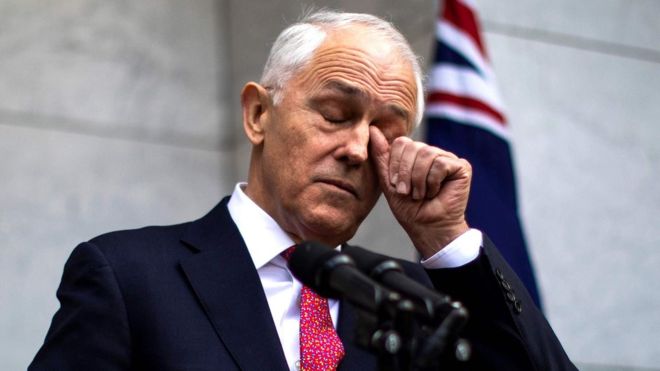
Malcolm Turnbull: PM loses ministers in leadership battle
-
 Loading...
 - Oscar Filipe
- 21 Aug 2021
- 1138 Views
- 0 Like
- 0 Comment
Ten government ministers in Australia have offered to resign following a failed bid to oust Prime Minister Malcolm Turnbull as party leader.
Mr Turnbull narrowly survived a vote against a senior government colleague on Tuesday, but is now likely to face a second leadership challenge.
He has accepted the resignation of only two ministers including the challenger, Home Affairs Minister Peter Dutton.
The division in the ruling party has thrown national politics into upheaval.
The prime minister has been under pressure following a by-election loss in Queensland and poor results in polls. Australia is due to hold its next election before May next year.
The opposition Labor party has accused the government of being in "chaos".
Mr Dutton has said he is still actively campaigning for the leadership and has lobbied other MPs for their support in a second vote.
"You do not go into a ballot believing that you can lose and if I believe that a majority of colleagues support me then I would consider my position," he told radio station 3AW.
'The country is not governed'
Mr Turnbull initiated the first vote among cabinet members on Tuesday in an attempt to end growing speculation about his position as leader of the Liberal party. He won by a margin of just 13 votes.
"The iron laws of arithmetic confirmed my leadership," he told reporters on Wednesday when asked about his future.
He has also abandoned a policy to set an emissions reduction target in law, in an attempt to ward off party conflict.
Mr Turnbull confirmed he had asked eight ministers to stay on in his ministry despite their offers to stand down.
Along with Mr Dutton's resignation, he also let go the International Development Minister Concetta Fierravanti-Wells.
Speaking to reporters on Wednesday, Mr Turnbull said: "What I'm endeavouring to do is to obviously ensure that the party is stable, to maintain the stability of the government of Australia."
Many Australians online have responded to the battle in Canberra with a sense of frustration and dismay.
The Labor opposition, which tried to move a motion of no confidence against the prime minister in parliament on Tuesday, has called the situation chaotic.
"While chaos reigns, the country is not governed," Deputy Opposition Leader Tanya Plibersek said.
Under the Australian system, as in the UK, the prime minister is not directly elected by voters but is the leader of the party or coalition that can command a majority in parliament.
Over the past decade, Australian politics has been marked by a series of leadership coups, with three sitting prime ministers deposed by party rivals within their first terms.