MCA San Diego's $105 M. Expansion Is An Odd, But Often Stunning Attempt To Create A ‘More Inclusive' Museum
-
 Loading...
 - Carmen Espina
- 14 Apr 2022
- 305 Views
- 0 Like
- 0 Comment
After a four-year wait and a $105 million expansion, the Museum of Contemporary Art San Diego’s reopening is a study in the changing shape of institutions.
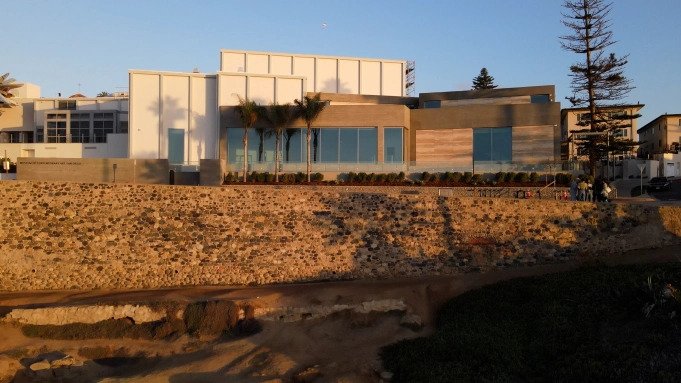
Overlooking the Pacific Ocean in the seaside neighborhood of La Jolla, the newly renovated complex is essentially two different buildings joined at the hip.
On the right, you’ll find a composite of white-stuccoed boxes, punctuated by curved windows that riff on the surrounding buildings’ Mediterranean-inspired archways. The first box was designed by celebrated modernist Irving Gill in 1916, and in later decades, more boxes were added by architects Mosher & Drew and Venturi Scott Brown & Associates (VSBA).
On the left, meanwhile, architect Annabelle Selldorf’s new expansion is roughly the same scale, but totally distinct in materiality. In lieu of stucco and curves, she chose a palette of glass walls, sandy-colored travertine, and aluminum beams joined at right angles.
All museum expansions, in a sense, are a type of rebranding, where new architecture coincides with a new public image. The two buildings’ odd union is emblematic of both the museum’s and the architect’s task: to align contemporary culture with a canonical history.
“The goal of this project was to create a more inviting and inclusive museum with a greater connection to the community,” the architect said at the ribbon-cutting ceremony last Tuesday.

“A museum can feel somewhat hard for people to enter in the first place, and then we hid the entrance,” MCASD Board Chair Paul Jacobs explained in his remarks.
Despite the outcry from Venturi Scott Brown fans, Selldorf replaced the columns with an entrance that, she said, “represents a true welcome for everyone.”Its glass walls are unobscured by a column-less aluminum brise-soleil, and the ticket counter is always visible from the outside. She and her team added 46,400 square feet of new build, effectively doubling the museum’s footprint while quadrupling its exhibition space. Skirting height restrictions on new construction, the existing auditorium was repurposed as a 20-foot-tall, 7,000-square-foot gallery.
“If this isn’t museum sized, I don’t know what is,” Selldorf said as she led a tour of the building.
A Building With Views To Match The Art

A favorite of gallerists David Zwirner, Hauser & Wirth, and other high-profile members of the art world, Selldorf Architects operates with what’s best described as an elegant pragmatism.
The MCASD’s new galleries possess clear circulation paths and a minimalist’s grandeur, where natural light fills generously proportioned, open spaces. Tall, thin windows frame exterior landmarks — individual palm trees, bell towers, and towering pines — alongside top-notch examples from the museum’s collection.
Roughly organized by era, there’s a triangular gallery of Color Field painters including Rothko, Morris, and Motherwell, and an enormous trapezoidal gallery for Light and Space artists like Larry Bell and Peter Alexander. (Most galleries are normal rectangles, but these were pinched where the new construction connected to the old.)Rather than construct a new traditional auditorium, Selldorf added a more current “flexible events space,” a hallmark of contemporary museum architecture that provides a blank slate for more varied public programming. Here, that includes a luxurious floor-to-ceiling view of the ocean.
The museum’s new luxurious Big Little Lies-esque views are not in fact “distractions from the art, but complementary,” Selldorf said twice during the museum preview, perhaps anticipating criticism.“For all of you who live here, the incredible light of Southern California and the incredible view of the Pacific Ocean is something you may take for granted,” the New York-based architect said. “We were thrilled to make it part and parcel of the experience. I think it will contribute to you remembering where you are, and what you have seen.”
For the most part, the historically relevant architecture of the original building was left untouched, providing an interesting side-by-side study of how much the shape and culture of museums has changed. The interior has no demarcations between the old and new, though there is a distinct sensation of entering another era in the original space, a time when museums were perhaps considered less destinations than rarified containers for art.On this older side, the relatively low-slung, windowless galleries with gray-and-white terrazzo floors form a warren that’s decidedly confusing to navigate. And the original VSBA lobby, still adorned on the ceiling with the architects’ metal-and-neon fins, is intact, but will likely be challenging to program. It still reads very much like a lobby, only without an entrance.
The MCASD Is Adopting Curatorial Changes To Match The New Architecture

The museum approached Selldorf Architects in 2014 seeking “a new architecture” that would “reach our full potential as a community resource for culture and education,” Kathryn Kanjo, MCASD’s director and CEO, said during her walkthrough of the building. Read More...