Mexican composers highlighted at Hop Symposium
-
 Loading...
 - Max Schneider
- 01 Jul 2022
- 131 Views
- 0 Like
- 0 Comment
On May 26 and 27, the Hopkins Center for the Arts hosted the Music Mexico Symposium, an interdisciplinary event that showcased the past, present and future of Mexican repertoire. The symposium included presentations, discussions and performances intended to highlight the diverse history of Mexican musical traditions.
“We wanted to do a conference where we could bridge the gaps between Mexico, Canada and the United States and bring together our art because art really does transcend borders,” Karina Sainz, associate producer at the Hop and one of the event’s producers, said. “We’ve got people coming from Mexico, from Texas, from the Bay Area, from Philadelphia, that all have the same thought of uplifting these Mexican composers that are here.”
Symposium attendees were greeted the evening of May 26 with a welcome reception followed by the Mexican Chamber Music Concert. The concert borrowed both new and classic works from the repertoire of Mexican chamber music, including pieces by Carlos Chávez — founder of the Mexican Symphonic Orchestra — and Manuel Ponce — widely considered to be the father of Mexican classical music.
The following day, attendees enjoyed a day of discussions and activities, culminating in a public talk on musical diplomacy with a panel featuring three Mexican composers: Juan Pablo Contreras, Nubia Jaime Donjuan and Rodrigo Martínez Torres. The event was hosted by Sixto Montesinos Jr., assistant professor of music and head of instrumental studies at Saint Mary’s College of California.
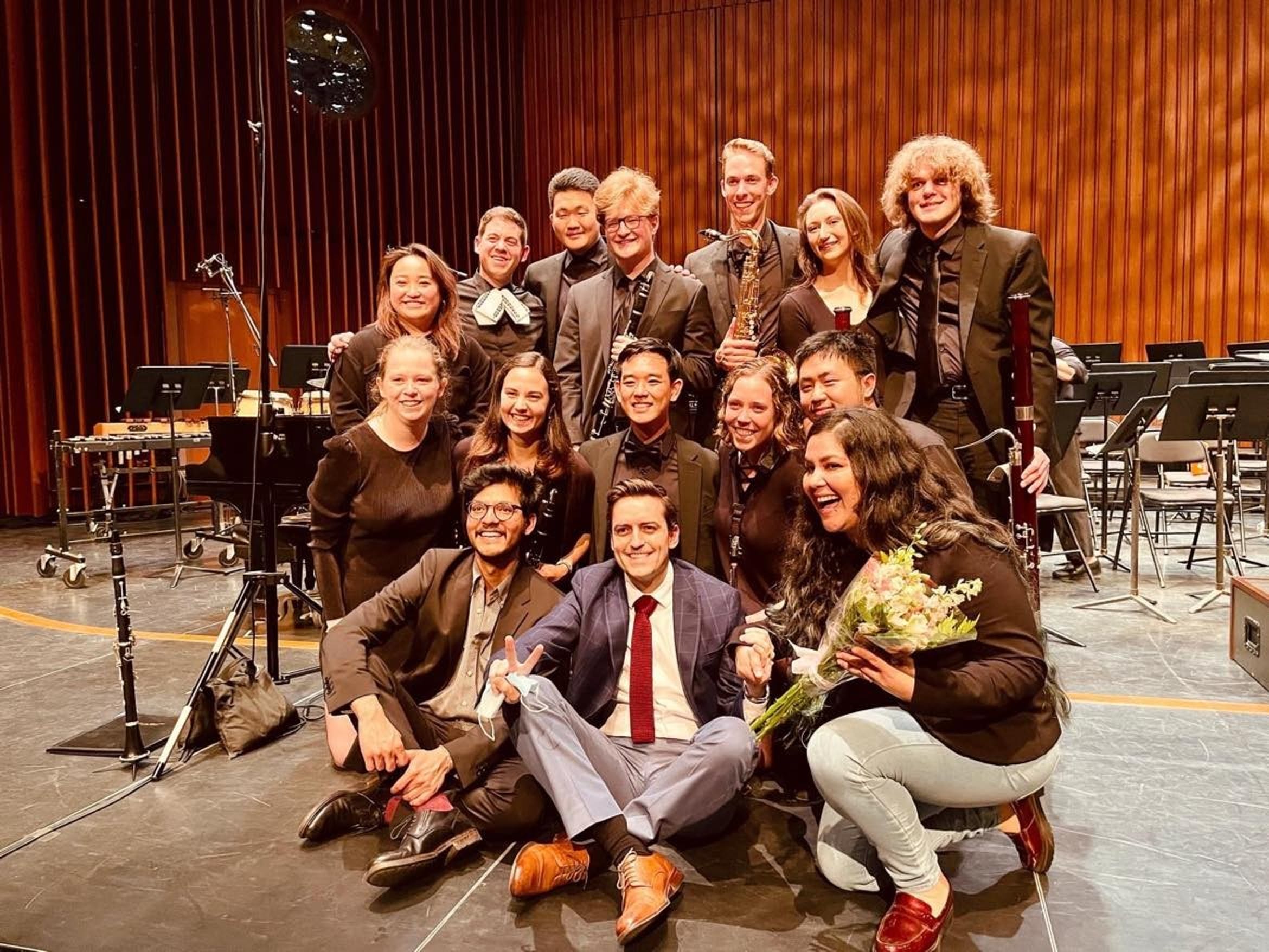
The Dartmouth College Wind Ensemble Spring Concert rounded out the symposium with a performance in Spaulding Auditorium later that night, highlighting pieces by a host of Mexican composers, including Contreas, Donjuan and Martínez Torres.
Sainz, who is Mexican-American, said she was able to sit in on a rehearsal for the Wind Ensemble earlier in the week.
“In symphonies, typically, the percussion is super light and then they do this buildup, but not necessarily in [these Mexican Compositions],” she said. “We are bold, we are loud.”
Sainz added that it was interesting to hear the critiques that the visiting composers had for the ensemble, gently pushing the students to make stronger sounds — to crash their cymbals even louder.
For Karsten Kleyensteuber ’23, who plays trumpet in the wind ensemble, being able to interact with some of the composers during rehearsal was a rewarding experience.
“Having [the composers] there and getting their feedback on stylistic choices, or what their intentions were when they were writing the piece, is really nice to have because we can be more honest to what the composer was intending, especially when premiering a work,” he said.
Kleyensteuber noted that the compositions were the most advanced that the ensemble had done since he joined his freshman year, and that the experience was overwhelmingly a positive one.
“From a musical perspective, [the show] was really rewarding to play. I think as a group, we grew through it and it was very enriching to immerse ourselves in this canon of Mexican music,” he said.
According to both Sainz and Dartmouth director of bands Brian Messier, who also produced the event, the symposium was an idea years in the making and was sparked before Messier was even working in his current role at the College.
In 2018, Messier was working with a different group that coincidentally had a concert scheduled for May 5, or the Mexican holiday Cinco de Mayo — which commemorates the anniversary of Mexico’s victory over France at the Battle of Puebla in 1862. At a time of political divide, when “the potential border wall was in the news,” Messier was inspired to research Mexican composers for the concert.
“I started looking into, if I’m going to do a concert on May 5, what could I program that would be authentic — that would actually be by Mexican composers,” he said. “And I found that there really was not anything [available].”
When these findings were corroborated by Mexican composers and conductors, Messier began commissioning them to compose authentic Mexican pieces. Read More...