Morrison goes all in on national security, while Albanese speaks from COVID isolation
-
 Loading...
 - Mary Campbell
- 22 Apr 2022
- 316 Views
- 0 Like
- 0 Comment
We are about to see a supreme test of one of Australian politics' great orthodoxies.
Since time immemorial, mainstream federal political campaigners have worked on the basis that the Coalition does better when the argument's about what used to be termed "daddy issues" — defence, security, economic management, keeping boats out, having views on whether an electric vehicle can pull a caravan, and so on.
Whereas Labor does better when the debate turns to health, education, aged care, environment – the "mummy issues" that we feel prepared to think about once we've established that the money's not running out, and there aren't barbarians kicking the door in.
It sounds stupid and reductionist, but it's a pretty central assumption that still drives campaign decisions.
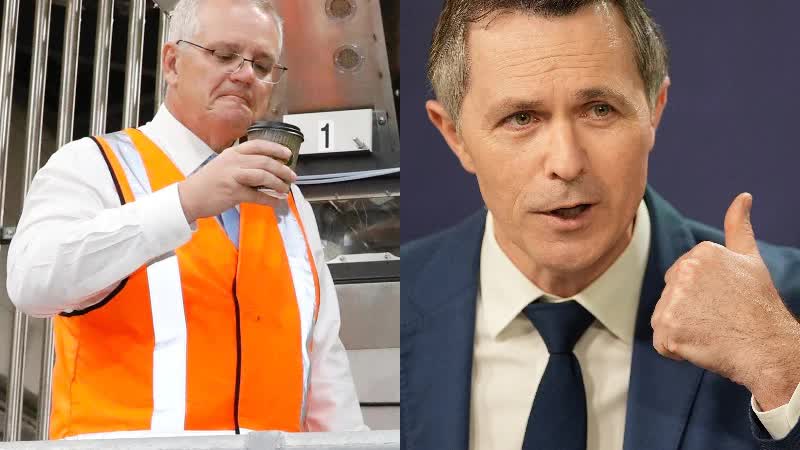
How do we know that Scott Morrison subscribes? Because he's been talking about national security all week, despite the fact that the major — some would say only — significant event of the campaign so far has involves a fairly acute pantsing of his government in this precise area.
This morning, Morrison zeroed in on deputy Labor leader Richard Marles, claiming Marles is soft on China. Now, this is a fairly front-foot sort of a move from the leader of a government whose work in this area includes the accidental leasing of the Port of Darwin to China and the establishment this week of a Chinese base in Solomon Islands, a development that Mr Morrison is additionally accused of deputising Pacific Minister Zed Seselja to prevent, rather than going to Honiara himself. (It's taken a few years, but Scott Morrison is now officially in trouble for NOT zooming to a tropical location in a time of national crisis)
Morrison is still talking about national security because he believes that if the story's about national security, it works for him no matter what the actual story is. (Obviously, to be fair, he's also talking about it because it's important, but so are plenty of other issues that aren't scoring a mention.)
National security is the new neutral — it goes with every kind of election announcement, as witnessed today when even the PM's health announcement was specifically for veterans, an announcement he made in Brisbane.
Will it work this time?
It's an approach which has borne fruit in the past.
In the 2001 election campaign, for example, right in the maelstrom of September 11 and the Howard Government's hard-line decision to turn away Afghan refugees who were fleeing our shared enemy in the Taliban, the story broke that government ministers had actively misled voters by claiming that refugees on boats were throwing their kids overboard.
It didn't harm the government electorally — not one bit. As long as the front pages were about boats and borders, it was helpful to John Howard, no matter the detail.
Will the orthodoxy hold this time? Do people still think broadly that the Coalition is better at Daddy stuff, and Labor at Mummy stuff? This was covered in a Newspoll last month, in which respondents were asked which leader they thought was better at handling the China threat. Morrison was favoured by 33 per cent, Albanese by 26 per cent (the rest either didn't know, or didn't think there would be much difference).
Something interesting happened along gender lines, though. The women questioned were noticeably less likely than the men to plump for either leader. They were much more likely to say they didn't know (26 per cent, compared with just 13 per cent of men who were undecided).
Where will undecided women land? It's one of the big questions of this campaign. Some research conducted over the past seven days by the strategic communications agency 89 Degrees East found that 55 per cent of women are still undecided on how to vote, compared with 48 per cent of men. The under-30s are even more undecided — 62 per cent.
And Anthony Albanese's historic decision to launch his campaign in Perth makes a lot more sense when you consider 89 Degrees East's finding that a huge 63 per cent of WA voters are yet to make up their minds.
How worried are voters?
Where does national security rank among voter's concerns? Emily Baker has analysed the nearly 600,000 responses that have come in so far for the ABC's Vote Compass project, and it turns out that climate change is the runaway number one concern of respondents, with cost-of-living a tie for distant second. National security was eighth on the list.
But here again, the gender division was readily apparent. Twenty-nine per cent of respondents nominated climate as the most important issue, but women felt that way much more strongly (35 per cent) than men (23 per cent).
Among men, 17 per cent nominated the economy, but only 8 per cent of women did. And defence was thought most important by 6 per cent of men, but only 3 per cent of women.
Scott Morrison's put his money on hard hats, khaki, construction and cheaper petrol to get him across the line in Election 2022. Will female voters back him in?
If you want a close look at how these issues work in the marginal seat of Solomon, take a visit with Jane Bardon.
Opposition Leader Anthony Albanese on how he’s coping after contracting COVID
Meanwhile, in the COVID ward
Looks like Anthony Albanese should just be able to sneak in to WA in time to become the first major party leader to launch their federal election campaign in Perth.
The launch is scheduled for next Sunday. Local Premier Mark McGowan has loyally also gone down with the spicy cough, just hours after Albanese, and he too should be clear by Sunday week.
And we saw proof of life today, with Albanese appearing on the ABC News Channel's Afternoon Briefing today.
What does it all mean for the campaign? Brett Worthington explains. Read More...