New research sheds light on quasar formation
-
 Loading...
 - Sophie Bakker
- 13 Aug 2024
- 52 Views
- 0 Like
- 0 Comment
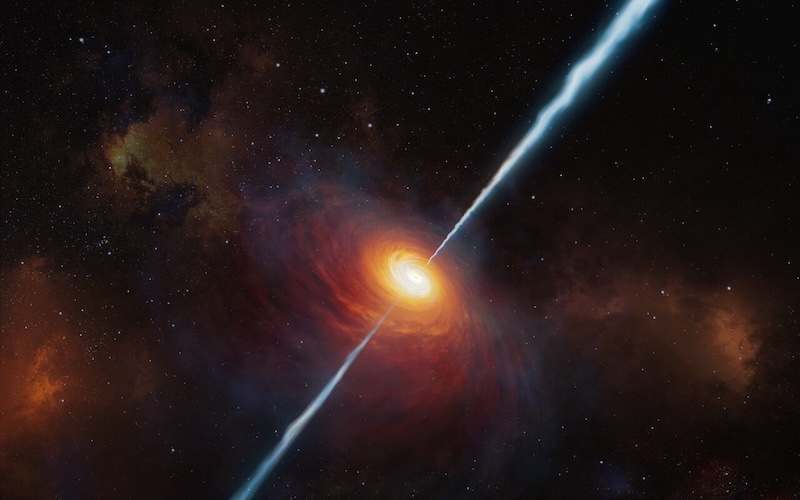
Recent research has provided new insights into quasar formation, revealing that these incredibly bright and distant objects are more complex than previously thought. Two significant studies have made strides in understanding the conditions under which quasars form and how they interact with their environments.
One study, found that some quasars are obscured not just by the dust and gas near their central black holes, but by the entire host galaxy itself. These quasars are often located in compact, "starburst" galaxies, where rapid star formation leads to dense clouds of gas and dust. In these cases, the surrounding galaxy can completely hide the quasar, even from X-rays, which challenges the previous assumption that only a dusty torus near the black hole could obscure these objects. This discovery suggests that obscured quasars may represent an early evolutionary stage in the life of a galaxy, offering a new perspective on the relationship between galaxy formation and black hole growth.
Another breakthrough involves the observation of the brightest quasar detected in the last 9 billion years, known as J1144. This quasar, located relatively close to Earth (about 9.6 billion light years away), provides an unprecedented opportunity to study the extreme conditions around a supermassive black hole. Researchers found that J1144's X-ray emissions varied on a very short timescale, which is unusual for quasars with such massive black holes. This variability, along with the quasar's intense luminosity, offers new clues about the complex processes occurring in the environments surrounding these cosmic giants.
These findings highlight the diverse mechanisms at play in quasar formation and evolution, deepening our understanding of these enigmatic objects.