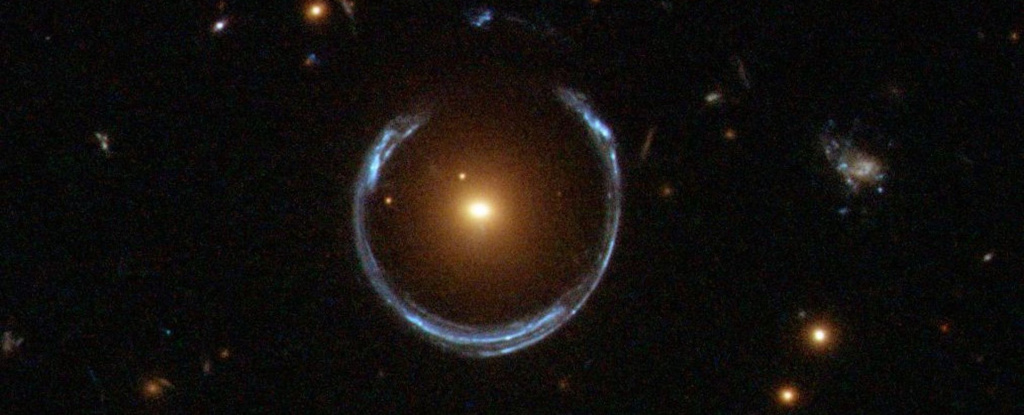
New Study of Einstein Rings Says Dark Matter Behaves More Like a Wave, Not a Particle
-
 Loading...
 - Rohkhaya Cisse
- 24 Apr 2023
- 63 Views
- 0 Like
- 0 Comment
Physicists believe most of the matter in the Universe is made up of an invisible substance that we only know about by its indirect effects on the stars and galaxies we can see.
We're not crazy! Without this " dark matter", the Universe as we see it would make no sense. But the nature of dark matter is a longstanding puzzle. However, a new study by Alfred Amruth at the University of Hong Kong and colleagues, published in Nature Astronomy, uses the gravitational bending of light to bring us a step closer to understanding.
Invisible but omnipresent
The reason we think dark matter exists is that we can see the effects of its gravity in the behavior of galaxies. Specifically, dark matter seems to make up about 85 percent of the Universe's mass, and most of the distant galaxies we can see appear to be surrounded by a halo of the mystery substance. But it's called dark matter because it doesn't give off light, or absorb or reflect it, which makes it incredibly difficult to detect.
So what is this stuff? We think it must be some kind of unknown fundamental particle, but beyond that we're not sure. All attempts to detect dark matter particles in laboratory experiments so far have failed, and physicists have been debating its nature for decades. Scientists have proposed two leading hypothetical candidates for dark matter: relatively heavy characters called weakly interacting massive particles (or WIMPs), and extremely lightweight particles called axions.
In theory, WIMPs would behave like discrete particles, while axions would behave a lot more like waves due to quantum interference. It has been difficult to distinguish between these two possibilities – but now light bent around distant galaxies has offered a clue. Read More…